Tailevu District, Fiji
pp. 23-27 · Read in the full issue
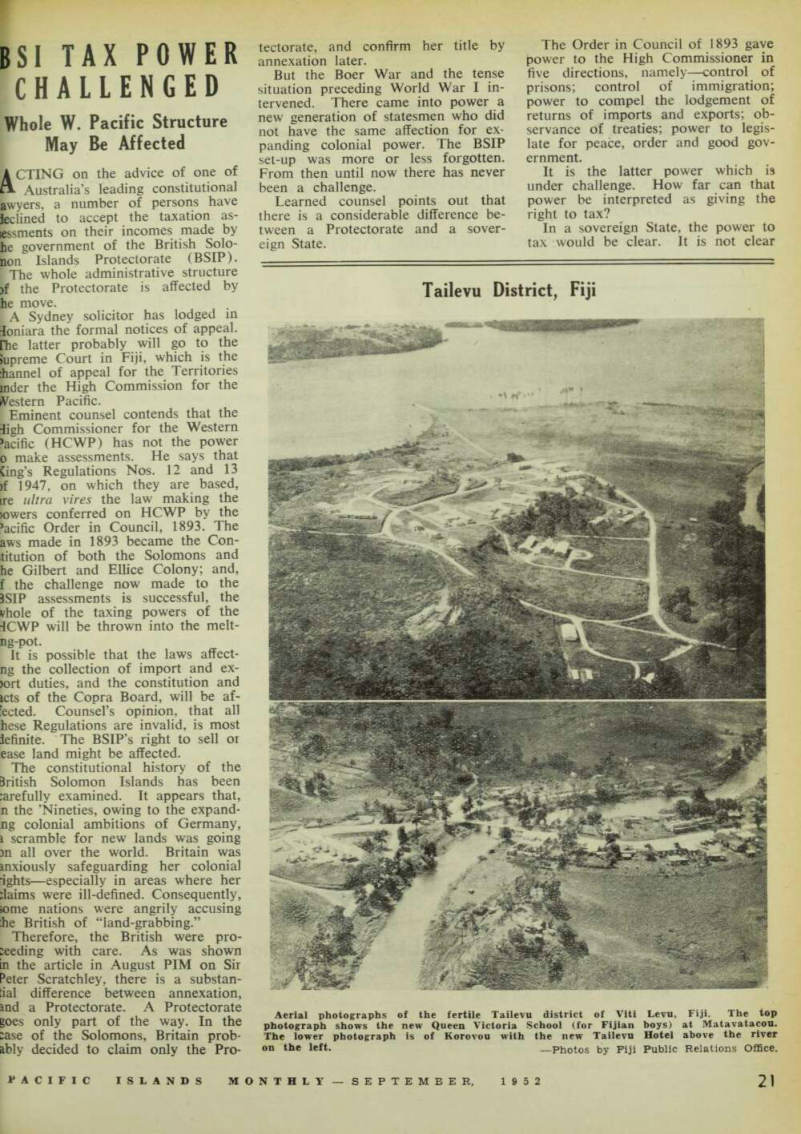
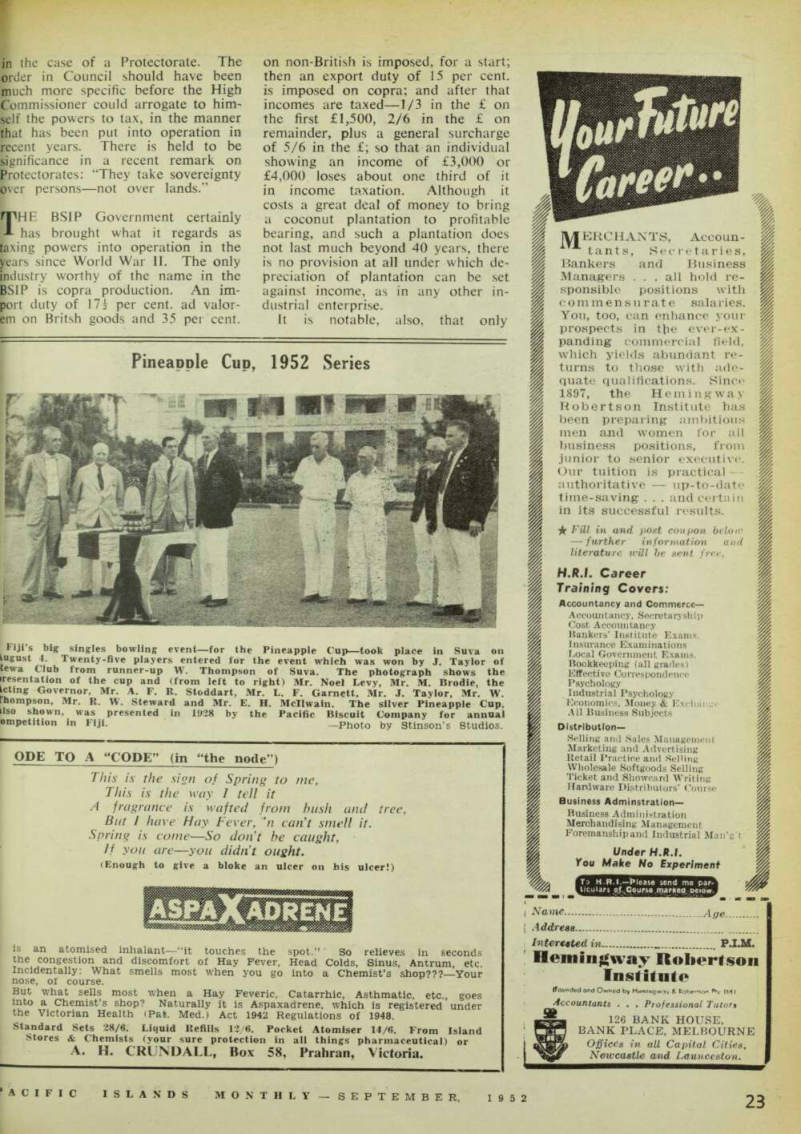
Aerial photographs of the fertile Tailevu district of Viti Levu, Fiji. The top photograph shows the new Queen Victoria School (for Fijian boys) at Matavatacou.
The lower photograph is of Korovou with the new Tailevu Hotel above the river on the left. —Photos by Fiji Public Relations Office.
in the case of a Protectorate. The order in Council should have been much more specific before the High Commissioner could arrogate to him self the powers to tax, in the manner that has been put into operation in recent years. There is held to be significance in a recent remark on Protectorates: “They take sovereignty over persons—not over lands.”
THE BSIP Government certainly has brought what it regards as taxing powers into operation in the years since World War 11, The only industry worthy of the name in the BSIP is copra production. An im port duty of 17i per cent, ad valor em on Britsh goods and 35 per cent.
on non-British is imposed, for a start; then an export duty of 15 per cent, is imposed on copra; and after that incomes are taxed—l/3 in the £ on the first £1,500, 2/6 in the £ on remainder, plus a general surcharge of 5/6 in the £; so that an individual showing an income of £3,000 or £4,000 loses about one third of it in income taxation. Although it costs a great deal of money to bring a coconut plantation to profitable bearing, and such a plantation does not last much beyond 40 years, there is no provision at all under which de preciation of plantation can be set against income, as in any other in dustrial enterprise.
It is notable, also, that only
traders and planters are taxed. All Dther classes escape. A new Gilbert ind Ellice Ordinance (No. 9 of 1952, iated June 11) deals with taxation, ind provides that Government offi cials, staff of Cable and Wireless Ltd., persons engaged in medical or nissionary work, and visitors shall lot be liable to taxation. Presum ibly, the same applies in BSIP.
The past acts of the BSIP Admin- Btration, taken under the various Regulations referred to, if they are ipset by the taxpayer’s challenge, Brill, of course, be validated by laws ushed through in Britain; and the axing powers of the High Commis ioner will be legally established, without delay.
The challengers recognise this; but, hey say, if their appeal succeeds, hey at least will get a chance to nake representations to the highest mthority concerning the injustices mder which they now suffer, and ibout which they have appealed in fain, in the last five years. ! They believe—and probably they re right—that Britain now is weary >f paying out for the privilege of lying the Union Jack over this un
developed and unprofitable Solomons archipelago; and that this might be a suitable occasion for the introduc tion of policies which, at least, would lead to European settlement and in vestment, and ensure that the area would become more self-supporting.
That will not be done by oppressive taxation.