Not Enough
p. 17 · Read in the full issue
Expert Says There Is
Good Land In Ng
AMID a chorus of persons who believe that the Central High lands of New Guinea offer great possibilities for European settlement comes the dissident voice of Dr. K.
E. Read, a Research Fellow of the Australian National University, who has just concluded two years in the Goroka area of the Highlands.
In an article in Sydney Morning Herald in early September he claimed that, among the vast areas of attractive-looking land in the Highlands there is a very high pro portion of soil of poor quality, and broken country; and he thinks that most of the first-class land is needed for the Highlands’ half-million nat ives.
He believes that the native popu lation will increase, and he argues that the disadvantages of introducing Europeans will far outweigh the ad vantages claimed. The high cost of the only available transport (air) rules out most European farming and planting, except perhaps coffee: but coffee will not come in under 3f years. A settler would need a mini mum of £5,000 of capital.
Praising Dr.
Read’s article, Mr.
J. T, Bensted, a retired Depart mental head with long experience in Papua, said the most logical long range policy for the development of these Territo ries appears to rest in native training under European management (both private and official), supple-
mented by the existing system of native plantations and co-operatives, together with technical education and manual training.
HC for WP
At Vila
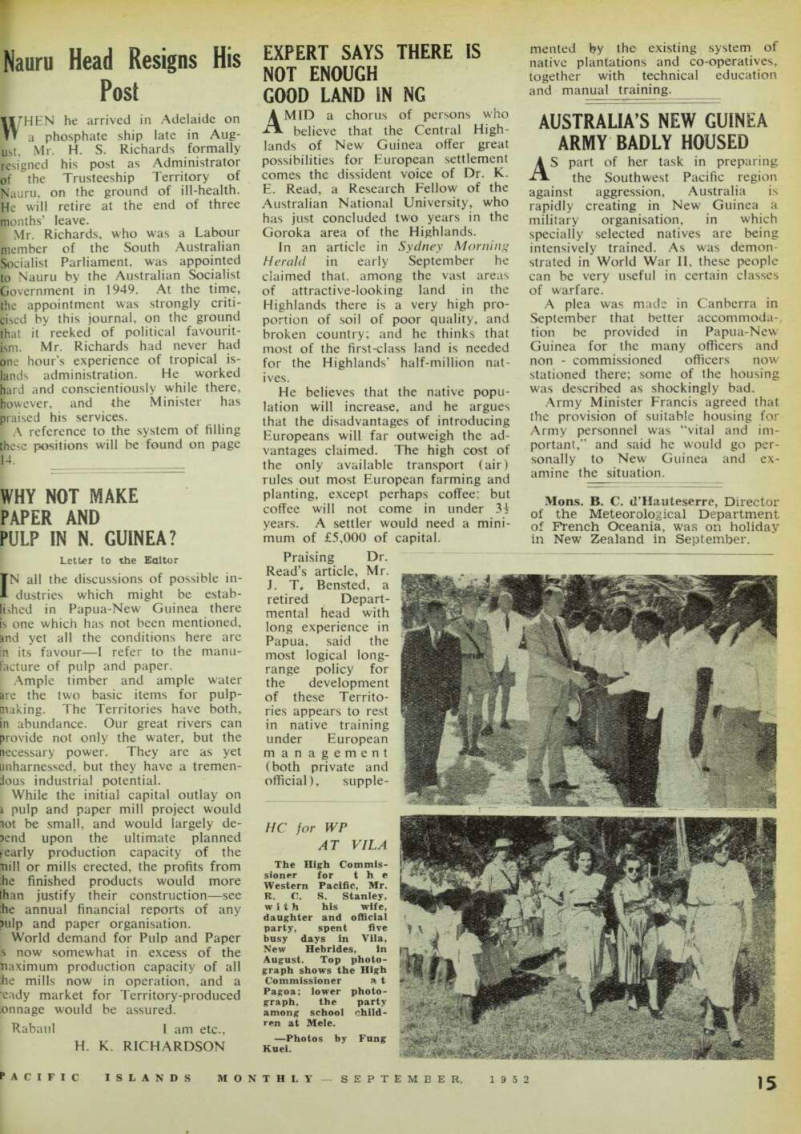
The High Commis sioner for the Western Pacific, Mr.
R. C. S. Stanley, with his wife, daughter and official party, spent five busy days in Vila, New Hebrides, in August. Top photo graph shows the High Commissioner at Pagoa; lower photo graph, the party among school child ren at Mele. —Photos by Fung Kuei.