his Papua
pp. 68-77 · Read in the full issue
Sir Peter and his Papua
The man who Laid the Foundation Stone of the Territory These old photographs—67 years old—are a link with an almost for gotten phase of the history of Papua.
For them we are indebted to The Australasian Photo-Review, whose editor used them to illustrate an article on “The Great Lindt” —a German who adopted Australia as his home in the 60's and became the outstanding photographer of the 80's, an era which thought more of the miracle of photography than the blase inhabitants of the world of 1952.
The link between Lindt and early Papua was that Lindt accompanied Sir Peter Scratchley to Papua on the Governor Blackall, in 1885, as of ficial photographer. All the photo graphs -shown {with the exception of the drawing of Sir Peter) are Lindt’s work. I 'Stratchley was in Papua only a few months, but he can be said to have at least laid the foundation stone —if not the foundations- —of modern New Guinea.
MOST of us are accustomed to thinking that the history of mod ern Papua—or British New Guinea as it was first called —began with Sir William MacGregor’s administration in 1888. But Sir William took over after BNG had been declared a ,British Colony. For almost four years before that, it had been a British Protectorate.
The distinction between a Pro tectorate and a Colony, which has almost disappeared to-day (for example the Solomon Islands are still a Protectorate while the Gilbert and Ellice Islands are a Colony, but both are in charge of the High Com" missioner for the Western Pacific) was apparently more finely drawn m Victoria’s day. It was, in effect, the staking of a claim.
The Australian colonies had urged the annexation of all of that part of New Guinea and the adjacent islands not claimed by the Dutch in 1828, for a quarter century before Britain brought herself to do any thing about it. In April 1883 there occurred that well-known incident
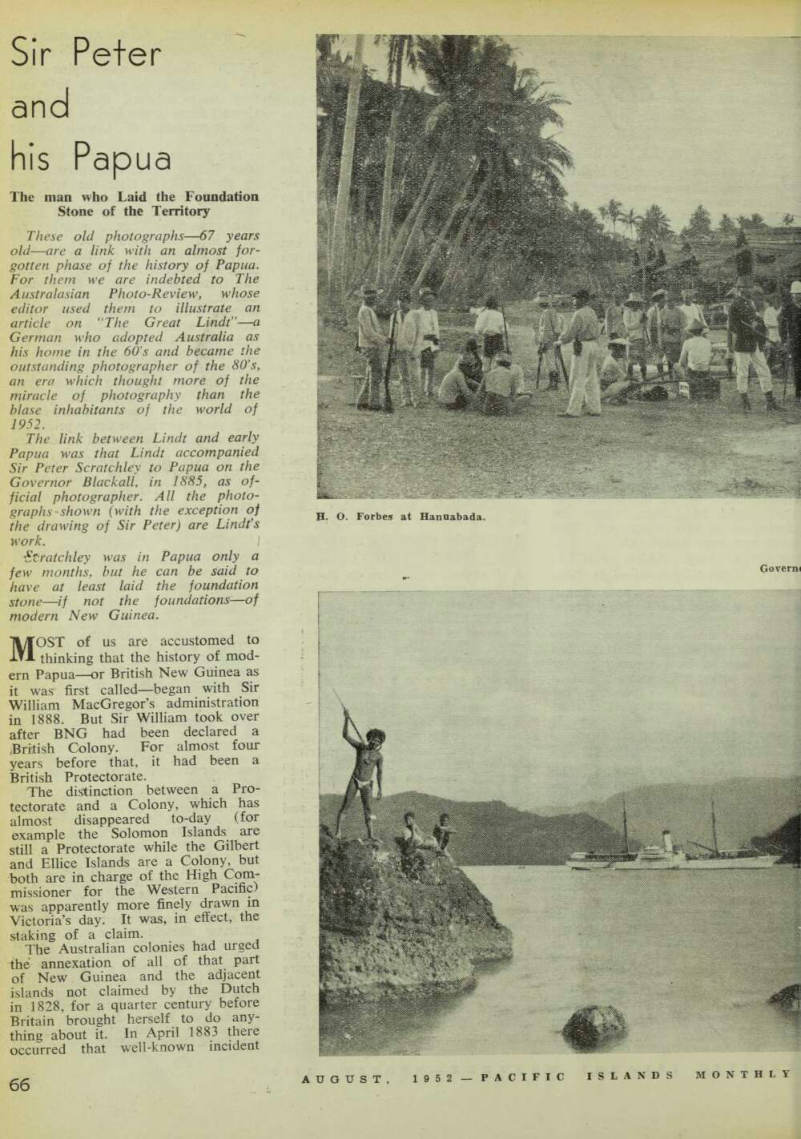
H. O. Forbes at Hanuabada.
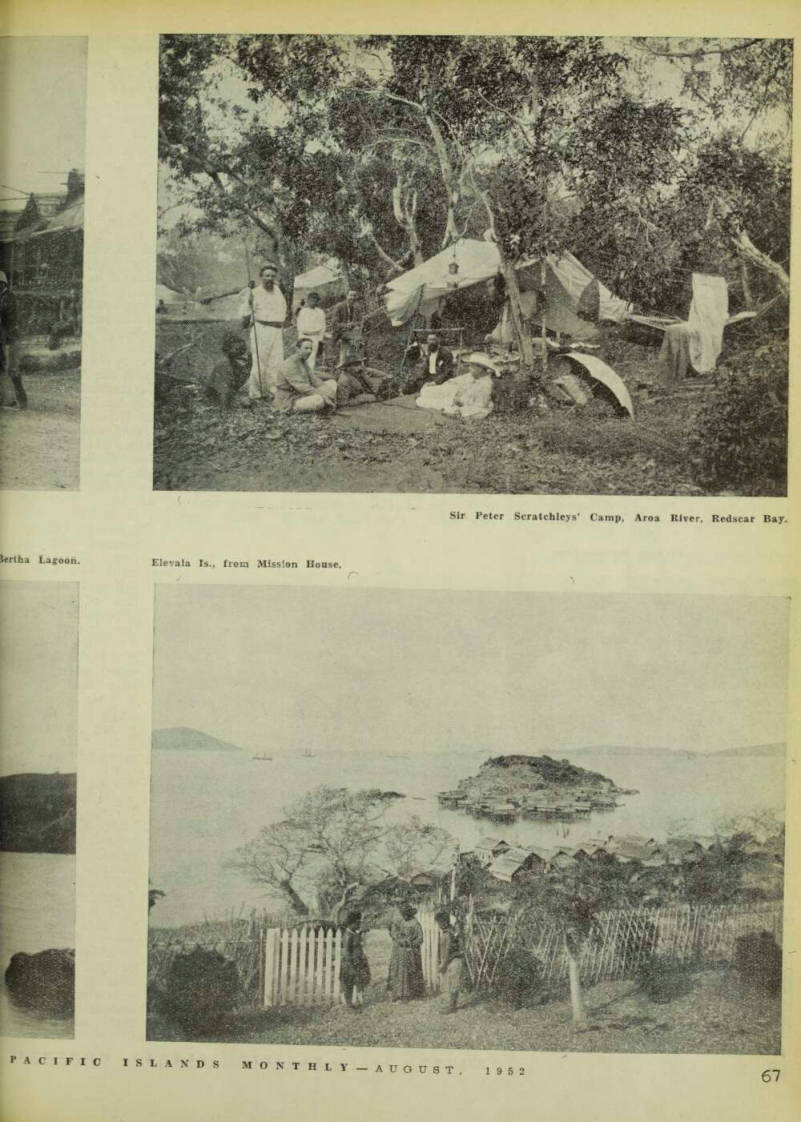
Govern
Bertha Lagoon.
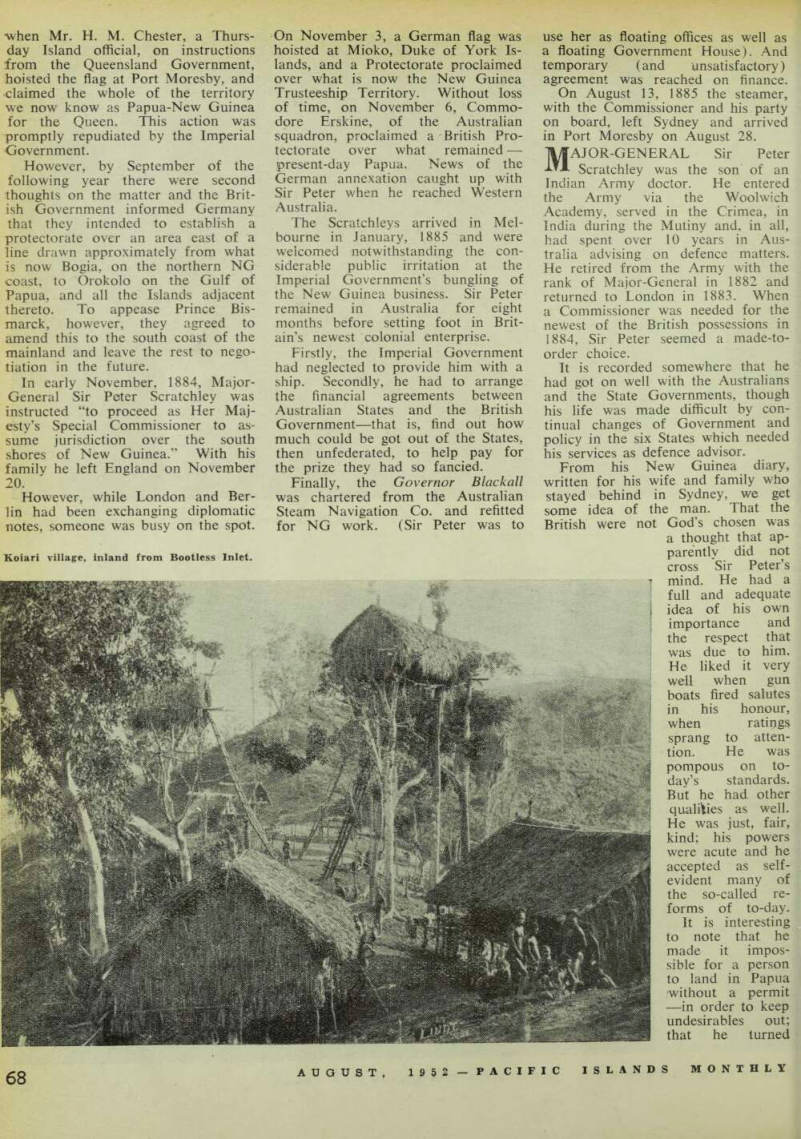
Sir Peter Scratchleys’ Camp, Aroa River, Redscar Bay.
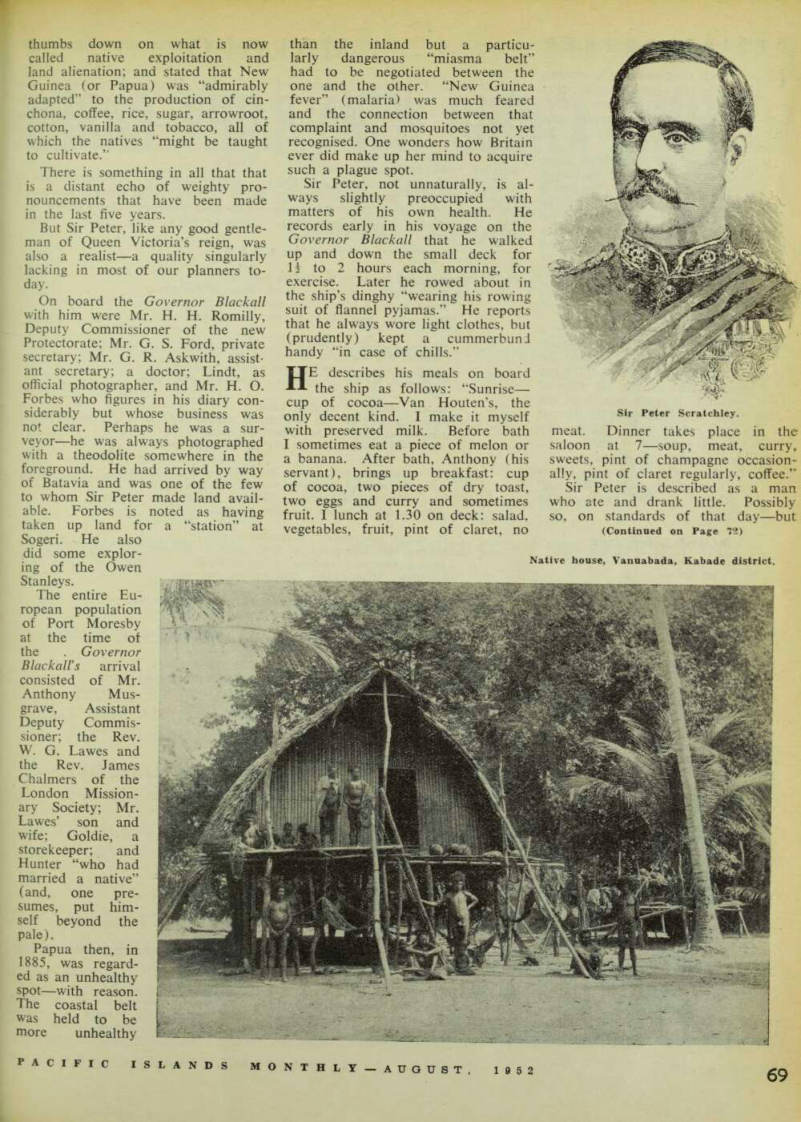
Elevala Is., from Mission House,
Mr. H. M. Chester, a Thursday Island official, on instructions from the Queensland Government, hoisted the flag at Port Moresby, and claimed the whole of the territory we now know as Papua-New Guinea for the Queen, This action was promptly repudiated by the Imperial Government.
However, by September of the following year there were second thoughts on the matter and the British Government informed Germany that they intended to establish a protectorate over an area east of a line drawn approximately from what is now Bogia, on the northern NG coast, to Orokolo on the Gulf of Papua, and all the Islands adjacent thereto. To appease Prince Bismarck, however, they agreed to amend this to the south coast of the mainland and leave the rest to negotiation in the future.
In early November, 1884, Major- General Sir Peter Scratchley was instructed “to proceed as Her Majesty’s Special Commissioner to assume jurisdiction over the south shores of New Guinea.” With his family he left England on November 20.
However, while London and Berlin had been exchanging diplomatic notes, someone was busy on the spot.
On November 3, a German flag was hoisted at Mioko, Duke of York Is lands, and a Protectorate proclaimed over what is now the New Guinea Trusteeship Territory. Without loss of time, on November 6, Commo dore Erskine, of the Australian squadron, proclaimed a British Pro tectorate over what remained present-day Papua. News of the German annexation caught up with Sir Peter when he reached Western Australia.
The Scratchleys arrived in Mel bourne in January, 1885 and were welcomed notwithstanding the con siderable public irritation at the Imperial Government’s bungling of the New Guinea business. Sir Peter remained in Australia for eight months before setting foot in Brit ain’s newest colonial enterprise.
Firstly, the Imperial Government had neglected to provide him with a ship. Secondly, he had to arrange the financial agreements between Australian States and the British Government—that is, find out how much could be got out of the States, then unfederated, to help pay for the prize they had so fancied.
Finally, the Governor Blackall was chartered from the Australian Steam Navigation Co. and refitted for NG work, (Sir Peter was to
use her as floating offices as well as a floating Government House). And temporary (and unsatisfactory) agreement was reached on finance, On August 13, 1885 the steamer, with the Commissioner and his party on board, left Sydney and arrived in Port Moresby on August 28.
"m/j AJOR-GENERAL Sir Peter Ifl Scratchley was the son of an Indian Army doctor. He entered the Army via the Woolwich Academy, served in the Crimea, in India during the Mutiny and, in all, h a d spen t over 10 years in Aus tralia advising on defence matters, He retired from the Army with the ran k of Major-General in 1882 and returned to London in 1883. When a Commissioner was needed for the newest of the British possessions in 1884, Sir Peter seemed a made-to order choice.
It is recorded somewhere that he had got on well with the Australians and the State Governments, though his life was made difficult by con tinual changes of Government and policy in the six States which needed his services as defence advisor, From his New Guinea diary, written for his wife and family who stayed behind in Sydney, we get some idea of the man. That the British were not God’s chosen was
a thought that ap parently did not cross Sir Peter’s mind. He had a full and adequate idea of his own importance and the respect that was due to him.
He liked it very well when gun boats fired salutes in his honour, when ratings sprang to atten tion. He was pompous on to day’s standards.
But he had other qualifies as well.
He was just, fair, kind; his powers were acute and he accepted as self evident many of the so-called re forms of to-day.
It is interesting to note that he made it impos sible for a person to land in Papua .without a permit —in order to keep undesirables out; that he turned
Koiari village, inland from Bootless Inlet.
thumbs down on what is now called native exploitation and land alienation; and stated that New Guinea (or Papua) was “admirably adapted” to the production of cin chona, coffee, rice, sugar, arrowroot, cotton, vanilla and tobacco, all of which the natives “might be taught to cultivate.”
There is something in all that that is a distant echo of weighty pro nouncements that have been made in the last five years.
But Sir Peter, like any good gentle man of Queen Victoria’s reign, was also a realist—a quality singularly lacking in most of our planners to day.
On board the Governor Blackall with him were Mr. H. H. Romilly, Deputy Commissioner of the new Protectorate; Mr. G, S. Ford, private secretary; Mr. G. R. Askwith, assist ant secretary; a doctor; Lindt, as official photographer, and Mr. H. O.
Forbes who figures in his diary con siderably but whose business was not clear. Perhaps he was a sur veyor—he was always photographed with a theodolite somewhere in the foreground. He had arrived by way of Batavia and was one of the few to whom Sir Peter made land avail able. Forbes is noted as having taken up land for a “station” at
Sogeri. He also did some explor ing of the Owen Stanleys.
The entire Eu ropean population of Port Moresby at the time of the Governor Blackall’s arrival consisted of Mr.
Anthony Mus grave, Assistant Deputy Commis sioner; the Rev.
W. G. Lawes and the Rev. James Chalmers of the London Mission ary Society; Mr.
Lawes’ son and wife; Goldie, a storekeeper; and Hunter “who had married a native” (and, one pre sumes, put him self beyond the pale).
Papua then, in 1885, was regard ed as an unhealthy spot—with reason.
The coastal belt was held to be more unhealthy
than the inland but a particu larly dangerous “miasma belt” had to be negotiated between the one and the other. “New Guinea fever” (malaria) was much feared and the connection between that complaint and mosquitoes not yet recognised. One wonders how Britain ever did make up her mind to acquire such a plague spot.
Sir Peter, not unnaturally, is al ways slightly preoccupied with matters of his own health. He records early in his voyage on the Governor Blackall that he walked up and down the small deck for U to 2 hours each morning, for exercise. Later he rowed about in the ship’s dinghy “wearing his rowing suit of flannel pyjamas.” He reports that he always wore light clothes, but (prudently) kept a cummerbund handy “in case of chills.”
HE describes his meals on board the ship as follows: “Sunrise— cup of cocoa—Van Houten’s, the only decent kind. I make it myself with preserved milk. Before bath I sometimes eat a piece of melon or a banana. After bath, Anthony (his servant), brings up breakfast: cup of cocoa, two pieces of dry toast, two eggs and curry and sometimes fruit. I lunch at 1.30 on deck: salad, vegetables, fruit, pint of claret, no
meat. Dinner takes place in the saloon at 7—soup, meat, curry, sweets, pint of champagne occasion ally, pint of claret regularly, coffee,”
Sir Peter is described as a man who ate and drank little. Possibly so, on standards of that day—but
(Continued on Page 72)
Sir Peter Scratchley.
Native house, Vanuabada, Kabade district.
(Continued from Page 69)
few Port Moresbyites to-day have the physical hardihood to make a pint of claret their regular mid-day tipple.
He was not impressed with his first glimpse of Port Moresby. “At present the country is much burnt up as there has been no rain for several months. (Where have we heard those words before?) The Mission Station is situated at the head of the harbour on low hills with the native villages at the foot.”
At that time there were two mis sions in Papua—the London Mission Society, well-established, which found favour in Sir Peter’s eyes; and the French Roman Catholic Mission which had “located themselves at Yule Island without authority,” and which did not. The fact that they were French probably did not help matters.
One of Sir Peter’s first actions was to despatch Musgrave to Yule Island to try to remove them to the Eastern end of Papua—reasons not stated unless it was believed they were poaching on LMS preserves by locat ing themselves 60 miles from Mores by. “If he succeeds,” Sir Peter tells his wife, “he will have rendered an important service.” He felt that the Catholics were not to be trusted, but when the mission fathers refused to be banished to the wilds of East ern Papua he found that legally he could do nothing about it. The French Catholics remained on Yule —and are there to this day.
After the first week Sir Peter was able to report that he -thought he could stand it for two years—but not for longer. Later, he tells his wife he could not bring her there: “The life is not suited to a lady, unless she has a calling for it like Mrs.
Lawes. The surroundings are dis gusting; naked barbarians (not savages, because, poor creatures, they are quiet enough if only fairly and justly treated) everywhere; dirty, without clothes and living purely animal lives, but with great possi bilities for a better and more useful life in the future.”
In early September he had gone westward as far as Redscar Bay where he camped ashore. By the middle of the month he was planning the future town of Port Moresby—a Residency, waterworks and botanical gardens (which Moresby has not got yet) “I attach much importance to plan ning everything from the beginning . . . one sees the lack of foresight in Australia in such towns as Bris bane, Sydney and others.”
Sir Peter made one fifty miles trip inland from Port Moresby—just
exactly where is not clear —but much of the time left to him was spent along the south eastern coast of the Protectorate where amongst other things he had to investigate numer ous native murders of European traders. He leaves no doubt as to where his sympathies lie: “I am convinced that all the outrages are justifiable. I have heard horrible stories of the doings of the whites and, please God, I shall let the light of day into them. A righteous cause I am engaged in and that gives me zest in working it. . . I cannot feel any sympathy for such men. They go where they have no business to.
They are a thorn in my side and I do not think the life of any white man should be risked in avenging their deaths.”
He decided to establish a station on Dinner Island (Samarai) but did not think much of it. “It is an un healthy place and not nearly so nice as South Cape.”
Towards the end of October, again being on the south-eastern coast ac companied by a naval vessel, he vis ited Moapa (between the Kemp Welch River and Abau) and with some ceremony from the sailors, ran up the flag there. This was out of gratitude to Koapena, a chief of the district “a fine old fellow, over six
feet high” who always treated Euro peans well. After three rounds of blank cartridge as a feu-de-joie, a short speech, and three cheers for the Queen, a distribution of axes and tobacco was made to the natives.
Koapena called for green coconuts for the visitors but Sir Peter found
it “mawkish stuff” (probably in com parison with a pint of claret).
ON November 19 Sir Peter made his last entry in his diary. Two days later while on his way to Mitre Rock to inspect the boundary of British territory, he was taken ill
aboard the Governor Blackall. At first it was thought that he had a bilious attack but it was soon ap parent that he was suffering from the dreaded New Guinea fever. On November 25, the ship turned south and ran for Cooktown, arriving on December 1. Sir Peter became worse and the ship left the same day for Sydney but in the early hours of December 2, 1885, he gradually sank and died at sea.
So ended the career of Papua”s first administrator. A late Victorian gentleman, given to thinking of his breakfast cocoa and his underclothes, perhaps. But a man of energy also; and a believer in those ideals so shopped around by this last decade’s reformers.
It is interesting to reflect that when Sir Peter visited his Papua, he went as Her Majesty’s representative and as such was pleased to receive a 19gun salute from a Navy ship and to see all yards manned in his and Her Majesty’s honour. About 60 years later, the Hon. E. J. Ward visited his Papua, wading ashore with his pants rolled up and, metaphorically if not actually, slapping Brown Brother on the back. It would prob ably surprise the Honorable Eddie to know that the starchy Victorian Empire Builder, no less than he, also was determined on a fair deal for the Papuans.