Papua-N. Guinea
p. 17 · Read in the full issue
Land Policy For
Cautious Newspaper State ment by the Minister
IN other sections of this issue, which were printed in the early days of I August, there are references to the > problems of Papua-New Guinea.
Emphasis is on the fact that the f development of the Territories cannot be f planned unless there is some clear indi i cation of land policy. Industries cannot jbe promoted without land. The practice [of the Ward-Murray administration, just ended, was to subvert all planning to the native welfare policy—to insist that there was little land for European interests, [because the natives needed it all. The PIM has pointed out repeatedly [that, if P-NG is to be developed as a defensive barrier for Australia and the South Pacific generally, the resources of the huge area must be made use of; and that this cannot be done unless the very large quantity of land which the natives I do not need —and are not likely to need— is made available for European use. [ Canberra has been asked again and I again for a P-NG land policy. But Canberra, fearing Socialist and Trustee ship Council reactions, has made no official announcement. But in the “Sydney Morning Herald’.’ of August 5, there is an article written by Mr. Has luck (Minister for Territories). The following extract (his exact words) may be accepted as a cautious outline of land policy in P-NG.
VJLTHILE the present Government is
positively promoting develop
ment in Papua and New Guinea, we are also setting some limits to that development in order that it shall not be injurious to native interests, and so that, in the long term, it will not set up barriers to native partici pation in the enjoyment of the life and wealth of their own country.
The chief limits are set by the administration of land policy.
The established land policy of the Territory is that no land can be ac
quired from the natives except by
the Government, which will then make it available on leasehold to the settler.
Before the Government acquires the land it satisfies itself both that the native is freely willing to sell, and that, even if he is willing to sell, the land is not required for native uses.
We are trying to facilitate the carrying out of this policy by the creation of a Native Lands Com mission and by the creation of a
Development Board, composed of
senior Administration officials in the
Territory.
The functions of the first-named body will be to discover more exactly native ownership in land and register it; and the functions of the second will be to assist the applicant for land by seeking out unwanted land and making it available without the long delays, sometimes as much as three years, which were common in the past.
The orderly and prompt avail ability of land is the key to any development of resources just as land is one of the most important factors in preserving native in terests.
There is no doubt that there is a considerable area of land in Papua and New Guinea which is waste land to which the natives make no claim, and that there are other lands which are not used and unlikely ever to be needed by the natives.
Furthermore, under changed methods of cultivation and with the introduction of new crops, an in dividual native or a native commun ity may be able to obtain from 1,000 acres of land more sustenance and a far greater income than was pre viously obtained from 50,000.
I have given a definite instruction that, side by side with any schemes for development, must go measures for the improvement of village agri culture and industry to ensure better land and a stable food supply.
It is also part of the Government’s policy that the natives should take an increasing part in the develop ment of the Territory. . . .
Considerable encouragement has been and will continue to be given according to the circumstances in each district for the participation by the natives in the development of the country, and to this end enough land will be reserved to them to make this participation in progress effective.
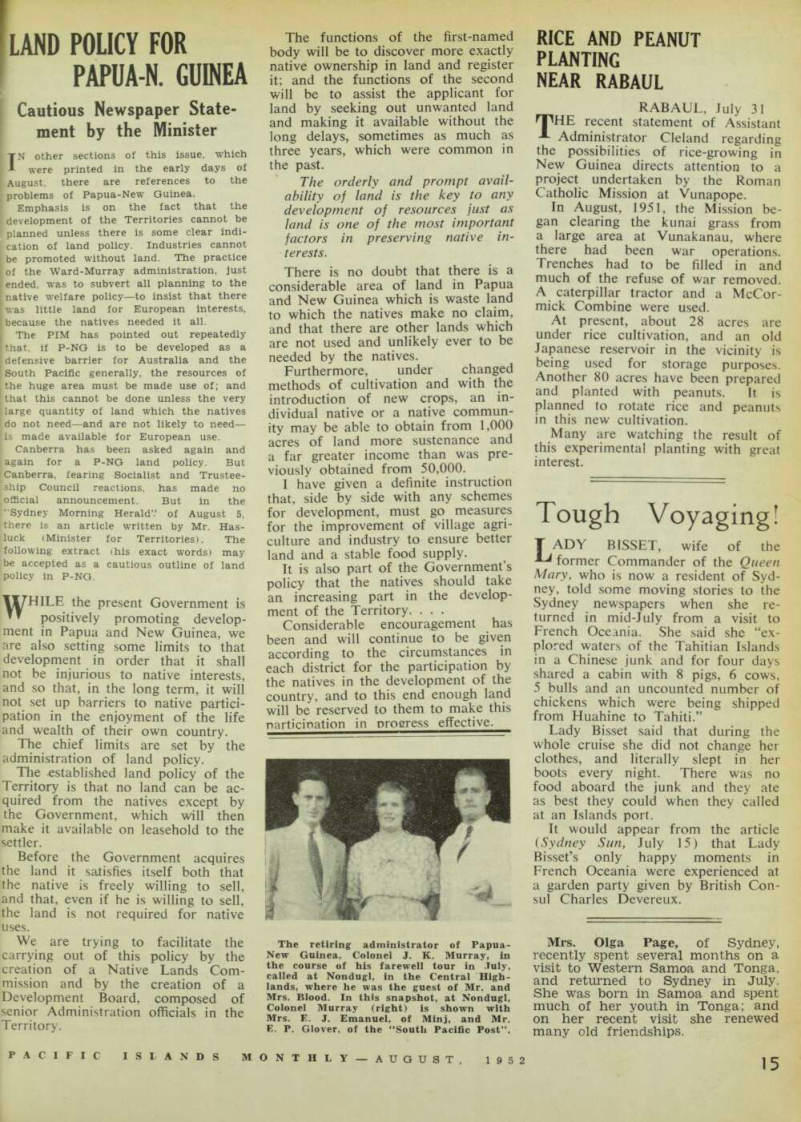
The retiring administrator of Papua- New Guinea, Colonel J. K, Murray, in the course of his farewell tour in July, called at Nondugl, in the Central High lands, where he was the guest of Mr. and Mrs. Blood. In this snapshot, at Nondugl, Colonel Murray (right) is shown with Mrs. E. J. Emanuel, of Minj, and Mr.
E. P. Glover, of the “South Pacific Post”.