The Decline of Fijian
pp. 124-125 · Read in the full issue
Culture Fiji Society Discusses Thorny Problem
H SUVA, June 30 AVING shelved for the time being the question of whether yaqona (kava) is, or is not a beverage with valuable medicinal qualities, (see May PIM). the Fiji Society has turned its attention to a problem nearly as old—the decay of traditional custom among the Fijian people.
At the end of a recent debate on a paper read by Mr. R. H. Lester, the society left this question as open as that concerning kava, but with a fairly general feeling that affairs were not as well as might be.
Mr. Lester’s paper inclined to the view that there had been little change of custom in Fijian society thanks largely to Sir Arthur Gor don’s Fijian Regulations in 1877 which, Mr. Lester claimed, had gone far to ensure that Fijian culture should be preserved.
Mr. Lester estimated that even to-day, out of a total of 78,000 Fijian males over the age of 12 years, only 14,700 were engaged in any sort of industry, “the remain- der being in their villages, living their traditional life.” (There is some doubt as to whether the 14,700 include all those in the armed forces, the police and many branches of the Government service, as well as in commercial employment. If so, the figure quoted may be on the conservative side.) Mr. Lester outlined the changes that had come into Fijian culture through the centuries. First there was the Melanesian influence (mat rilineal descent, rule by elders and belief in the spirits); then Polynes ian (rule by chiefs and an ancestral cult) and lastly the European im pact together with the code based on Christian ethics.
In the discussion that followed the paper, Mr, R. A. Derrick, Fiji’s foremost present-day historian, said that without customs any race loses its character and added that it was Fijian custom which had made the Fijian people distinguished on all occasions He praised the work of Sir Arthur Gordon towards the pre servation of Fijian culture and re called how bitterly the Fijian Regu lations were assailed by the Euro peans in the years after Cession.
When Dr. A. S. Frater, the Soci ety’s president asked Mr. Lester if he believed that the British had given the Fijians enough in the way of interest and training to take the place of lost customs, the lecturer said that the Fijian was by nature a busy and not a lazy person. Hard daily work went into the Fijian village food gardens.
A Fijian contributor to the dis-
Hussion was Ravuama Vunivalu, a member of the Legislative Council with a brilliant record in New Zea land and English Universities. He said that fewer and fewer of his people were now really conversant with Fijian customs, that they were dying out and that it was only a matter of time before only well-to do Fijians would be able to afford them as luxuries.
In reply to a question by Dr.
Todd, who is a visitor from Papua, Ravuama said that witchcraft was dead, although there were still cer tain young men who posed as seers.
This was countered by the Rev. L.
D. Fullerton, of the Methodist Mis sion, who said he understood that witchcraft was still prevalent.
Mr. G. K. Roth, an authority on Fijian history and. culture, drew attention to two ways in which the decay of custom was obvious —the decline in quantity and workman ship in the making of pottery and
the decrease in the women’s contribution to society, such as the making of mats, tapa and certain foods.
The latter, he added, was fortunately being remedied to-day.
Mrs. Derrick, who said that young Fijian women were no longer being taught many of the traditional crafts, suggested that the study of customs be introduced among them.
Captain A. V. Bunyan, Harbour master at Makatea, well-known phosphate-producing island m French Oceania, will leave Sydney on July 17 on his way back to Ma katea. He has been harbourmaster since 1945, and prior to that served in the Navy and as Master of the British Phosphate Commission s vessels.
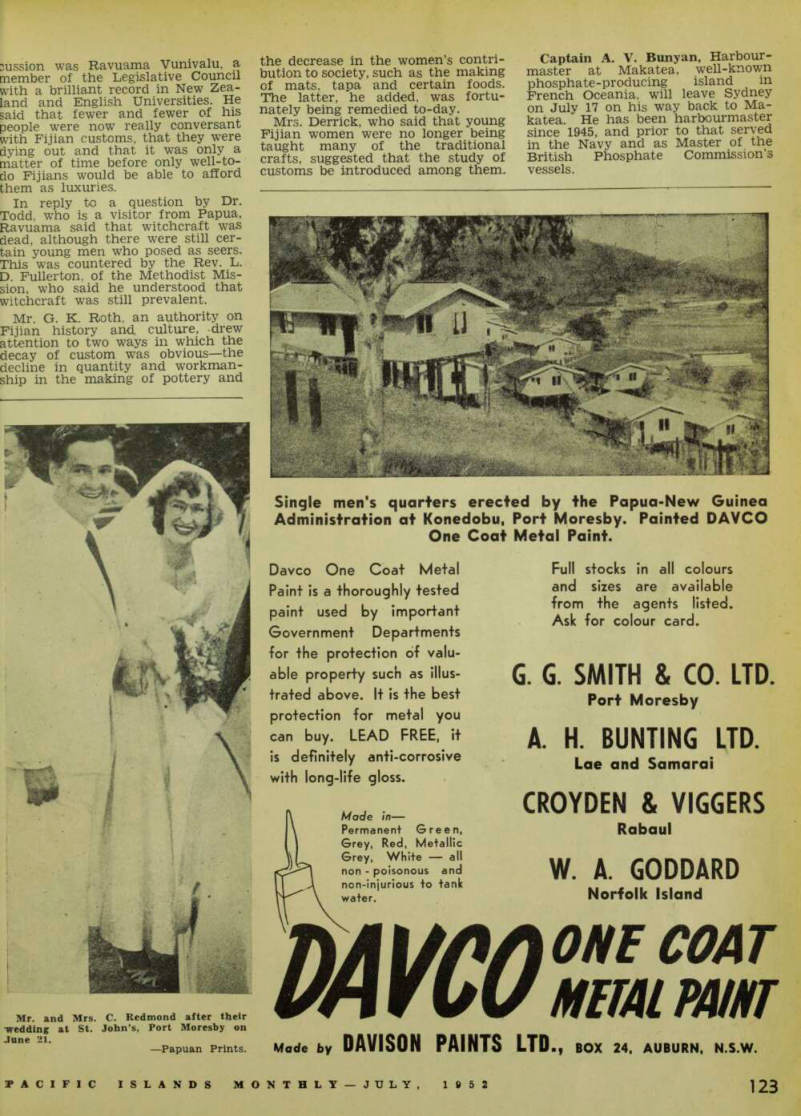
Mr. and Mrs. C. Redmond after their wedding at St. John’s, Port Moresby on June 21.
Papuan Prints.