Now Open
pp. 33-35 · Read in the full issue
Big Lae Hotel Is
Mrs. Stewart Wins An Epic Fight
CHE new Hotel Cecil, built slowly in the last 3i years by well known Mrs. Flora Stewart, has een opened for business. It is not uite finished, but it is functioning t last. It is claimed for it by its roud proprietress that it is “the est hotel in Papua and New ruinea”. No one is likely to tiallenge the statement.
Mrs. Stewart —she was formerly [rs. Gofton, and has been twice idowed—is one of the best known nd warmly esteemed “old hands” f Papua and New Guinea. She as in the Bulolo Valley almost efore the great goldfield was pened; and she established the rst hotel in Wau, and made a lot F money. With her profits, she uilt a fine modern hotel at the len new port of Lae, and her ster, Mrs. Baldie, managed it for er. Just before the war, she sold >me of her interests in Wau, and er Wau hotel business became a irt of uneasy partnership.
Then war came, and in 1942-3 rery building in Lae and Wau as shattered. For a time, it looked s.e blue ruin for Mrs. Stewart, ien a New Guinea “evacuee” in pdney. But the War Damage ampensation Fund gave her lother chance.
The indomitable woman was one the first Territorians to return the war-smashed Territory. She ok over a collection of Army itments out in the jungle, a tuple of miles behind Lae, and lened up the first post-war hotel, was not luxurious—in fact, it was )t anything much, except a bed id a good meal—but she carried i there for five years while she ught a series of mighty battles.
The first were with High Official ►m. The Planners had decided at Lae should not be rebuilt on e flat land beside the beach and e air-strip, but up on the terrace, the back. They laid out the eal town. But that did not suit rs. Stewart: she wanted to build ir new hotel on the site of her st Lae Hotel, near the beach, and irthward of the airfield.
Officialdom would not give her permit to build there. She would it build in the place where Eicialdom said a hotel should go. seemed an impasse, because—so mplete was the wartime oblitera >n—a new survey was necessary fore people could find their own rmer allotments.
But some of the concrete founda )ns of the old Hotel Cecil, and
especially the iron stanchions which used to hold up the tennis net, were located and identified.
Mrs. Stewart took legal advice, and then went ahead with her building.
In a double sense, she was sure
of her ground. High official dom, naturally eager to build a tidy, well-planned town, snarled a good deal, but Mrs.
Stewart went steadily ahead.
They finally decided that nothing could stop her.
With building materials scarce and artisans scarcer; and all costs rising every month, she entered into a second series of battles. Even her friends and well-wishers,
at times, wondered if she could succeed. Having overcome supply and artisan troubles, she still had the problem of the shrinking pound.
The building of that big hotel must have cost very many tens of
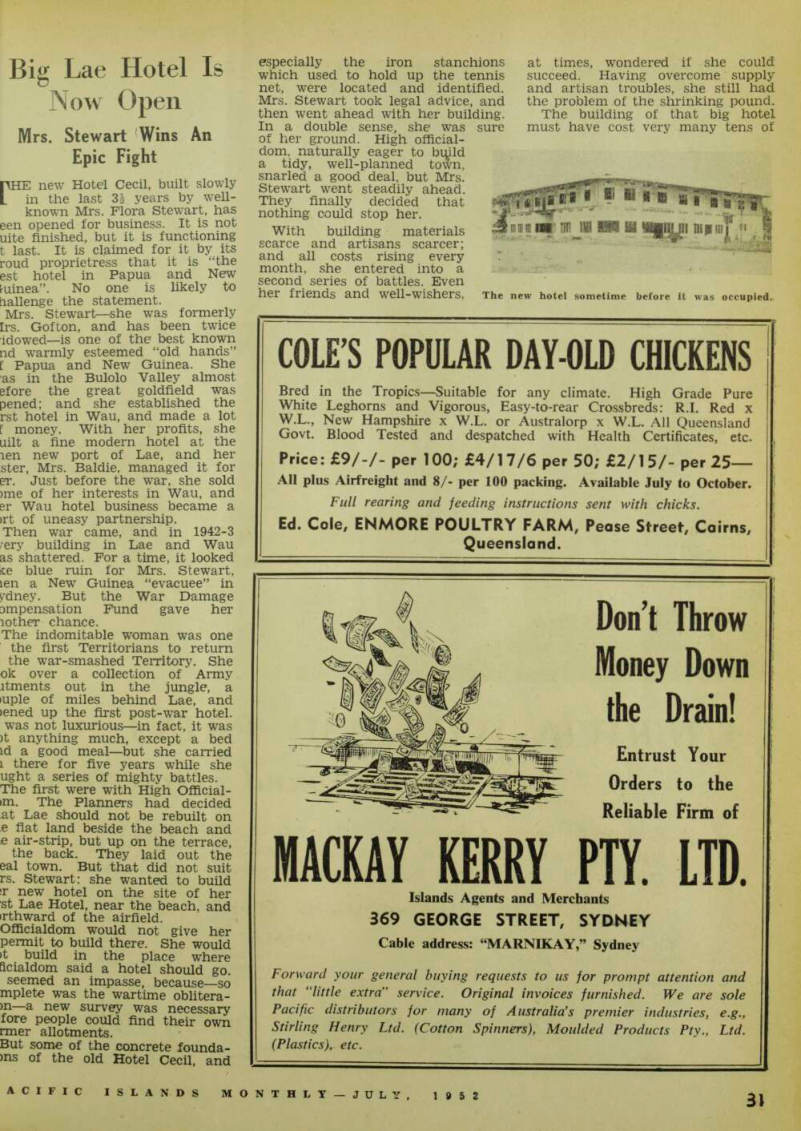
The new hotel sometime before It was occupied.
housands of pounds. But Mrs.
Jtewart survived, and won through, md is still in control of her big Titerprise. An account of what his strong-willed woman has ac omplished in New Guinea, before nd after the war, should rank ugh among the success stories of he South Pacific.
The new Hotel Cecil is near the irport, but at the opposite end f the town from Milfordhaven, the iew sea-port. It is in the same rea as the big stores, and it is lose to an attractive beach. With be careful planning that has gone ito this place, and with its many menities, cool lounges, well quipped bed-rooms, plus the tewart family’s skill and ex erience in New Guinea hotel lanagement this should become a opular—and profitable—resort for jurists, as well as a long-desired sfuge for the travelling public.