Rubber Planters
p. 28 · Read in the full issue
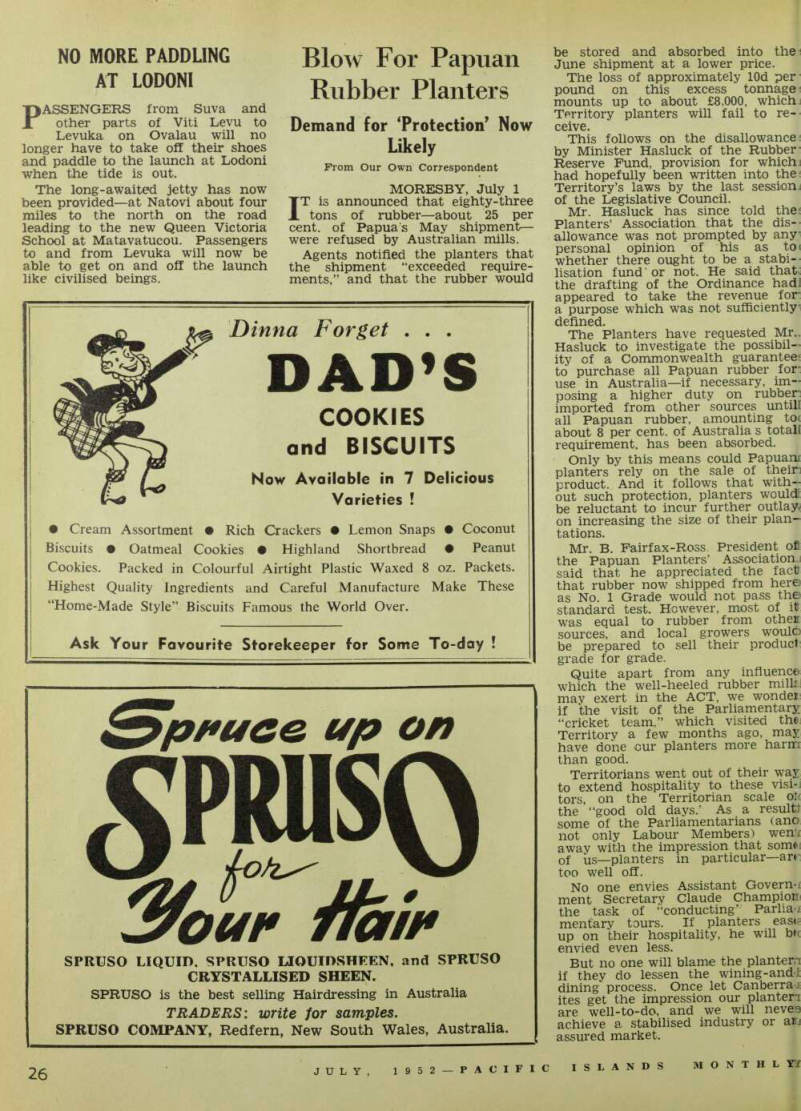
Blow For Papuan Rubber Planters Demand for ‘Protection’ Now Likely
From Our Own Correspondent
Moresby, July 1
IT is announced that eighty-three tons of rubber —about 25 per cent, of Papua's May shipment— were refused by Australian mills.
Agents notified the planters that the shipment “exceeded require ments,” and that the rubber would
be stored and absorbed into the t June shipment at a lower price.
The loss of approximately lOd per' pound on this excess tonnage t mounts up to about £B,OOO, whichj Territory planters will fail to re-ceive.
This follows on the disallowance; by Minister Hasluck of the Rubber* Reserve Fund, provision for which j had hopefully been written into the; Territory’s laws by the last session j of the Legislative Council.
Mr. Hasluck has since told the; Planters’ Association that the dis allowance was not prompted by any 1 ; personal opinion of his as to< whether there ought to be a stabi lisation fund or not. He said thatd the drafting of the Ordinance had] appeared to take the revenue fon a purpose which was not sufficiently 1 ; defined.
The Planters have requested Mr,.
Hasluck to investigate the possibil ity of a Commonwealth guarantee; to purchase all Papuan rubber fon use in Australia—if necessary, im posing a higher duty on rubben imported from other sources untill all Papuan rubber, amounting tot about 8 per cent, of Australia s total! requirement, has been absorbed.
Only by this means could Papuanr planters rely on the sale of thein product. And it follows that with out such protection, planters wouldt be reluctant to incur further outlays on increasing the size of their plan tations.
Mr. B. Fairfax-Ross President ofi the Papuan Planters’ Association,/ said that he appreciated the fact] that rubber now shipped from her© as No. 1 Grade would not pass the standard test. However, most of it] was equal to rubber from other sources, and local growers woulo be prepared to sell their product; grade for grade.
Quite apart from any influence; which the well-heeled rubber millsJ may exert in the ACT, we wonder; if the visit of the Parliamentary “cricket team,” which visited the; Territory a few months ago, may have done cur planters more harmr than good.
Territorians went out of their way. to extend hospitality to these visi-i tors, on the Territorian scale ok the “good old days.’ As a result] some of the Parliamentarians (ano. not only Labour Members) wenr away with the impression that some; of us—planters in particular—arn too well off.
No one envies Assistant Govern- l ment Secretary Claude Champion; the task of “conducting’ Parlia-r mentary tours. If planters eas«g up on their hospitality, he will bfc envied even less.
But no one will blame the plantern if they do lessen the wining-andf dining process. Once let Canberran ites get the impression our planter*! are well-to-do, and we will neve;e achieve a stabilised industry or an assured market.