The Editors' Mailbag
pp. 19-20 · Read in the full issue
Tofa Ma Feleni”
17HEN looking through a 45years-old scrap-book, Oscar fordman found an early English ersion of the famous old Samoan arewell Song, Tofa Ma Feleni. [ere it is:— Goodbye, Samoa, my ship now sails away.
Away from fair islands, where all Is bright and z ay.
But I*ll not forget you, not this belov’d strand When far, far away, upon my native land.
Do not despise me, O do not angry be: Though rank and colour differ, my heart is warm to thee.
Think nought upon what matters, what on the surface lies.
But hasten to assure me of love that never dies.
Such bitter sorrow has never touched my heart As what it’s feeling, from loving friends to part. *Tis an affliction, when hearts would linger nigh Whilst lips reluctant must say a fond goodbye. 0 I never will forget you; Hear this, my fond Adieu— -1 never will forget you— Samoa, I say Adieu.
“I heard that song first in Samoa 1907,” says Mr. Nordman, “and ose were the words as I wrote em down, then. The enclosed lotograph shows the band on the harf at Apia, playing the tune, as e pulled out.”
The picture is too faded for repro iction; and the words are different om to-day’s version but the ntiment is exactly the same.
rims and Publicity
A film of Tahiti made by a De >it business man, Earl D. Brink, is been shown widely in USA. ifter every showing,” writes Mr. rink, “people come up and want ore information, and ask how to t there. It is too bad that there are )t better facilities for travel to zeania. My wife and I went there r Tahiti-Hawaii Airways; but then at Line folded up, and we were arooned there, and finally got away 1 teaming up with four boys who
*re sailing the schooner California
ound the world.”
Mr. Brink wanted to make similar ms, of marked publicity value, in □stralia and New Zealand; but the jstoms officials in both places made much fuss about his introduction cameras and films that he can ned his plans; and his consequent counts of his experiences under ficialdom in both places have no iblicity value!
(Tahiti now has regular air con nection—but via Fiji, not via
Hawaii.)
A Menace to Natives!
It is interesting to learn that Hein rich Rudolph Wahlen, who was a notable merchant and planter in New Guinea before World War I, visited Australia in 1929 in connection with the affairs of the Melanesian Com pany, and that he was refused per mission to visit New Guinea. It was felt that his influence as a former German commercial leader would, in the opinion of the then Adminis trator, be bad for the natives. Flat tered, amused and maybe irritated, Mr. Wahlen returned to Germany.
“Although I am 80, I should very much like to see Australia and New Guinea again,” says Mr. Wahlen, in a nostalgic note from Hamburg. “Do you think they would still keep me out, if I turn up there again?”
We do not think so. Probably, a few of the Oldtimers would make somewhat of a fuss over the former “Duke of the Northwest Islands.”
‘Political Appointments’ ?
“I am much amused by the noisy indignation of Mr. Eddie Ward in relation to the retirement of Ad ministrator Jack Murray,” writes J. J. C., from Brisbane.
“When he shouts so much about political appointments, Mr. Ward evidently forgets about the circum stances surrounding the retirement of Mr. Leonard Murray from the Administratorship in Papua when he (Mr. Ward) wanted to appoint Mr. J. K. Murray. Those circum stances reflected no credit on Mr.
Ward.
“And was it not Mr. Ward who was responsible for the appoint ment of Mr. Wilson. ex-MP. to Norfolk Island, and of Mr. Rich ards of the Adelaide Trades Hall, to Nauru? If these were not poli tical appointments, in essence and in substance, what were they?”
Chinese in the Islands
There seems to be much interest throughout the Pacific in the de velopment of Chinese immigration and settlement. This note comes from Fiji: “The old Chinese in Fiji were a self-effacing, pleasant crowd who had a good deal of public spirit and who could be fully trusted in business. At the end of the war, however, we had an influx of a different type— arrogant and as sertive. A generation is now grow ing up with these characteristics.
“You notice it if you drive a car
in Suva. Chinese youths in lorries hog the road and show not the slightest sign of consideration for others. . . .
"I don’t know whether it is pos sible to calculate the amount of Chinese-Fijian interbreeding that is going on but it is considerable and increasing. . . .
“It is not a pretty prospect. Our Chinese population has increased from 2,874 in 1946 to 3,581 in 1951 about 25 per cent, in five years. It is about time we followed the ex ample of Western Samoa.” (West ern Samoa, 20 years ago, had a large community of Chinese who were intermarrying with the Sa moans. The NZ authorities imple mented a ruthless policy of depor tation, and there now are practi cally no Chinese in Samoa.) An anonymous writer in Vila challenges our recent statement that many new Chinese stores have been opened in New Hebrides. He says only two or three stores have been opened by newcomers—the others, especially at Santo, belong to old-established Chinese. He considers there is no danger of Chinese selling alcohol to the na tives—the Government has this well under control.
Home for Plaque
The little Wembley plaque found by the small son of Mrs. V. A.
Cooper, in a dustheap in Rabaul, has now been completely identi fied. It appears that it was attach ed to an ink stand that had been made out of wood from the origi nal warship Australia; and the ink stand was presented to the Hon.
A. J, Jones when he represented Qeensland at the Wembley Exhi bition in 1924—he was then Lord Mayor of Brisbane and had been for many years Minister of Mines.
When he died a few years ago, it was given to his daughter, and she lost it in Rabaul, The history of the plaque was traced through the PIM. As it has not been claimed by others, the officials of the Premier’s Depart ment of Queensland asked Mrs.
Cooper if they might have it, to be placed among official records in Brisbane, and Mrs. Cooper has sent it to them.
Pests in Ml
“Your article gave an accurate picture of Norfolk Island” writes an old resident of that pleasant place. “There was one thing wrong, however—there is not here a com plete absence of fruit pests. As a matter of fact, the passionfruit fly has practically wiped out most of the vines on the western side of the Island; and, as you know, the pro duction of passionfruit pulp was at one time an important industry.
I might also quarrel with you about your reference to the quiet and peace of the Island. Quiet is be coming a thing of the past, what
with motor-scooters, bicycles with motor attachments find the thump of home-lighting plants.
In Defence of BSI Set-Up
“I note what is said about Aus tralia taking over the British Solomons (says a valued observer of Southwest Pacific affairs) but, with all respect. I could not agree with you less ... I recently saw something of the New Guinea Ad ministration on the New Britain side. „ .
“Both Australia and Britain are concerned with welfare of the natives. Australia can afford to leave the private people alone, be cause she is not as concerned as the British with taxing them. The only advantage the Australians have lies in the enormous quantities of funds available to them, even when they think they are being economical.
The same criticisms are levelled at the Administration in New Guinea as in the Solomons, but with less venom, because there is less taxa tion.
“As Australia, like Britain, is committed to the welfare of the natives, the Australian methods would have to be applied in BSI; and, believe me, they wouldn’t go.
The BSI natives are entirely different from those I saw in P-NG.
The BSI folk are unconsciously very English in many ways. They don’t like Australians; they are very wary of anyone who hasn’t got the character and the manner they consider suitable; and they just despise matey people.
“If you could just get BSI a couple of million pounds a year from the Colonial Office, plus all the shipping P-NG has, plus war damage and no income tax, they might really get somewhere . . .
It isn’t fair to go on belting this BSI administration, which is doing its perspiring and exhausted best.”
Darwin to Fiji
Prom Mrs. F. M. Parrack, of Stu
art Highway, Darwin, comes a cheque for £l2/15/0 Australian, to be sent on to the Treasurer of the Fiji Hurricane Relief Committee.
She asks that the money be used for the relief of individual sufferers, rather than in the expensive work of restoring public buildings, etc.
The sum was contributed by the RAAP and Air Force Association, £ll/7/6; Constable Tiernan, 10/-; and School Children, 17/6. The generous donation has been sent on to Suva.
Mrs. Parrack was for several years a teacher in Indian and CSR Co. schools in Fiji and she has the warmest memories of Fijian hospi tality. She also was a resident of New Guinea and her son, Desmond, married Miss Cynthia Came at Bulolo not long ago, and took her to live in Toowoomba, Q. Mrs. Par rack sends warm greetings to friends in Fiji, and asks if anyone will send her some copies of the Fiji Times.
Ducks That Get Around
Recent press mention of godwits recalls a stir that occurred in the ornithological world 2i years ago, which seems to have missed com ment in PIM time.
Late in 1949, Meteorologist L. T.
Craig, stationed up on Penrhyn atoll in the Northern Cooks, shot two ducks of a flight of six which he put up from a small swamp on one of the northern islets of the atoll. To his —and ornithologists’—surprise, one duck wore a band which the US Fish & Wild Service had given it three months earlier in a Californ ian game reserve, 4,000 miles away.
The birds were American pintail ducks, and this was the longest re corded flight of any of the species.
Penrhyn natives reported that a few ducks visit the island for about a month, late each year.
Bird watchers are now wondering whether the pintails migrate even farther south. American tourists are no longer news in Tahiti —but US pintails certainly would be.
Late in June this year, another kind of migrating bird did reach
Tahiti—the first consignment of air freighted chickens from Auckland.
Malekula Story
“The article about the old and new Maleluka, by Captain Blrett Hilder was most interesting,” writes Mr. G. R. Younger, of Cape Marsh, BSI. “May I correct him on one small point.”
“The first master of the schooner was Captain Fotheringham. Captain Butchart succeeded him. On the last trip to Sydney, Captain McPhail, from the Kulambangra, was in charge and, with him, were Tom Shapland as mate and, I think, Jones, as second mate. After the wreck these three repaired the best whaleboat and left for the Queensland coast, and they arrived at Lucinda Point after eight days’ sailing. The crew were picked up some weeks later. They had plenty of food and they had refused to take a long boat trip.”
Rubber—or Rats?
“Apropos of all this talk about development of new industries in the Territories, you must know that little can be done unless land is available.” writes “Old Timer” from Melbourne.
“Did you ever hear the story of Captain Fitch and the thousands of acres of good rubber land he had lined up in the Kanosia district of Papua? Fitch had the plan in gpod shape and the Melbourne capital ready to invest in rubber. The area was surveyed by an ARM.
“But when enquiries were made about the owners (the Kabadi people, a useless and inbred crowd) it was found that one of the owners was a youth and technically a mi nor. Thereupon Sir Hubert Mur ray refused to sanction the trans fer, and that large area, of no use to the Kabadis, is still in its vir gin state.
“Captain Fitch was very angry about it. ‘Fancy one native brat holding up a big developmental plan like this.’ he said to me. ‘All these natives will ever do on the area is catch an old lizard or rat.’ ”
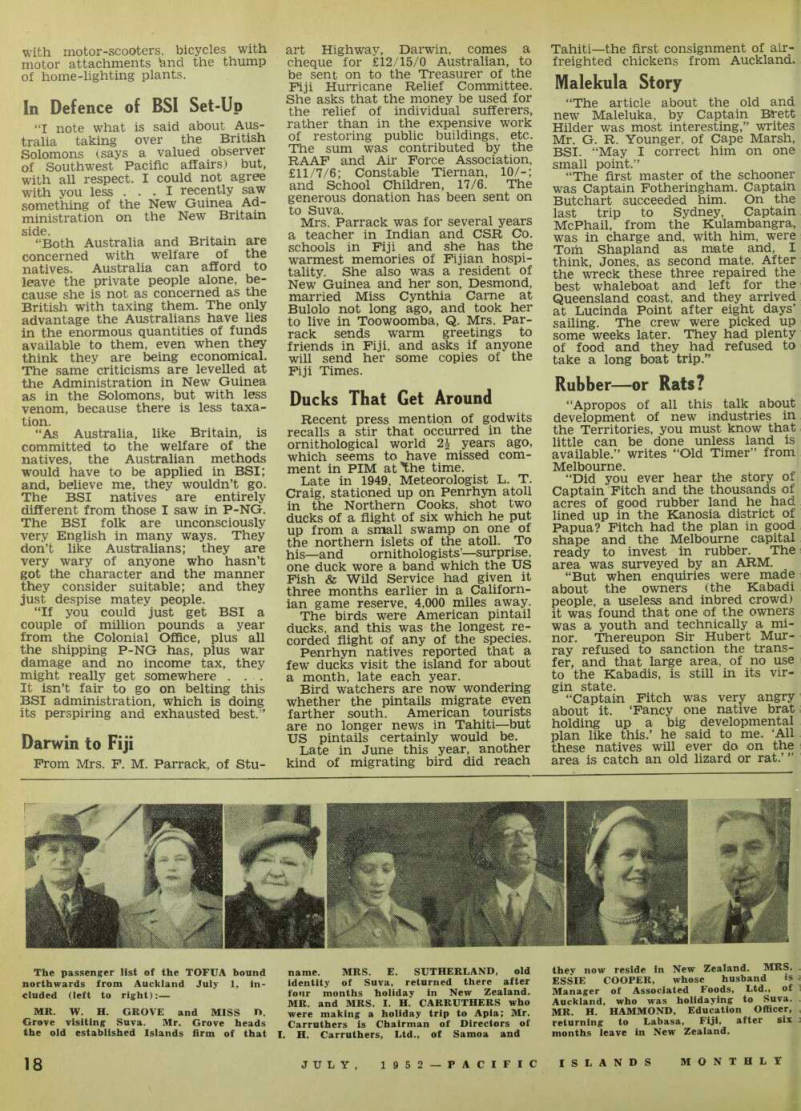
The passenger list of the TOFUA bound northwards from Auckland July 1, ineluded (left to right):- MR. W. H. GROVE and MISS D.
Grove visiting Suva. Mr. Grove heads the old established Islands firm of that
name. MRS. E. SUTHERLAND, old identity of Suva, returned there after four months holiday in New Zealand.
MR. and MRS. I. H. CARRUTHERS who were making a holiday trip to Apia; Mr.
Carruthers is Chairman of Directors of I, H. Carruthers, Ltd., of Samoa and
they now reside in New Zealand. MRS.
ESSIE COOPER, whose husband is Manager of Associated Foods, Ltd., of Auckland, who was holidaying to Suva, MR. H. HAMMOND. Education Officer, returning to Labasa, Fiji, after six months leave in New Zealand.