Deport Fiji’s Indians—Now
pp. 55-59 · Read in the full issue


Mr. Ragg’s Startling Solution to “No. 1” Problem
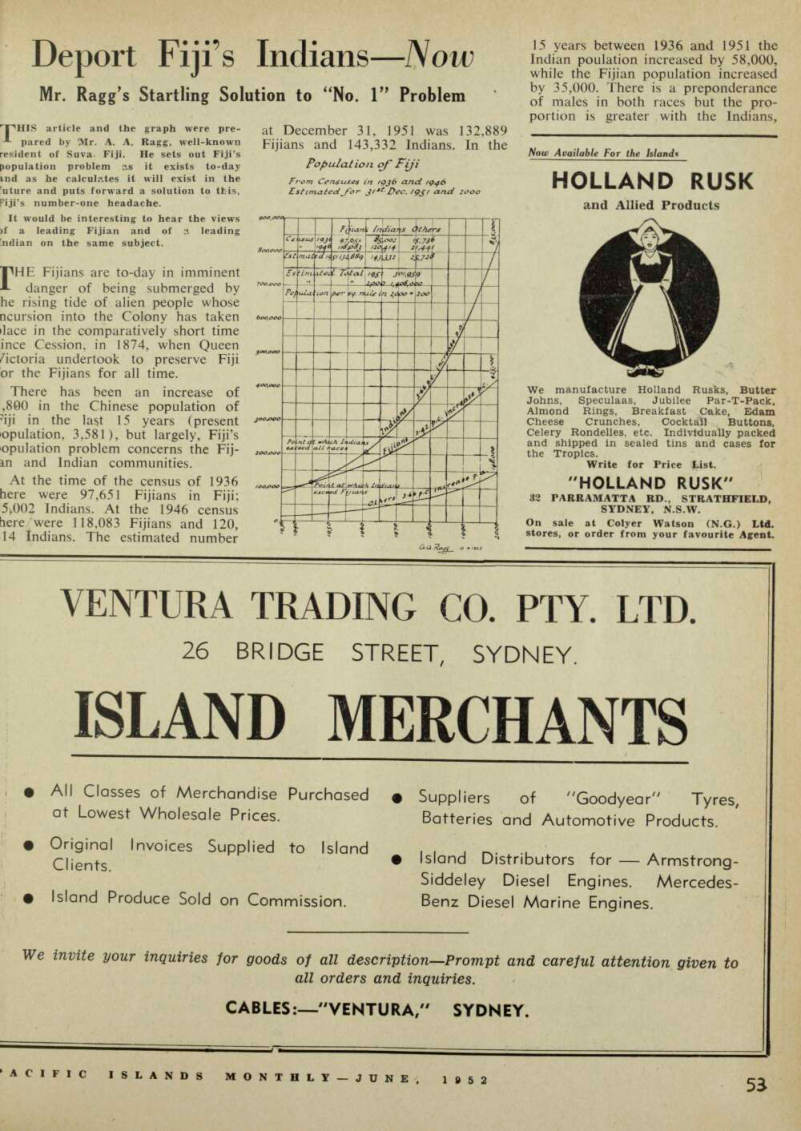
T'HIS article and the graph were pre -*■ pared by Mr. A. A. Ragg, well-known resident of Suva. Fiji. He sets out Fiji’s population problem as it exists to-day ind as he calculates it will exist in the ’uture and puts forward a solution to this, Fiji's number-one headache.
It would be interesting to hear the views )f a leading Fijian and of a leading Indian on the same subject. rHE Fijians are to-day in imminent danger of being submerged by he rising tide of alien people whose ncursion into the Colony has taken ilace in the comparatively short time ince Cession, in 1874, when Queen Victoria undertook to preserve Fiji or the Fijians for all time.
There has been an increase of ,800 in the Chinese population of Tji in the last 15 years (present population, 3,581), but largely, Fiji’s population problem concerns the Fij an and Indian communities.
At the time of the census of 1936 here were 97,651 Fijians in Fiji; 5>002 Indians. At the 1946 census here were 118,083 Fijians and 120, 14 Indians. The estimated number
at December 31, 1951 was 132,889 Fijians and 143,332 Indians. In the
15 years between 1936 and 1951 the Indian poulation increased by 58,000, while the Fijian population increased by 35,000. There is a preponderance of males in both races but the pro portion is greater with the Indians,
there being only 85 women to every 100 men.
The graph shows what could hap pen in the next half century. The calculations are based on the trends of the last 5i years—that is, since the 1946 census—and it can be argued that this is too short a time on which to base such calculations. However,
this period was chosen for several reasons, one being that the Indian figures for that period represent, sub stantially, the natural increase where as previously the Indian population had increased both naturally and by migration. The increase by migration is now small although it still has to be considered.
It must not be assumed that the increases given in the graph will actually take place but the graph shows the trend and as such should inform the Government and public of the political and other problems that will arise in the next 50 years.
The present position results largely from the different cultural attitudes to children of the two races. The Indian places a great value on chil dren: the Fijian merely accepts them as a matter of course. The care given their offspring by Indians is well known, and is of a higher order than that given by the Fijians, especially in the first three years of life when Fijian mortality rates are high. And, in thinking of the future, it is as well to calculate that any war or pesti lence will, as in the past, carry off more Fijians than Indians.
Fijians First
The disparity in the increases in the Fijian and the Indian populations in the last 14 or 15 years presents a grave problem to local and Imperial Government and is certain to intensify with the passage of time. Unquestion ably, the Fijian race must receive first consideration. They had been in occupation of Fiji for centuries be fore it was discovered by the Euro peans and had developed a com munal system of government that.
with few modifications, is still in force to-day.
Unfortunately, because they are now living in a community that is largely controlled by a competitive and individualistic economy that has developed since the incursion of alien races, Fijians are being subjected to forces undreamed of at the time of Cession and are faring badly.
The increase of the Indian popu lation now menaces the future of the Fijians and it is the duty of the Imperial Government to remove that menace.
At the same time, consideration must be given the Indians and the part they have played in the Colony’s development.
Indians were first introduced into the Colony in 1879. They came in under indenture and their purpose was to solve the sugar industry’s labour problems. The rest is an old story, but over the years they have acquired a position in the colony’s economy equal to that of the Euro peans and have out-distanced the Fijians who are still shackled to the old communal system.
In summing up the characteristics of the two races one can say that the Fijians are easy-going, docile and communalistic; the Indians active, aggressive and individualistic. The Fijians are politically inert and are shackled to the restrictive communal system socially, politically and eco nomically; the Indians are politically aggressive and have the same rights as the Europeans; they are free men politically and economically. The Fijians own about 90 per cent, of the land of the Colony; the Indians are practically landless. The Fijians’ loyalty to the Empire is proved; Indian loyalty is questionable; they have a divided allegiance—lndia and Fiji.
The Solution
Little has been done by the Gov ernment to resolve the situation. The only practical measure has been the Fijian Land Trust Board to provide land reserves for the Fijians and control the remaining lands which may be leased to other races. This might be effective if the two races, Fijian as well as Indian, were not increasing at a rapid rate.
Leaving the Indians right out of it, the Fijian population at present rate of increase will be 440,000 by the year 2000, which means that they will need 3.4 times more land than they do now. If the Indians increase unchecked, they will need seven times more land then than they have the use of now.
It is obvious from the foregoing that measures so far taken cannot effectively protect the heritage of the Fijians and the question now arises, what can be done before the problem gets beyond our control?
The Indians are alive to the situation and are biding their time.
They believe that they can dominate the situation by sheer force of numbers. They maintain that the problem
can be solved by transferring the Fijians on Viti Levu to Vanua Levu, the second largest Island of the group; a simple and satisfactory solution from their point of view but one hardly acceptable to the Fijians.
In the absence of any constructive scheme on the part of the Fijian Government or the Colonial Office the writer submits, in all humility, a plan which is radical in conception
but, if implemented, will save Fiji for the Fijians.
First, shut down all permanent immigration from India and China.
Second, in the next 20 years, re patriate the Indians and Chinese at the annual rate of 12,000 and 200 respectively.
Repatriates should be chosen by ballot and first attention given to those of the age groups 16 for males and 14 for females in order that they may adapt themselves to their new
environment without difficulty. Fam
ily groups to be repatriated to be governed by the age of the father.
The Government would pay pas sages and compensation to the re patriates for their possessions; un expired leases and other property and chattels to be taken over at valuation by the Government.
If handled sympathetically the scheme would occasion the minimum af distress to the repatriates and as it would be spread over 20 years would not affect the Colony too ad versely. If the scheme were put into effect without delay it would cost about £2O million—£lo million less ban the infamous African ground aut scheme.
Violent opposition will be raised against these proposals by the Indians
but what would the Indians do if the position were reversed?
One last word: The Fijians have been and are loyal to the British Crown whereas the Indians have attempted to use our predicaments to their own advantage. Are we going to be loyal to those who are loyal to us or are we going to abandon them?
When PlM’s Auckland representa tive returned from Sydney per Wan ganella, early May, he found Mr.
George Casbolt, well-known Rabaul resident and long-time employee of W. R. Carpenter & Co., as fellow passenger. Mr. Casbolt is spending leave in his homeland, New Zealand.