Outh Pacific Commission
pp. 25-28 · Read in the full issue
Stimulating Fishing in South Pacific
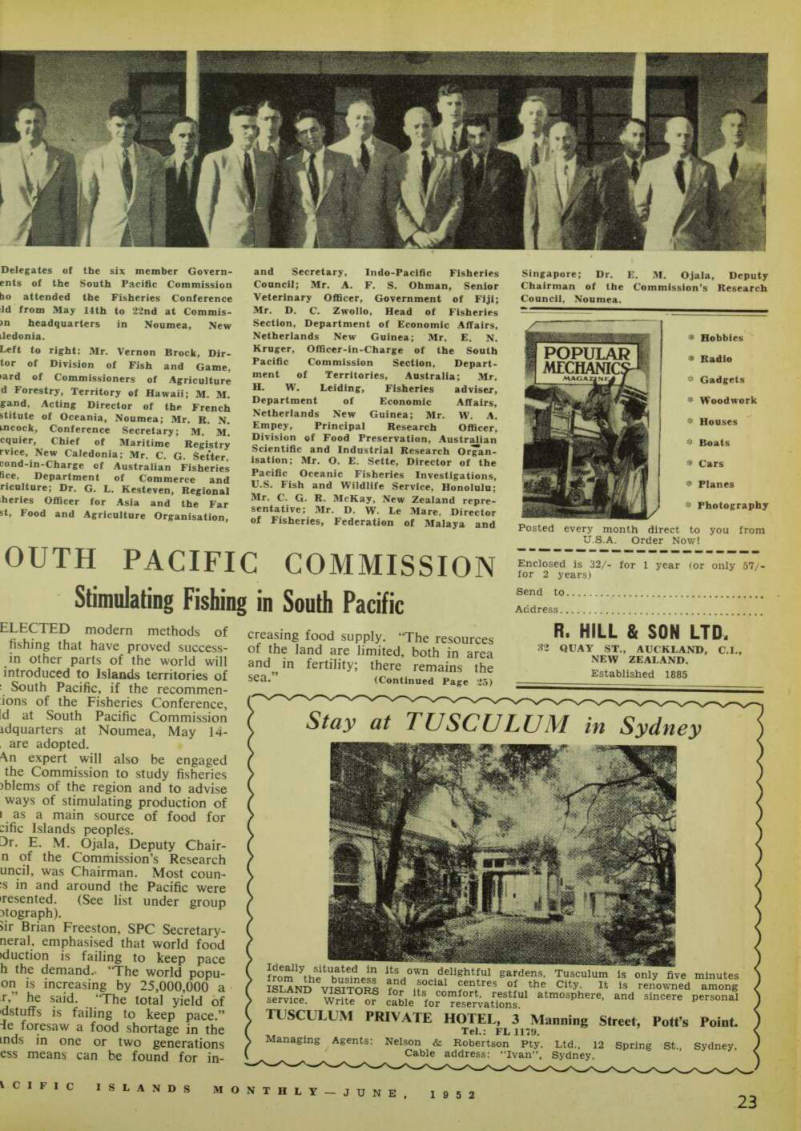
Delegates of the six member Govern ents of the South Pacific Commission bo attended the Fisheries Conference Id from May 14th to 22nd at Commis m headquarters in Noumea, New Jedonia.
Left to right: Mr. Vernon Brock, Dir tor of Division of Fish and Game, >ard of Commissioners of Agriculture d Forestry, Territory of Hawaii; M. M. gand, Acting Director of the French stitute of Oceania, Noumea; Mr. R. N. uncock, Conference Secretary; M. M. cquier, Chief of Maritime Registry rvice, New Caledonia; Mr. C. G. Setter cond-in-Charge of Australian Fisheries Bee, Department of Commerce and riculture; Dr. G. L. Kesteven, Regional heries Officer for Asia and the Far st. Food and Agriculture Organisation,
and Secretary, Indo-Pacific Fisheries Council; Mr. A. F. S. Ohman, Senior Veterinary Officer, Government of Fiji; Mr, D. C. Zwollo, Head of Fisheries Section, Department of Economic Affairs, Netherlands New Guinea; Mr. E. N.
Kruger, Officer-in-Charge of the South Pacific Commission Section, Depart ment of Territories, Australia; Mr.
H. W. Leiding, Fisheries adviser, Department of Economic Affairs, Netherlands New Guinea; Mr, W. A.
Empey, Principal Research Officer, Division of Food Preservation, Australian Scientific and Industrial Research Organ isation; Mr. O. E. Sette, Director of the Pacific Oceanic Fisheries Investigations, U.S. Fish and Wildlife Service, Honolulu; Mr. C. G. R. McKay, New Zealand repre sentative; Mr. D. W. Le Mare, Director of Fisheries, Federation of Malaya and
Singapore; Dr. E. M. Ojala, Deputy Chairman of the Commission’s Research Council, Noumea.
ELECTED modern methods of fishing that have proved success in other parts of the world will introduced to Islands territories of : South Pacific, if the recommen ions of the Fisheries Conference, Id at South Pacific Commission idquarters at Noumea, May 14are adopted. expert will also be engaged the Commission to study fisheries )blems of the region and to advise ways of stimulating production of i as a main source of food for zific Islands peoples. 3r. E. M. Ojala, Deputy Chair n of the Commission’s Research uncil, was Chairman. Most coun ts in and around the Pacific were •resented. (See list under group Dtograph). hr Brian Freeston, SPC Secretary neral, emphasised that world food Auction is failing to keep pace h the demand.* “The world popu on is increasing by 25,000,000 a r,” he said. “The total yield of •dstuffs is failing to keep pace.” ie foresaw a food shortage in the mds in one or two generations ess means can be found for in
creasing food supply, “The resources of the land are limited, both in area and in fertility; there remains the sea.” (ContinueT Page
Fhe Conference took as its primary sideration the development of ling within the area to meet the ritional needs of the people. In ne territories the populations were wing so rapidly that even the ;sent levels of average fish connption could be maintained only
by increasing production. The Con ference considered that a major effort to develop fisheries must be made, Coral reef and atoll areas are the present main sources of fish supply in the area. The Conference felt that such areas have a definite limit of yield. (Next Page)
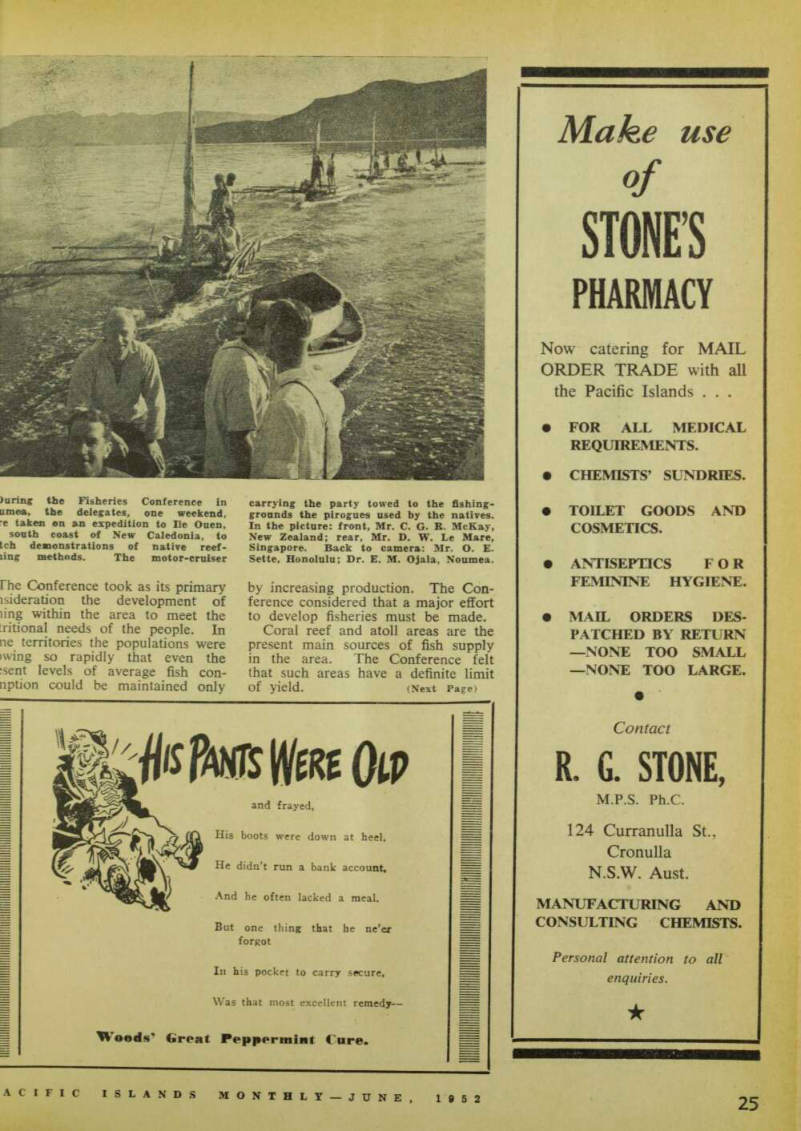
During the Fisheries Conference in [?]umea, the delegates, one weekend, [?]e taken on an expedition to Ile Ouen, south coast of New Caledonia, to [?]tch demonstrations of native reef [?]ning methods. The motor-cruiser
carrying the party towed to the fishing grounds the pirogues used by the natives.
In the picture: front, Mr. C. G. R. McKay, New Zealand; rear, Mr. D. W. Le Mare, Singapore. Back to camera: Mr. O. E.
Sette, Honolulu; Dr. E. M. Ojala, Noumea.
Mangrove and estuarine areas, most important in New Guinea and New Caledonia, are abundant and relatively unexploited sources of fish.
Oceanic sources are more extensive, and in some areas, notably north of New Guinea and south of Hawaii, commercially-valuable species such
as tuna and mackerel are found in abundance. As regards freshwater fish, New Guinea, with its large bodies of fresh water, offers the richest field for development.
The Conference considered that methods at present used in the pro cessing, marketing and distribution of fish in the South Pacific were generally inadequate, even at the present relatively low levels of con sumption. The only methods of pro cessing employed in the region are salting, smoking and drying, mostly by crude and primitive methods, while facilities for the transport, storage and marketing of locally caught fish are generally non-exis
tent, except that fish are usually soldi at the food markets of the maim towns.
The Conference recommended the; establishment where necessary of] territorial fishing services to encour age development of the industry, and! requested the Commission to explores the possibility of providing a speciall course of lectures on fisheries ad ministration for officers recruited! within the region.
It further recommended thatl Governments should promote the; development of community fishing enterprises, should encourage the use; of modern fishing techniques, and! should aid fishermen to acquire the; necessary powered craft and modem equipment.
If the appointment by the Com mission of a fisheries officer to im plement the Conference recommen dations is approved, his main tasks will be to co-ordinate fishing de velopment projects in the various territories, to study new fishing techniques tested in the region, toe advise member Governments ofi the Commission regarding thein fisheries programmes, and to gathen and disseminate information that is at present lacking on the fisheries oft the South Pacific.