Over The Reef
pp. 70-71 · Read in the full issue
Landing on Ocean Is.—ROSA MOORE Tells Us How it is Done In a Westerly Gale
VISITORS approaching Ocean Island when a westerly is blowing (open season from November to March, but possible at other times of the year) are feelingly advised to put their shoregoing models back in their suitcases and disguise themselves in the oldest garments their repertoire has to offer.
Our Ocean Island ETA was 8 a.m.; so, at 7 a.m., clad in their best, our family group of three was hanging over the rail, peering hopefully through the morning’s rain and spray for signs of our welcoming party of one.
It meant little to us that a westerly was blowing. Certainly, the island appeared to be heaving in a surging sea, and an extraordinary quantity of water was hurling itself in skyscraper formation against such of the shoreline as we could pick out; but we really didn’t take in the implication of it all.
At least, not until breakfast time, when we were told all over again about the record drift of 28 days made by one ship in Ocean’s westerly weather, until the wind finally went
back to the rightful east and the mooring buoy on the edge of the reef could safely be approached.
After that we quietly hung up our shoregoing models, unpacked our ship-weary garments and sat about staring at Ocean Island from various angles, as our cargo ship drifted through the westerly wind.
Wireless communication with the shore cheered us with the news that an attempt would be made to take us off, on the drift, at 2 p.m. We got all dressed up again; but the afternoon was more boisterous than ever, so our ship turned away and soon the island was blotted out by spray and
misty rain.
Night came. Far off, the lights on
the phosphate workings twinkled
along the shoulders of Ocean. Again, the wireless spoke: a try would be made to take us off at 6 a.m. next day, from as near as our ship could approach. went the shoregoing models in v/ the windy dawn, towards the shore battled our cargo ship, until we were near enough to see enormous
gouts of spray battering at the boat harbour walls—no launch could get through that. We changed back in to our old clothes for breakfast and heard another wireless plan for a fourth attempt, with barge, at 11 a.m.
“Please wear old clothes Ominous words! We duly retained the old clothes; but 11 a.m. came and
went fruitlessly— : sea impossible.
Next we were told that a new idea was afoot—a rendezvous with a whaleboat early in the afternoon, this time in the lee of the island, on the east, and the whaleboat would take us in over the reef.
Our reaction to this was to have a nice sceptical siesta: from which we had to be awakened, wild-eyed, with the news that Operation Five was actually under way!
Brushing down our old clothes, we hurried unbelievingly up to the flying bridge, and from there we saw, a long way away, a little black beetle kicking and struggling in the boiling sea, while slowly, slowly, we edged in to meet it.
At this point, a sort of mariners* flurry set in among the bridge person nel, with bells ringing and in explicable orders bouncing about.
At this moment, too, our small fe male passenger sailed into the middle of the official party carrying a shoe box and announcing chattily, “O, Captain, I forgot to show you my silkworm moths.”
Since it turned out that our ship had chosen this ticklish juncture to break a fuel pump and was having to heave-to in di s grace, the silk worm moths were scarcely well timed; but nobody allowed their beaming owner to guess it.
THIS situation
left the water beetle in sole charge of the rest of the proceedings, no explanation of why we had stopped so far out being possible. So it went on kicking and struggling and shooting high into the air until at last it began to resemble a whale bo a t and then, ages later, it was
actually tossing
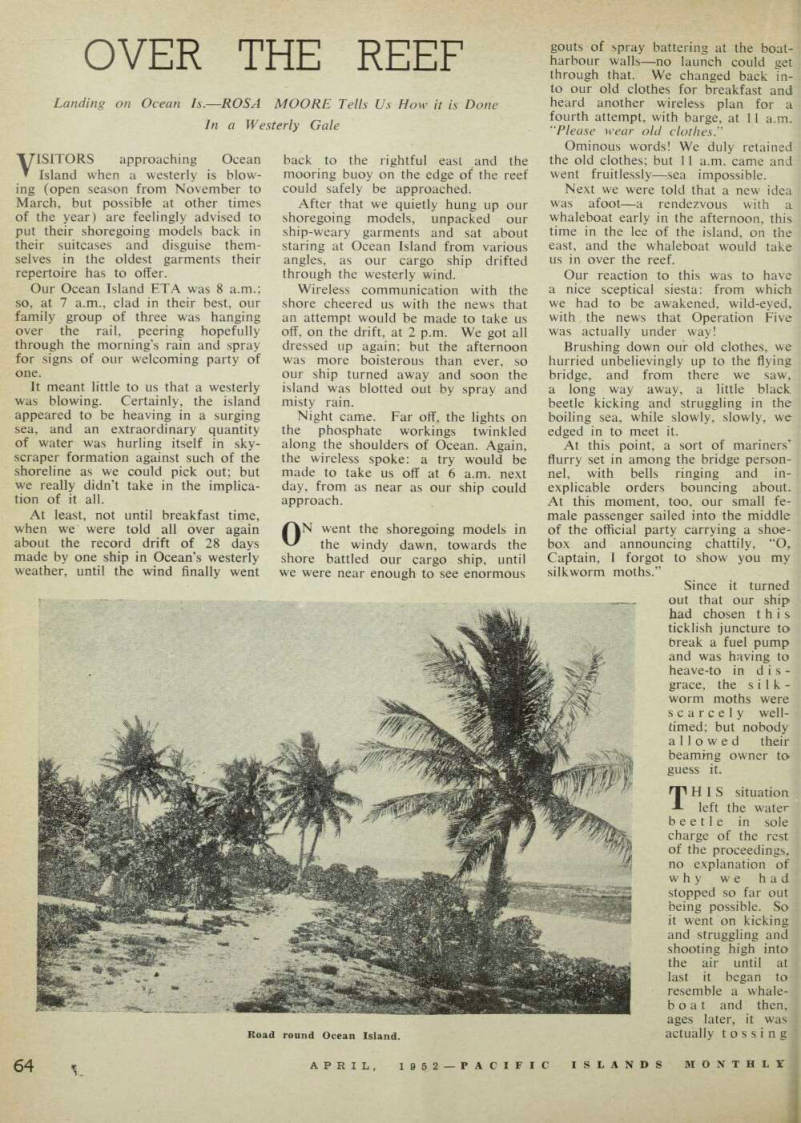
Road round Ocean Island.
ike a walnut shell at the foot of the iteep gangway.
Our Relative, the Harbour Master, ind five Gilbertese lifted salty faces ip to us as we struggled down in he wake of our luggage.
At this point, more human beings han we ever suspected were con ealed on board appeared like light ling all along the decks, many of hem holding cups of tea and chew ng in a heartless manner as they pre lared for the amusing drama of how he landlubbers tried to embark in a whaleboat which, one moment, was 2 feet below the gangway foot and, he next, shooting skyward on the op of a wave.
The next ten minutes were a night lare of strong arms, barked shins, houts of “Wait!”, yells of “Look ut!”, roars of “Now! No, wait!”; /hile with steady monotony a water all from one of those inexplicable rain affairs which gush out of the ides of ships cascaded with unerring im into the whaleboat and all over ;s occupants.
What we looked like, nobody can ver tell us; but, somehow, into the Tialeboat we crashed one by one, nd were gathered up and parked in nice, wet cranny, plus amazingly itact silkworm moths, a hatbox mashed to pulp, and merrily swim
ling suitcases.
Then away rowed our four oars ten, while the fifth stood miracu 3usly balanced in the stern with le steering oar. Huge waves bore own on us and leaned over us—and p them we rode and down them we
lid again.
The Gilbertese rowed and rowed nd rowed, and huge drops of sweat ailed rhythmically down their faces, own their arms, down their chests, Tile we baled with jam-tins the 'Sder dapping over the tops of our hoes and shoved fitfully at sliding iitcases.
Up on to wave crests we hurtled, nd glimpsed far-off Ocean; then own we dropped and saw nothing ut greeny-grey sea.
After we'd done this for forty finutes, it was startling to hear the aund of human shouts—and over a rave slid two outrigger canoes to wards us. First one, then the other, mazingly came alongside and four
resh oarsmen astonishingly changed
laces with our weary crew. Then n we went with renewed energy. 1/ T E got through the .off-island currents all right; then all we ad to do was to negotiate the reef.
The beach, we could see, was quite black with sightseers; and, as we ar rived at the surfline, we suddenly shot towards them at an exhibition speed, caught by a wave which bumped and banged us over the coral niggerheads with terrific jolts and alarming sound-effects.
Into the sea rushed many Gilbert and Ellice islanders—and a number of European men, too—to steady us by the gunwales—and there we were at Ocean Island after 75 minutes from ship to shore.
This landing over the reef, we were later told, had been done only once before in the island’s history; so we
felt belated gratitude to everybody who cheerfully took part in the pro
ceedings.
And, ah, the blissful moment of preparing to step at last on to firm, firm land! In crumpled clothes en crusted with spray, grease and rust marks, I clambered to the bow of the whaleboat for a graceful leap into Ocean Island’s social life.
Up loomed a stalwart Gilbertese who gathered me ignominiously into what looked like a bundle of soiled laundry, wobbled his way to the nearest batch of sightseers and, with a grunt, dropped his green-faced burden at their feet.