This Was The End Of Taipi
p. 73 · Read in the full issue
Story of Capt. Cambridge's Famous Old Argosy
According to advice from Rarotonga, Captain Cam bridge’s famous Taipi has finally ceased to disturb the Cook Islands.
The Taipi, we believe, was formerly the Javo 11, purchased by two Polish nationals at Panama in 1932 and sailed to Suva. There she was abandoned and became a dere lict on the mud flats of Walu Bay —until Captain Cambridge sighted her in the middle 30 s.
The little craft was then in a very sorry condition—and remained so for the rest of her days, though Captain Cambridge sailed thou sands of miles in her. She was held together mainly by tarred can vas, tarred brown paper, and the will of Allah —according to con temporary observers.
Devoid of engines and with any thing but speedy lines, this extra ordinarily-shaped argosy drifted from island to island in the Cooks for 12 years or more.
Regularly, as she became long overdue, all Islands would be alerted to keep a sharp lookout for the vessel. A voyage which took a normal vessel 6 days frequently took Taipi as many weeks.
The 24-hour schooner run from Aitutaki to Rarotonga took Taipi three weeks on one memorable oc casion. For two weeks she was within cooee of Rarotonga. Each night the little craft managed to creep up to windward, almost within reach of its goal, only to be blown away to the westward with the freshening morning breeze.
Finally, she ran right back to Aitu taki to get a fresh slant at Raro tonga.
On one of his last lengthy voyages to Manihiki, Captain Cam bridge related how, a month out of Rarotonga, his crew of three natives mutinied —to the extent of refusing duty unless he turned back.
Nothing daunted, the skipper con tinued north, the crew lying in the fo’csle below. Two days later, Manihiki in sight, the crew, full of apologies, reported for duty.
“Yes,” said the skipper, “by all means get back to work. But naturally I’ve had to log you for refusing duty. You are each fined the amount of your wages to date.
Then, of course, if you should be thinking of returning home to Raro tonga, there will be a passenger ves sel sailing within a week—other wise I will be very happy to let you work your passages south!”
That was- the cheapest voyage the little ship ever made.
About 1948, Taipi made her last voyage. Somehow, Captain Cam bridge got her inside the Palmer ston lagoon. But it is believed
that not even his endless ingenuity could get her out again—though after a long spell there a radio mes sage came to Rarotonga appealing to the pilot of an NAC plane ta drop a nautical almanac some time when passing towards Samoa. This was big news—the Taipi was com ing out again.
But, about thpt time, Captain Cambridge is reported to have married an attractive young Palmerstonian and swallowed the anchor—or, rather, the old MDdel-T Ford engine which served that purpose.
Captain Cambridge now lives quietly at Manihiki. But, lately, came word from Palmerston that the rotting bones, of Taipi, well anointed with tar, are piece by piece helping to cook the local flying-fish.
—Jps.
Miss Roberte Charon, daughter of the Consul for Norway in Tahiti, was one of 19 students from New Caledonia who visited Sydney in February. The trip was a reward for high marks.
Sister I. Dreckow, having com pleted training for her double cer tificate in nursing, expected to join the Lutheran Mission. Rocke Is land, New Guinea, in March.
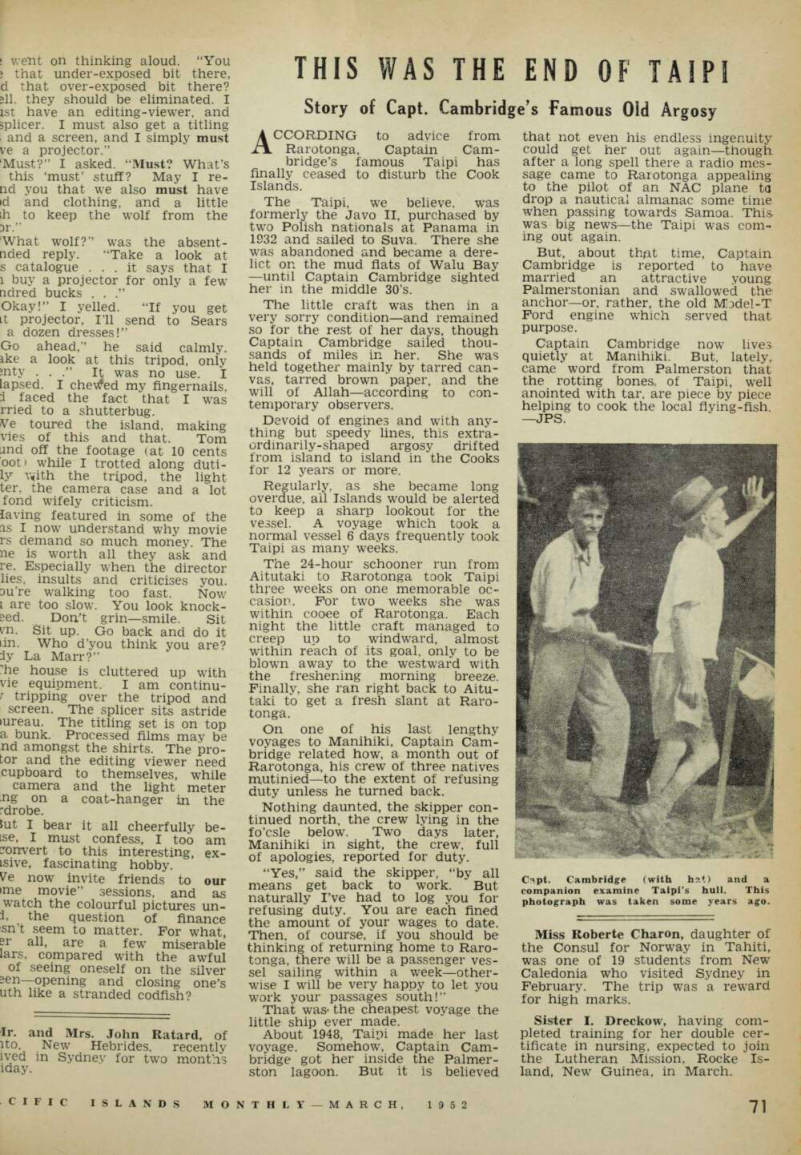
Capt. Cambridge (with hat) and a companion examine Taipi’s hull. This photograph was taken some years ago.