Toughest Sea Way
pp. 71-72 · Read in the full issue
Pilots On The World's
By J. W. Morris
TSE by the Americans during J the war, and increased peace time shipping have spotlighted ie Great North East Channel, one the main arterial sea lanes which averse the Straits north of Cape ork Peninsula.
Here ships of the world make teir way through reef-studded aters in safety because of deep id wide channels which connect e Coral and Arafura seas and the iciflc and Indian Oceans.
The Great North East Channel ;elf is 143 miles long and follows safe pilotage course from Bramble ly to Tucker Buoy at the western trance to Normandy Sound (the irbour for Thursday Island). It is e longest pilot cutter service (erated by any maritime service the world. But it is safe only cause of the knowledge of the lots of the Torres Strait Pilot irvice.
Shipowners using this channel to ,y find that time is saved and nning costs of their ships reduced, ve to ten days are saved through e Great North East Channel mpared with ships using the athern routes via Bass Strait.
This particularly applies to ship ig trading between Eastern Aus ilia, America, Fiji and the S-W .cific and the Far East. Singapore d India. rhe route is used also by the great oker fleet which moves oil from 3 big refineries at Tanjong Ueban, ilikpapan, Tarakan and Singa re.
Because of the navigational pro ;ms involved world shipping lines mg the Great North East Channel Llise the services of Torres Strait ots, and although the pilot ser ;e has operated since 1865, never fore have so, many been employed to-day.
During World War II the volume traffic was particularly heavy and is pilot service safely navigated lied ships of all types from amble Cay and set them safe the inner route of the Great
Barrier Reef for Eastern Australian ports.
This service would not have been possible if it had not been for the unremitting co-operation of the women of Stephen’s Island who, without thought to themselves, set up a voluntary pilot cutter service.
They rowed heavy dinghies from the quiet waters of Stephen’s Island to any incoming ship which carried a pilot, and with expert seamanship, brought their small row-boats alongside large warships and ocean liners and safely transferred the pilot.
This was a period of radio silence.
Commanders of warships or mer chantmen, simply blew the ship’s siren. The island women then launched their dinghies and rowed out to the vessel.
Knowing that such a voluntary service was available, most of the master mariners did not wait at Bramble Cay to pick up the pilot but navigated the open water be tween it and Stephen’s Island, 40 sea miles on a south-west course.
BRAMBLE Cay is a small sand bank, half a square mile in area, with little vegetation. It is 190 miles west of Basilisk Passage, the entrance to Port Moresby, and it is here that pilots normally meet ships en route to the Arafura Sea or Indian Ocean.
The cay itself is marked by iso lation and loneliness and the only visible link with civilisation is an unattended navigation light.
An unusual feature of the sur rounding area is the seasonal pollu tion of the sea bv the discoloured waters of Papua’s mighty Fly river.
Logs and other debris are washed down during the wet season from December to March.
Around the reef of Bramble Cay the rotting hulls of old windjammers can clearly be seen resting on the bottom at 20 fathoms. It is claimed that more than 200 ships have been wrecked there —barques, brigantines
and schooners of types that were fashionable years ago.
Bramble Cay is the graveyard of three centuries of ships whose mas ters could not foresee the dangers of the apparently calm waters of Torres Strait.
It was because of these dangers and disasters that a demand for pilotage arose and Torres Strait Pilots with local knowledge of the area began to navigate this route.
TO-DAY modern passenger liners of up to 40,000 tons use the Great North East Channel and the luxury liner Caronia on its re cent visit to the S-W Pacific steamed through at 22 knots.
Such a demand for pilotage es tablished the longest pilot cutter run of the world, and the cutter’s run from Thursday Island to Bramble Cay is to-day famous.
This course of 143 sea miles is unique: there are longer distances from world ports, but in such cases a pilot vessel is adjacent to the pilot pick-up point and the pilots operate from a mother ship.
In the case of Thursday Island to Bramble Cay it takes from 20 to 24 hours steaming each way and generally in daylight; three over night stops are made on the four day voyage. In early days, cutter crews rowed or sailed the 143 miles.
Sometimes the estimated arrival of a ship at Bramble Cay demands that a non-stop run be made by the pilot cutter in order that no undue delay is caused to ships awaiting pilotage.
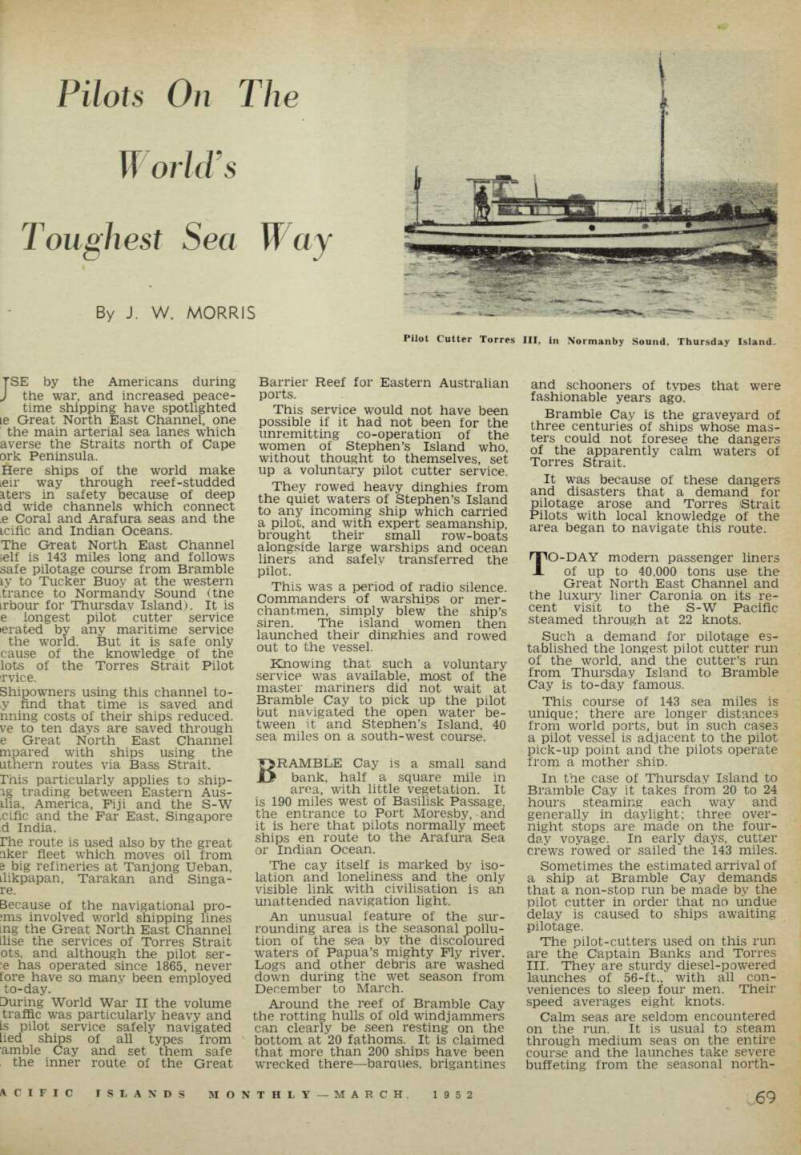
The pilot-cutters used on this run are the Captain Banks and Torres 111. They are sturdy diesel-powered launches’ of 56-ft., with all con veniences to sleep four men. Their speed averages eight knots.
Calm seas are seldom encountered on the run. It is usual to steam through medium seas on the entire course and the launches take severe buffeting from the seasonal north
Pilot Cutter Torres III, in Normanby Sound, Thursday Island.
wester or south-westers. The crew of three have no easy time. Main meals are served only when an chored at night.
The actual course navigated by the cutter is identical to that used by the piloted ships. All navigation is by dead reckoning on modern navigation instruments fitted to the cutter.
Prominent landmarks seen through the Channel are Twin Brothers Island, Three Sisters (Bet, Sue and Poll Islands) Bet and Dun geness Reefs and Coconut Island.
Stephen Island is sometimes used as a stop-over place for the night.
Manoeuvring pilot cutters along side a large ship at Bramble Cay calls for a high order of seaman ship.
Generally the ship is slowed down to about five knots and the cutter then makes a wide circuit so that it comes alongside at the beam of the vessel where the pilot’s ladder has been suspended over the side.
Once the pilot and his baggage have been transferred the cutter exercises the same care in leaving the vessel and is steamed off the ship’s side at maximum speed. If the ship is stopped, the cutter some times cannot clear.