Magazine Section
pp. 67-68 · Read in the full issue
NORFOLK: Tourists’ Island
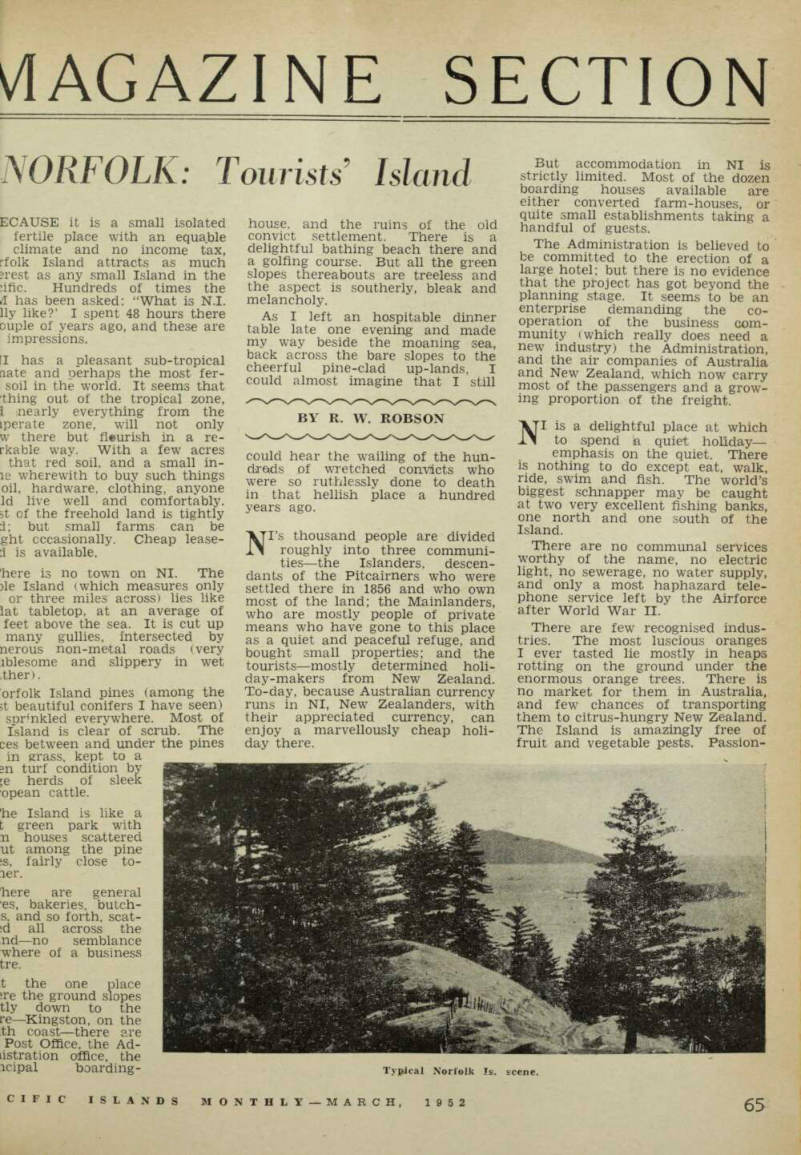
ECAUSE it is a small isolated fertile place with an equa.ble climate and no income tax, rfolk Island attracts as much Brest as any small Island in the ;ific. Hundreds of times the A has been asked: “What is N.I. lly like?’ I spent 48 hours there ouple of years ago, and these are Impressions. [I has a pleasant sub-tropical Date and perhaps the most fer soil in the world. It seems that thing out of the tropical zone, I nearly everything from the iperate zone, will not only w there but fleurish in a re rkable way. With a few acres that red soil, and a small in le wherewith to buy such things oil, hardware, clothing, anyone Id live well and comfortably, st of the freehold land is tightly d; but small farms can be ght occasionally. Cheap lease d is available. here is no town on NI. The )le Island (which measures only or three miles across) lies like iat tabletop, at an average of feet above the sea. It is cut up many gullies, intersected by nerous non-metal roads (very iblesome and slippery in wet ,ther). brfolk Island pines (among the >t beautiful conifers I have seen) sprmkled everywhere. Most of Island is clear of scrub. The ces between and under the pines
in grass, kept to a sn turf condition by ;e herds of sleek opean cattle.
'he Island is like a t green park with n houses scattered ut among the pine ;s, fairly close to ler. here are general ■es, bakeries, butch s, and so forth, scat id all across the nd—no semblance where of a business tre.
t the one place
;re the ground slopes tly down to the re —Kingston, on the th coast—there are Post Office, the Ad dstration office, the
icipal boarding
house, and the ruins of the old convict settlement. There is a delightful bathing beach there and a golfing course. But all the green slopes thereabouts are treeless and the aspect is southerly, bleak and
melancholy.
As I left an hospitable dinner table late one evening and made my way beside the moaning sea, back across the bare slopes to the cheerful pine-clad up-lands, I could almost imagine that I still
By R. W. Robson
could hear the wailing of the hun dreds of wretched convicts who were so ruthlessly done to death in that hellish place a hundred years ago.
NTs thousand people are divided roughly into three communi ties—the Islanders, descen dants of the Pitcairners who were settled there in 1856 and who own most of the land; the Mainlanders, who are mostly people of private means who have gone to this place as a quiet and peaceful refuge, and bought small properties; and the tourists —mostly determined holi day-makers from New Zealand.
To-day, because Australian currency runs in NI, New Zealanders, with their appreciated currency, can enjoy a marvellously cheap holi day there.
But accommodation in NI is strictly limited. Most of the dozen boarding houses available are either converted farm-houses, or quite small establishments taking a handful of guests.
The Administration is believed to be committed to the erection of a large hotel; but there is no evidence that the project has got beyond the planning stage. It seems to be an enterprise demanding the co operation of the business com munity (which really does need a new industry) the Administration, and the air companies of Australia and New Zealand, which now carry most of the passengers and a grow ing proportion of the freight.
NI is a delightful place at which to spend la quiet holiday— emphasis on the quiet. There is nothing to do except eat, walk, ride, swim and fish. The world’s biggest schnapper may be caught at two very excellent fishing banks, one north and one south of the Island.
There are no communal services worthy of the name, no electric light, no sewerage, no water supply, and only a most haphazard tele phone service left by the Airforce after World War 11.
There are few recognised indus tries. The most luscious oranges I ever tasted lie mostly in heaps rotting on the ground under the enormous orange trees. There is no market for them in Australia, and few chances of transporting them to citrus-hungry New Zealand.
The Island is amazingly free of fruit and vegetable pests. Passion-
Typical Norfolk Is. scene.
fruit grow very easily and luxur iantly. There is a factory for can ning passionfruit pulp which oper ates sometimes. The Island's chief source of revenue, apart from tour ists, comes from the export to Australia of bean seed.
Sea transport is the Island’s worst headache. There is nothing even resembling a sheltered port.
Ships lie off the rocky coast — either north or south of the Island according to the weather —and car go is loaded and unloaded by lighters. The sea is rarely calm.
All financial and trading trans actions take place in Australian terms of currency. Practically every home has a radio set capable of picking up Australian, New Zea land and Fiji broadcasts.
Air services link Australia, New Zealand and Fiji closely to NI. In creasing quantities of Nl’s splendid vegetables go by air to Suva.
The three communities —keeping mostly to themselves —provide their own entertainment: and there seems to be plenty of it. There is
a regular cinema in the Rawson Hall, at about the centre of the Island.
Any married couple would be quite happy in Norfolk Island, pro vided that they liked each other’s company and shared a liking for gardening, I should call the Is land a garden-lover’s paradise.
People who want other kinds of entertainment should not commit themselves to too long a stay.
The famous Pine Avenue, planted across the south-west side of the Island by a wise Governor in 1853, had to be cut down in 1942 to allow a great airstrip to be constructed for urgent war purposes. Everyone deplored the loss* of Nl’s most notable feature.. Now they deplore the loss for another reason—it was a remarkable break for the Island’s prevailing wind. Since the avenue of tall pines disappeared, the winds often sweep brutally across the flat top of the Island in a way not known for a hundred years.
There is no licensed hotel on the Island —the residents obtain all reasonable liquor requirements at
the Government’s bond store. That is the Island’s second great attrac tion. The first of course, is the absence of income tax. It may be added, in parenthesis, that most NI householders are skilful brewers,