Fiji Courageously
pp. 22-113 · Read in the full issue
Repairing Storm Damage
THE after-effects of the record speed hurricane which struck north-east Viti Levu, Fiji, on January 28, and cut a 35-mile-wide swaihe of destruction from Penang to Suva, may be summarised thus; • Under the dismal conditions created by much wreckage and far too much rain, the local authorities and private citizens of Suva and district have done a remarkable job of repairs. The town, having lost most of its luxuriant vegetation and many of its roofs, has a battered look, and will retain it for some time; but most pubhc utilities and communal life generally are functioning again. • Although some 30,000 Fijians (out of 120,000) lived in the district affected by the storm, they have accommodated themselves very quickly to the new conditions and, with the assistance now 7 being pro vided from various Relief Funds, and help from other native com munities outside the w 7 recked belt, they will be sustained until their crops grow again. They are rapidly rebuilding and replanting. • Because of somewhat mis leading reports about “famine in the villages”, and the publicity given to same, there has been a lively, three-cornered fight between the Government, the Methodist Church and the Fiji Times. • Although, owing to the des truction of communal services, there w 7 as for a time some con siderable danger of epidemics and disease, good and prompt work by the medical officials prevented any troublesome outbreak. • A great deal of expensive repair work is being undertaken by both the Government, the local bodies and private-property owners.
But the burden has been accepted philosophically and there generally has been a ready disposition on the part of the lucky ones to help those less lucky.
THE three-cornered fight started when a Fijian Methodist minister reported to his head quarters that Fijians in some of the villages of the Waidina River area were suffering famine con ditions and that some actually had bartered their treasured personal possessions to the Indian store keepers for food.
The Methodist Church is by far the most powerful mission organi sation in Fiji. Its head, the Rev. A. Tippett, immediately organised relief for the Waidina area and then—apparently with out checking the report with the
Government and the local authorities—gave the information to the Suva newspaper.
The Fiji Times gave great prominence to the report. The press associations distributed it.
“Famine in Fiji” was a heading prominent throughout the British Empire in the last week of February.
Naturally, the Fiji Government was much disturbed. Its disturb ance turned to anger when it sent officials to investigate and found (it says) that, while some of the natives were distressed, there was nothing resembling famine con ditions. It said, in forthright fashion, that there had been grave exaggeration by both pulpit and press.
The Church and the newspaper defended themselves, and hit back with shrewd blows at officialdom.
Early in March, the clamour still was echoing along Victoria Parade.
THE row probably had its base in the criticism which some citizens, and the newspaper, had directed at the organisation (or lack of it) responsible for dis tribution of relief. New Zealand and Britain gave £lO,OOO each; NZ newspaper subscribers found another £12,000; the Fiji Govern ment made £2,000 available; the Methodist Church provided £5,000; many private citizens and institu tions subscribed to a fund which reached £3,500 at the end of February; the Fijians of Lau sent £2,000.
But these considerable funds did not appear to be assembled in one place, nor was their distribution made the responsibility of any one authority. Questions arose.
Who were entitled to ask for financial help: The head man of a Fijian village or the small Suva businessman? Or the European householder of small means whose house had collapsed? Or the Indian cane-farmer who had lost everything?
How were claims to be assessed — was it first in, first served? Did a smashed Fijian house in Tavua, from a relief viewpoint, have priority over a smashed European roof in Suva?
The Government appeared to be slow in giving a lead in these matters —probably because so many of the donors wanted to attach conditions to their gifts. “This must be used only for the help of the native Fijians,” and so forth.
With so many demanding infor mation and guidance, and the officials being as cautious as they always are when there are no pre
cedents to help them, mi irritation was engendered; m people were feeling the strain the disaster and its effects; and 1 Fijian - Government - Methodis Fiji Times incident came just the right moment to touch off explosion.
However, observers in K Zealand and Australia, getting better perspective than the rr living too close to the hurrlcj troubles in Fiji, could appreci the courage displayed by all Fiji communities in attacking innumerable problems created the visitation, and the w< done by all sections in quickly restoring order.
Hurricane Not As Bai
As Reported
SOME prominent residents of ! have told the FIM that t resent the incorrect preser tion in Australian and I Zealand newspapers of the n of the hurricane.
“From these reports,” writes man, “people abroad would imag that the colony has suffered im devastation, and that the nat are starving. These appeals funds have given a very wr impression.
“The track of the hurricane only 35 miles wide, and it exten only over one end of Viti L< Eastern Viti Levu is not Fiji.
“Our property-owners are doir good job in re-building, and are grumbling too much. This is i of the risk, which we all accept living in the hurricane area.
“When the rebuilding is finis] Suva will be a cleaner and be town. Quite a number of the buildings shattered in the bush section are well out of the we the hurricane has saved Council from ordering their < truction, and the owners the pense of fighting the Council, other cases, some compensation be in order —and very welcome it comes. This applies to Ei peans and Indians.
“A lot of silly nonsense has t published about the sufferings the Fijians. There are 125 Fijians, and not a quarter of tl were in the track of the hurrici “Their gardens and houses \ smashed; but this is not nearly bad as it sounds. The Fijians, a thousand years, have been £ ject to these storms. They k: what to do. They do not sit d< and weep and starve. They rr to one side or other of devastated belt, and join up \ the Fijian settlements which not affected, and which usu have surplus food. They can ways get some sort of foodst out of the bush. In a few mon
y have re-built their homes, and ir food-gardens are back to duction.
They can do with all the help liable, in the way of foodstuffs I simple household goods, during
this period of restoration; and they are getting that help, right now.” prortftvt of SUVA port rKUßLftra up fuki A MOTHER correspondent says that the Government’s biggest
problem probably is the port of Suva. The King’s Wharf (which parallels the shore) was badly damaged—although some re pairs very quickly made have (Continued on Page 109)
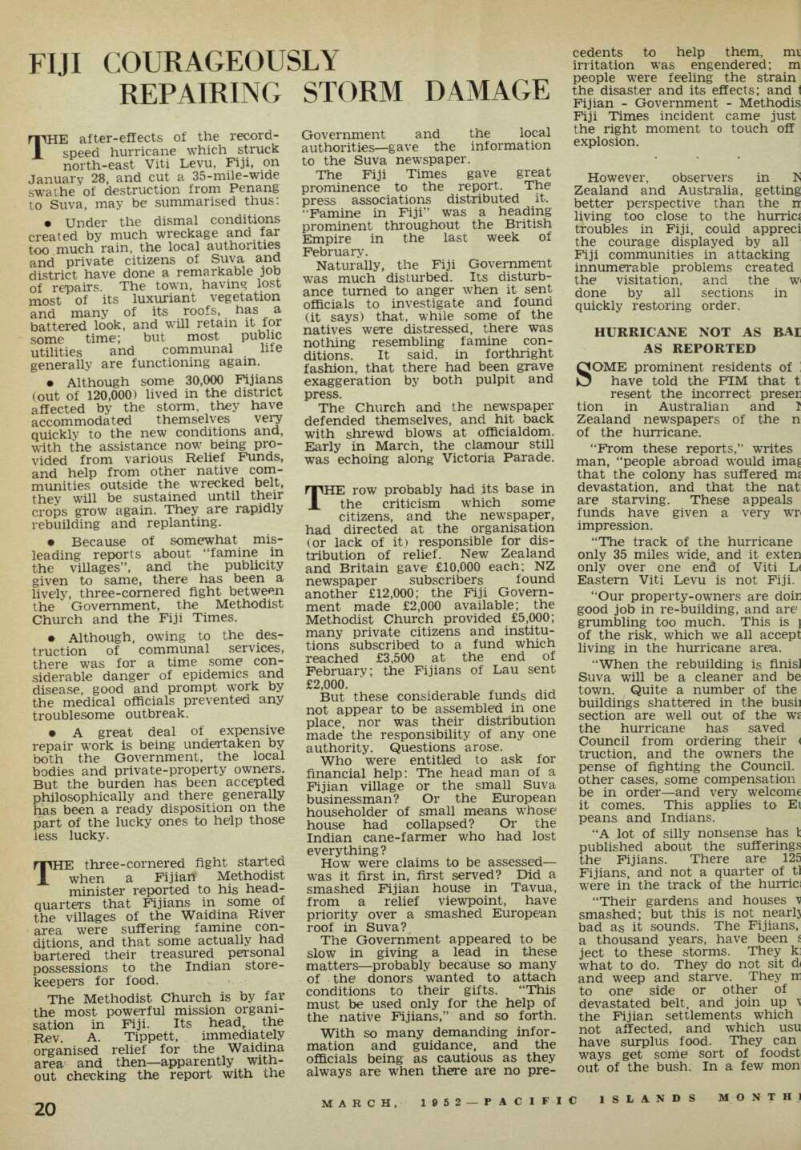
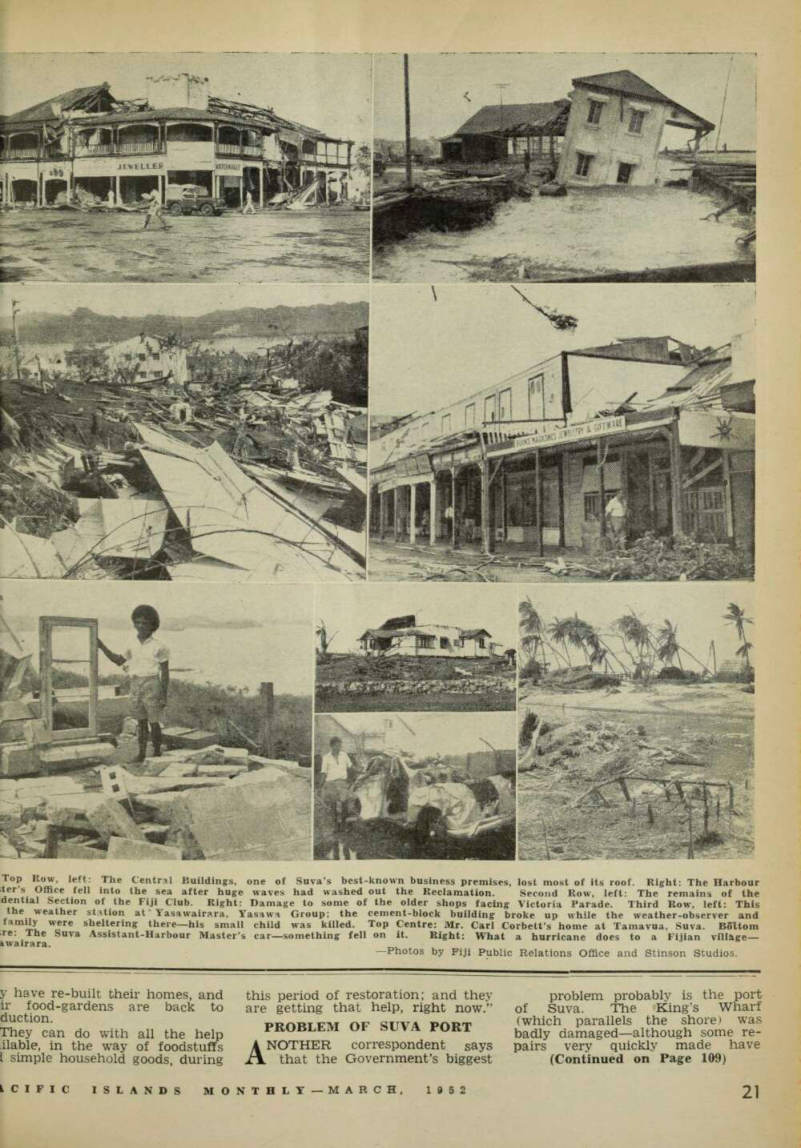
Top Row, left: The Central Buildings, one of Suva’s best-known business premises, lost most of its roof. Right: The Harbour [?]ter’s Office fell into the sea after huge waves had washed out the Reclamation. Second Row, left: The remains of the dential Section of the Fiji Club. Right: Damage to some of the older shops facing Victoria Parade. Third Row, left: This the weather station at Yasawairara, Yasawa Group; the cement-block building broke up while the weather-observer and family were sheltering there—his small child was killed. Top Centre: Mr. Carl Corbett’s home at Tamavua, Suva. Bottom [?]re. The Suva Assistant-Harbour Master’s car—something fell on it. Right: What a hurricane does to a Fijian village— [?]wairara. —Photos by Fiji Public Relations Office and Stinson Studios.
whole situation is being surveyed and reviewed, to see whether big scale repairs are possible, or whether the docks area will have to be virtually rebuilt.
An expert (Mr. D. V. Buck) has been brought out from London to inspect and advise; and he will work with a Government Com mittee which includes Sir Alport Barker and Messrs. Vishnu Deo, D.
Butler, M. H. Helsen, J. K. Desai, C. K. Kapadia and L. F. Garnett.
Some old residents are discussing the question of whether this may not be an opportune time to re arrange Suva’s wharfage. A wharf paralleling the shore is modern practice—it simplifies the move ment of cargo when it is leaving or approaching the ship.
But it does limit berthage; and,
in the case of Suva, it creates s very real problem because thej prevailing southerly winds force thei snips up against the wharf. Again, and again, big liners have had to; struggle for hours before thei; could be pulled clear of the Suvs 1 wharf and get their bows pointeo; towards the port entrance.
For these reasons, some peopM advocate a big, strong jetty, rum ning at right angles to the presenr wharf, so that ships could lie or both sides of it.
Whatever the decision, thx Government is faced with an ex> penditure running into hundred! of thousands of pounds.
IT is difficult to get an' accurate idea of what the January hurricane has cost and is goc ing to cost Fiji.
The current tendency is to seal! down the losses suffered by thr big commercial concerns, iii damaged machinery and plant, anu step up the value represented b;c destroyed Fijian villages, food cropq and personal property.
Loss suffered by the CSR Co. ae the Penang sugar-mill, and ini stocks of bagged sugar at thr Ellington port storage sheds, ii less than was feared —mainly bee cause immediate steps were takeß to save everything that could be saved.
The same thing is believed ti
ave been done by the gold mines t Vatukoula.
Nevertheless, both the sugar id mining companies have lost eavily in wrecked buildings.
No one seems yet to have tackled le problem of assessing the loss ivolved in the destruction of iveral thousand Fijian houses and imdreds of village food-gardens— us the virtual elimination of the inana export industry.
Four weeks after the hurricane, iva was still without street light g; but most of the houses, shops id commercial buildings had both ?ht and power. Repairs to imaged buildings are well ad mced and total losses are being eared away fast. The wrecked ub Hotel will riot be re-built.
Pate Of Banana Industry
THE storm’s most serious after . effect, affecting all com munities, is the complete terruption of the rapidly veloping banana industry.
By hurriedly raking over the vastated plantations, the Fijians thered 4,263 cases of bananas for e February Matua; and now ere will be practically no more ji bananas for the hungry New aland market for six months.
This is particularly unfortunate r the Union SS Co., which had st introduced the new Tofua, in e belief that the Fiji-NZ banana dustry would provide adequate rgo. Now. the Matua has been mporarily withdrawn, for service >e where.
That banana money tended to sist and sweeten the whole Fiji onomy. Fortunately, banana antations soon recover, and the ade should be back to normal thin the year, with 20,000 cases month available. But it means
c months of belt-tightening,
pecially for the thousands of jians who were transferring from eir old village economy to this dustry.
The whole Colony has rallied to e help of the Fijians in distress, /her districts have sent thousands kumala cuttings for planting; ipowners have carried them free charge; a Savu Savu European ls sent a consignment of fruit id vegetables to the affected ardmg-schools; NZ sent two tons clothing for the Fiiians and £AL carried it without charge; 5R Co. carried relief supplies on i vessels; and so on—the list is dless.