[?]Opra Market
p. 17 · Read in the full issue
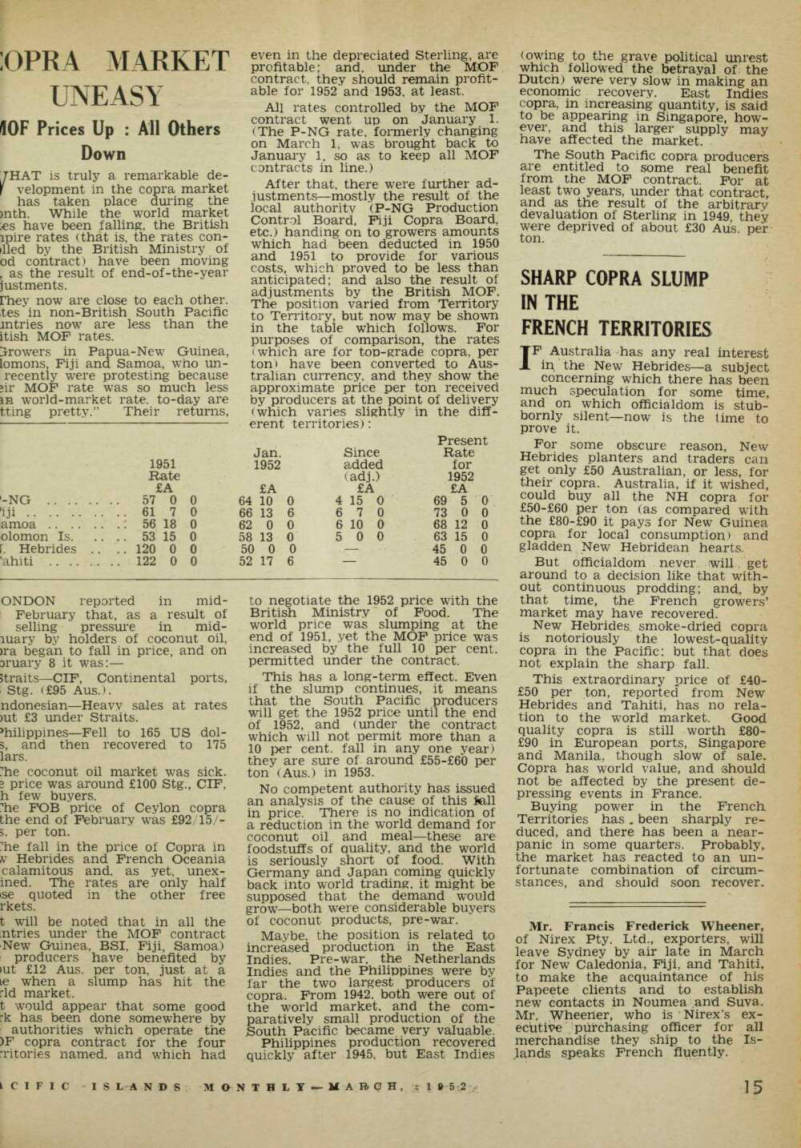
Uneasy
[?]OF Prices Up: All Others Down
THAT is truly a remarkable de- I velopment in the copra market has taken place during the with. While the world market es have been falling, the British ipire rates (that is, the rates con illed by the British Ministry of od contract) have been moving , as the result of end-of-the-year justments, rhey now are close to each other, tes in non-British South Pacific intries now are less than the itish MOF rates.
Growers in Papua-New Guinea, lomons, Fiji and Samoa, who un recently were protesting because nr MOF rate was so much less m world-market rate, to-day are tting pretty.” Their returns,
ONDON reported in mid- February that, as a result of selling pressure in mid luary by holders of coconut oil, >ra began to fall in price, and on Druary 8 it was;— Jtraits —GIF, Continental ports, Stg. (£95 Aus.). ndonesian —Heavy sales at rates >ut £3 under Straits. >hilippines—Fell to 165 US dol 3, and then recovered to 175 lars.
Tie coconut oil market was sick, s price was around £lOO Stg., GIF, h few buyers.
Tie FOB price of Ceylon copra the end of February was £92/15/- 3. per ton.
Tie fall in the price of Copra in v Hebrides and French Oceania calamitous and, as yet, unex ined. The rates are only half ise quoted in the other free rkets. t will be noted that in all the ntries under the MOF contract New Guinea, BSI, Fiji, Samoa) producers have benefited by »ut £l2 Aus. per ton, just at a ie when a slump has hit the rid market. t would appear that some good rk has been done somewhere by authorities which operate the )F copra contract for the four rritories named, and which had
even in the depreciated Sterling, are profitable; and, under the MOF contract, they should remain profit able for 1952 and 1953, at least.
All rates controlled by the MOF contract went up on January 1. (The P-NG rate, formerly changing on March 1, was brought back to January 1, so as to keep all MOF contracts in line.) After that, there were further ad justments—mostly the result of the local authority (P-NG Production Control Board, Fiji Copra Board, etc.) handing on to growers amounts which had been deducted in 1950 and 1951 to provide for various costs, which proved to be less than anticipated; and also the result of adjustments by the British MOF.
The position varied from Territory to Territory, but now may be shown in the table which follows. For purposes of comparison, the rates (which are for top-grade copra, per ton) have been converted to Aus tralian currency, and they show the approximate price per ton received by producers at the point of delivery (which varies slightly in the diff erent territories);
to negotiate the 1952 price with the British Ministry of Food. The world price was slumping at the end of 1951, yet the MOP price was increased by the full 10 per cent, permitted under the contract.
This has a long-term effect. Even if the slump continues, it means that the South Pacific producers will get the 1952 price until the end of 1952, and (under the contract which will not permit more than a 10 per cent, fall in any one year) they are sure of around £55-£6O per ton (Aus.) in 1953.
No competent authority has issued an analysis of the cause of this fall in price. There is no indication of a reduction in the world demand for coconut oil and meal—these are foodstuffs of quality, and the world is seriously short of food. With Germany and Japan coming quickly back into world trading, it might be supposed that the demand would grow—both were considerable buyers of coconut products, pre-war.
Maybe, the position is related to increased production in the East Indies. Pre-war. the Netherlands Indies and the Philippines were by far the two largest producers of copra. From 1942. both were out of the world market, and the com paratively small production of the South Pacific became very valuable.
Philippines production recovered quickly after 1945. but East Indies
(owing to the grave political unrest which followed the betrayal of the Dutch) were very slow in making an economic recovery. East Indies copra, in increasing quantity, is said to be appearing in Singapore, how ever, and this larger supply may have affected the market.
The South Pacific copra producers are entitled to some real benefit from the MOP contract. For at least two years, under that contract, and as the result of the arbitrary devaluation of Sterling in 1949, they were deprived of about £3O Aus. per ton.
1951 Rate £A -NG 57 0 0 Iji 61 7 0 amoa 56 18 0 olomon Is 53 15 0 f. Hebrides .. .. 120 0 0 'ahiti 122 0 0
Present Jan. Since Rate 1952 added for <adj.) 1952
£A £A £A
64 10 0 4 15 0 69 5 0 66 13 6 6 7 0 73 0 0 62 0 0 6 10 0 68 12 0 58 13 0 5 0 0 63 15 0 50 0 0 — 45 0 0 52 17 6 — 45 0 0