Last Cannibal Outpost
pp. 71-72 · Read in the full issue
MIARASA —New Guinea's Last Cannibal Outpost
By Pastor A. J. CAMPBELL, of SDA Mission, Kainantu, New Guinea.
i SURPRISED person recently \ exclaimed to the writer, “I didn’t know there were any lore cannibals left in the world. It Jems incredible!” Doubtless it
oes— particularly when canniba
sm is practised as recently as this ear, 1952.
During the latter part of last ear. a party of our Central New Guinea mission workers, including le writer with his twin sons, some ative teachers and a carrier line f fifty, made up a missionary ex edition into the primitive country ;mg south-west of Kainantu Highlands). We planned to reach le Moke area, which lies four days’ alk out in the mountainous re ions of the Purari’s vast headwater rstem.
One morning, leaders of our arty set out in a jeep for our vani mission station, cared for by am and his wife. It is a pretty lace, where we have an organised lurch, by the main road between .amantu and Bena Bena. Here our Jhicle was placed in a shed to ivait the return of our tired legs id bodies, and we faced the ranges
lying in tumbled profusion to the south.
The assault on this rugged coun
try began in earnest as we climbed nearly 3,000 feet from the floor of the Komperina Val ley, over the range into the next and higher Sunofyra Valley, which from that approach is the door to the can nibal country.
Mr. Gane, with some of his Omaura Mission teachers and students, after a long cross country walk, joined us for the weekend.
In a large build ing constructed for this occasion, meetings were at tended by about 1,500 people.
Among the multitude attending the services were twelve cannibals, who had trustingly followed their teacher through country completely strange to them, and come to meet us.
NEXT morning, our cannibal friends accompanied us on their return journey, for we were bound for their land.
The mountains surrounding Sunofi are pierced by many large limestone caves, most having not been explored. Some of us pene trated a cave for one hundred yards and, with its stalagmites and stalactites, it reminded us of visits to Jenolan Caves. We turned back, but some of the boys went on, and came out in a small valley.
Ceaseless streams run through most of these caves. It is not long since the local people used them as hiding places from their enemies.
Here they concealed their families pigs, food and firewood. They had a good water supply.
That we were entering the gates of the cannibal areas of the south west was impressed upon us one morning, when hushed exclama tions called our attention to two skulls in position in the bushes, several feet from the ground. They had been placed opposite each other, on either side of the jungle trail. Victims of cannibalism, we were told.
In company with our twelve “hawk-eyed cannibals” (as one of our party called them), we arrived at Moke at 3 p.m.
The Fore area natives have in formed our teachers that once their people sold their aged parents to the highest bidder, to be killed and eaten. As there has been no in fluence to bring any change for tne better, until the arrival of the
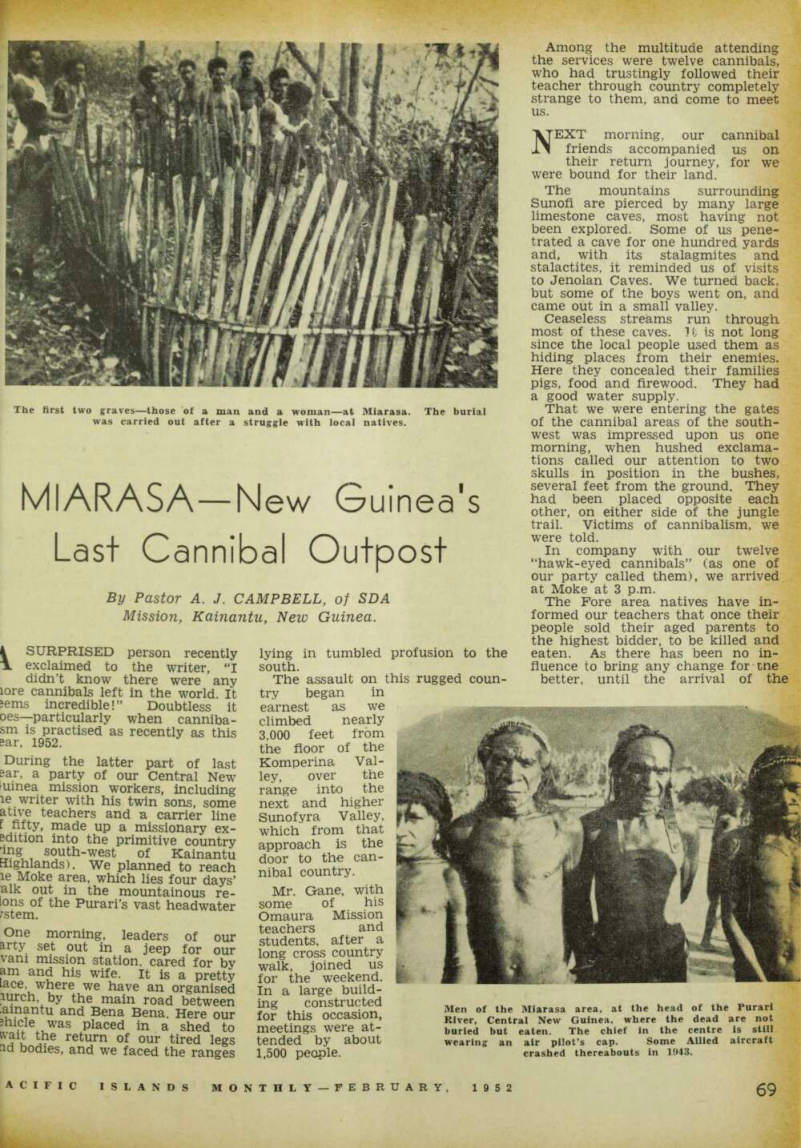
The first two graves—those of a man and a woman—at Miarasa. The burial was carried out after a struggle with local natives.
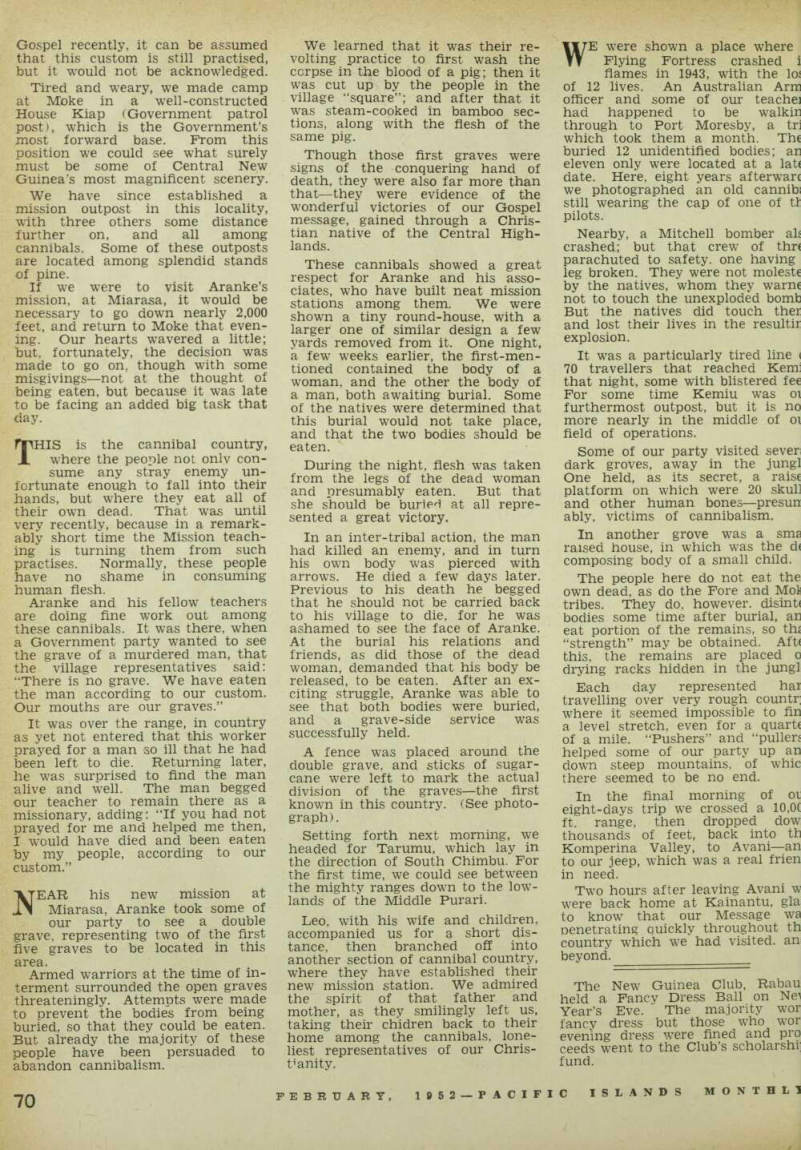
Men of the Miarasa area, at the head of the Purari River, Central New Guinea, where the dead are not buried but eaten. The chief in the centre is still wearing an air pilot’s cap. Some Allied aircraft crashed thereabouts in 1943.
Gospel recently, it can be assumed that this custom is still practised, but it would not be acknowledged.
Tired and weary, we made camp at Moke in a well-constructed House Kiap (Government patrol post), which is the Government’s most forward base. From this position we could see what surely must be some of Central New Guinea’s most magnificent scenery.
We have since established a mission outpost in this locality, with three others some distance further on, and all among cannibals. Some of these outposts are located among splendid stands of pine.
If we were to visit Aranke’s mission, at Miarasa, it would be necessary to go down nearly 2,000 feet, and return to Moke that even ing. Our hearts wavered a little; but, fortunately, the decision was made to go on, though with some misgivings—not at the thought of being eaten, but because it was late to be facing an added big task that day, THIS is the cannibal country, where the people not only con sume any stray enemy un fortunate enough to fall into their hands, but where they eat all of their own dead. That was until very recently, because in a remark ably short time the Mission teach ing is turning them from such practises. Normally, these people have no shame in consuming human flesh.
Aranke and his fellow teachers are doing fine work out among these cannibals. It was there, when a Government party wanted to see the grave of a murdered man, that the village representatives said: “There is no grave. We have eaten the man according to our custom.
Our mouths are our graves.”
It was over the range, in country as yet not entered that this worker prayed for a man so ill that he had been left to die. Returning later, he was surmised to find the man alive and well. The man begged our teacher to remain there as a missionary, adding: “If you had not prayed for me and helped me then, I would have died and been eaten by my people, according to our custom.”
NEAR his new mission at Miarasa, Aranke took some of our party to see a double grave, representing two of the first five graves to be located in this area.
Armed warriors at the time of in terment surrounded the open graves threateningly. Attempts were made to nrevent the bodies from being buried, so that they could be eaten.
But already the majority of these people have been persuaded to abandon cannibalism.
We learned that it was their re volting practice to first wash the corpse in the blood of a pig; then it was cut up by the people in the village “square”; and after that it was steam-cooked in bamboo sec tions, along with the flesh of the same pig.
Though those first graves were signs of the conquering hand of death, they were also far more than that —they were evidence of the wonderful victories of our Gospel message, gained through a Chris tian native of the Central High lands.
These cannibals showed a great respect for Aranke and his asso ciates, who have built neat mission stations among them. We were shown a tiny round-house, with a larger one of similar design a few yards removed from it. One night, a few weeks earlier, the first-men tioned contained the body of a woman, and the other the body of a man, both awaiting burial. Some of the natives were determined that this burial would not take place, and that the two bodies should be eaten.
During the night, flesh was taken from the legs of the dead woman and presumably eaten. But that she should be buried at all repre sented a great victory.
In an inter-tribal action, the man had killed an enemy, and in turn his own body was pierced with arrows. He died a few days later.
Previous to his death he begged that he should not be carried back to his village to die, for he was ashamed to see the face of Aranke.
At the burial his relations and friends, as did those of the dead woman, demanded that his body be released, to be eaten. After an ex citing struggle, Aranke was able to see that both bodies were buried, and a grave-side service was successfully held.
A fence was placed around the double grave, and sticks of sugar cane were left to mark the actual division of the graves—the first known in this country. (See photo graph) .
Setting forth next morning, we headed for Tarumu, which lay in the direction of South Chimbu. For the first time, we could see between the mighty ranges down to the low lands of the Middle Purari.
Leo, with his wife and children, accompanied us for a short dis tance, then branched off into another section of cannibal country, where they have established their new mission station. We admired the spirit of that father and mother, as they smilingly left us, taking their chidren back to their home among the cannibals, lone liest representatives of our Chris tianity.
WE were shown a place where Flying Fortress crashed i flames in 1943, with the lo: of 12 lives. An Australian Arm officer and some of our teache] had happened to be walkin through to Port Moresby, a tri which took them a month. The buried 12 unidentified bodies; ar eleven only were located at a lat( date. Here, eight years afterwarc we photographed an old cannibi still wearing the cap of one of tl pilots.
Nearby, a Mitchell bomber ah crashed; but that crew of thr( parachuted to safety, one having leg broken. They were not moleste by the natives, whom they warm not to touch the unexploded bomb But the natives did touch ther and lost their lives in the resultir explosion.
It was a particularly tired line ( 70 travellers that reached Kem: that night, some with blistered fee For some time Kemiu was oi furthermost outpost, but it is no more nearly in the middle of oi field of operations.
Some of our party visited sever dark groves, away in the jungl One held, as its secret, a raise platform on which were 20 skull and other human bones—presun ably, victims of cannibalism.
In another grove was a sms raised house, in which was the d( composing body of a small child.
The people here do not eat the own dead, as do the Fore and Mol tribes. They do, however, disinh bodies some time after burial, an eat portion of the remains, so ths “strength” may be obtained. Aft( this, the remains are placed o drying racks hidden in the jungl Each day represented hai travelling over very rough countr; where it seemed impossible to fin a level stretch, even for a quartc of a mile. “Pushers” and “pullers helped some of our party up an down steep mountains, of whic there seemed to be no end.
In the final morning of oi eight-days trip we crossed a 10,0( ft. range, then dropped dow thousands of feet, back into th Komperina Valley, to Avani—an to our jeep, which was a real frien in need.
Two hours after leaving Avani w were back home at Kainantu, gla to know that our Message wa penetrating quickly throughout th country which we had visited, an beyond.
The New Guinea Club, Rabau held a Fancy Dress Ball on Year’s Eve. The majority wor fancy dress but those who wor evening dress were fined and pro ceeds went to the Club’s scholarshi; fund.