Terrific Hurricane Strikes Fiji
pp. 17-123 · Read in the full issue
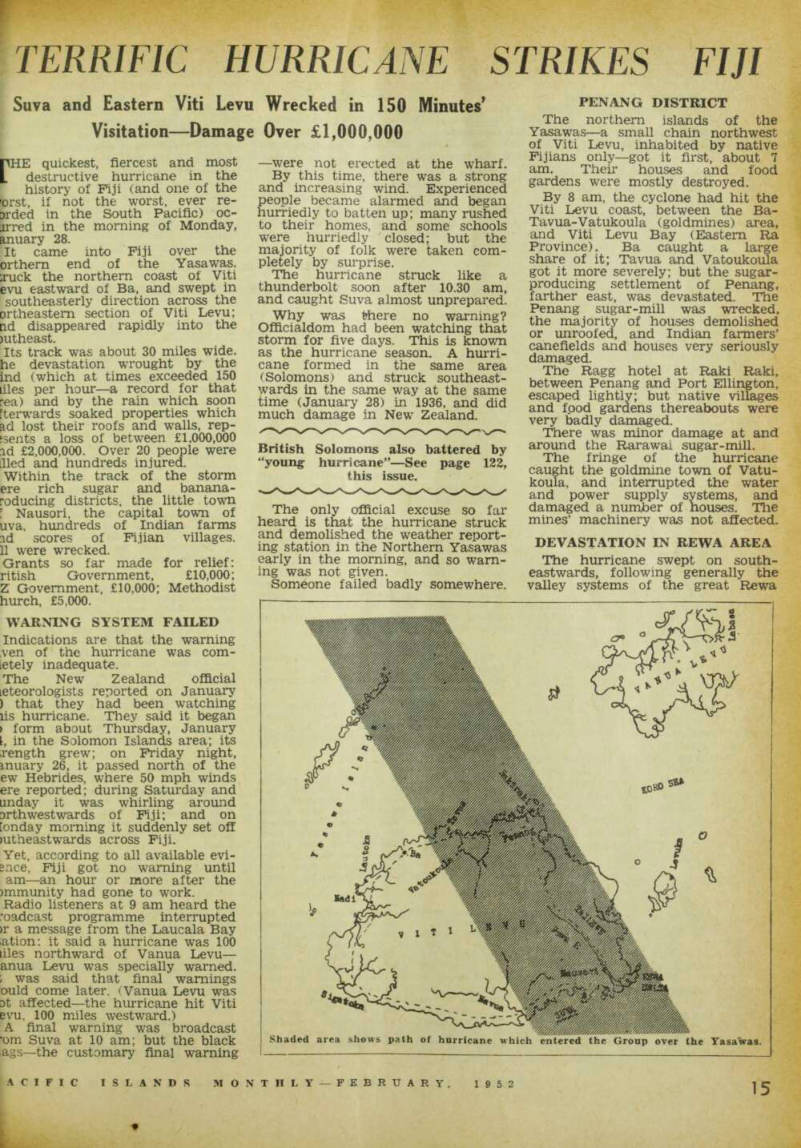
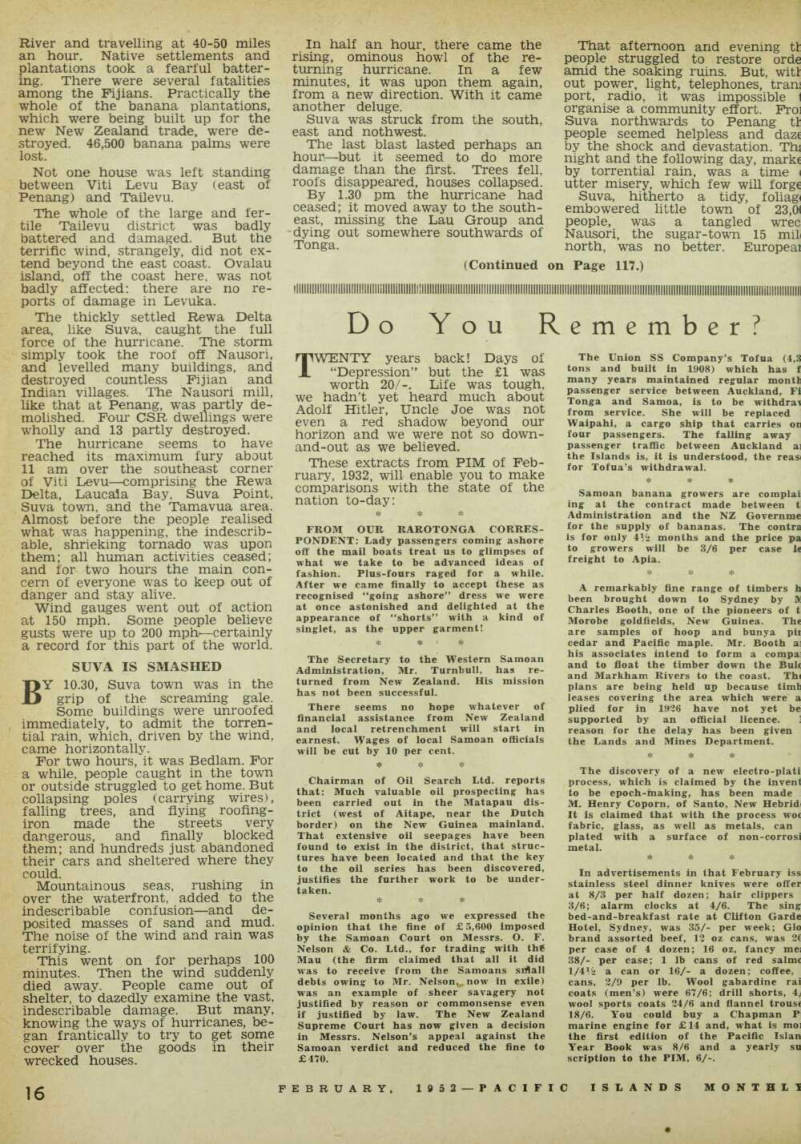
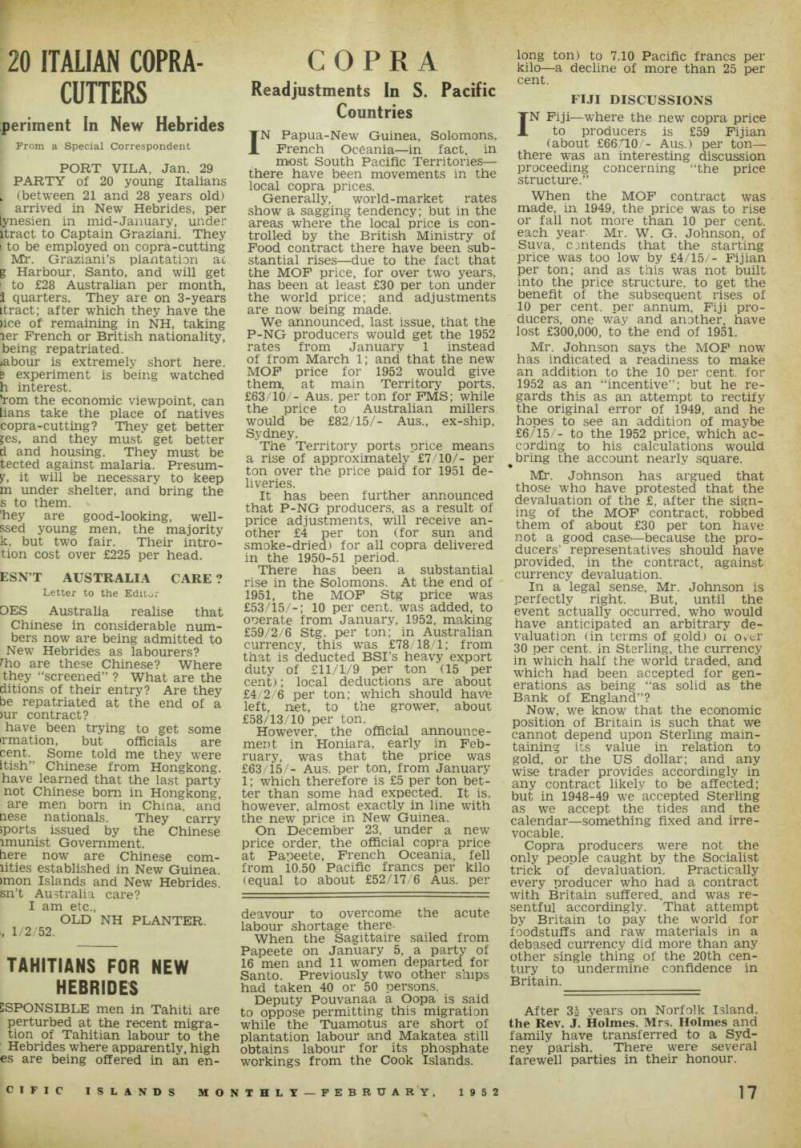
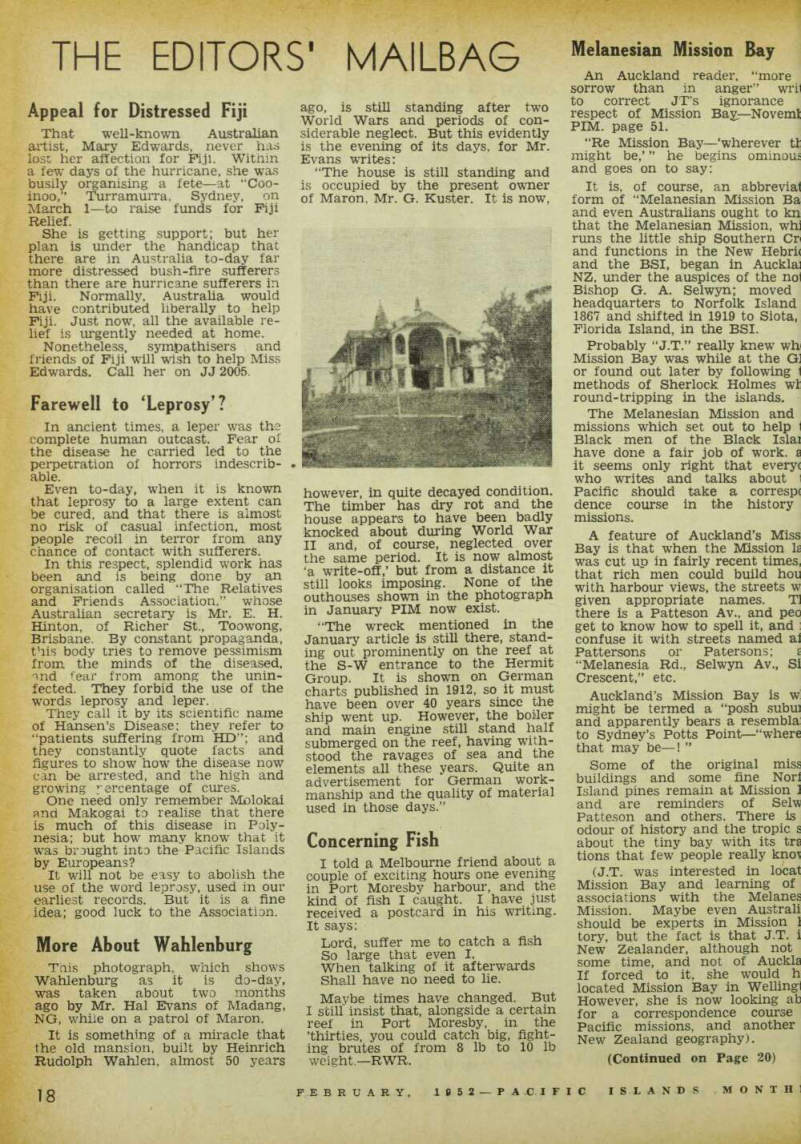
Suva and Eastern Viti Levu Wrecked in 150 Minutes’
Visitation—Damage Over £1,000,000
CHE quickest, fiercest and most destructive hurricane in the history of Fiji (and one of the torst, if not the worst, ever re- Drded in the South Pacific) oc iirred in the morning of Monday, anuary 28.
It came into Fiji over the orthem end of the Yasawas. ;ruck the northern coast of Viti evu eastward of Ba, and swept in southeasterly direction across the ortheastem section of Viti Levu; nd disappeared rapidly into the mtheast.
Its track was about 30 miles wide, he devastation wrought by the ind (which at times exceeded 150 dies per hour—a record for that rea) and by the rain which soon fterwards soaked properties which ad lost their roofs and walls, rep •sents a loss of between £1,000,000 id £2,000,000. Over 20 people were lied and hundreds injured.
Within the track of the storm ere rich sugar and banana roducing districts, the little town : Nausori, the capital town of uva, hundreds of Indian farms id scores of Fijian villages. 11 were wrecked.
Grants so far made for relief: ritish Government, £10,000; Z Government, £10,000; Methodist hurch, £5,000.
Warning System Failed
Indications are that the warning ven of the hurricane was com ic tely inadequate.
The New Zealand official teteorologists reported on January ) that they had been watching lis hurricane. They said it began > form about Thursday, January [, in the Solomon Islands area; its rength grew; on Friday night, inuary 26, it passed north of the ew Hebrides, where 50 mph winds ere reported; during Saturday and unday it was whirling around orthwest wards of Fiji; and on [onday morning it suddenly set off mtheast wards across Fiji.
Yet, according to all available evi snce, Fiji got no warning until am—an hour or more after the immunity had gone to work.
Radio listeners at 9 am heard the 'oadcast programme interrupted >r a message from the Laucala Bay .ation: it said a hurricane was 100 Liles northward of Vanua Levu — anua Levu was specially warned, ; was said that final warnings ould come later. (Vanua Levu was ot affected—the hurricane hit Viti evu, 100 miles westward.) A final warning was broadcast ■om Suva at 10 am; but the black ags—the customary final warning
—were not erected at the wharf.
By this time, there was a strong and increasing wind. Experienced people became alarmed and began hurriedly to batten up; many rushed to their homes, and some schools were hurriedly closed; but the majority of folk were taken com pletely by surprise.
The hurricane struck like a thunderbolt soon after 10.30 am, and caught Suva almost unprepared.
Why was there no warning?
Officialdom had been watching that storm for five days. This is known as the hurricane season. A hurri cane formed in the same area (Solomons) and struck southeast wards in the same way at the same time (January 28) in 1936, and did much damage in New Zealand.
British Solomons also battered by “young hurricane”—See page 122, this issue.
The only official excuse so far heard is that the hurricane struck and demolished the weather report ing station in the Northern Yasawas early in the morning, and so warn ing was not given.
Someone failed badly somewhere.
Penang District
The northern islands of the Yasawas —a small chain northwest of Viti Levu, inhabited by native Fijians only—got it first, about 7 am. Their houses and food gardens were mostly destroyed.
By 8 am, the cyclone had hit the Viti Levu coast, between the Ba- Tavua-Vatukoula (goldmines) area, and Viti Levu Bay (Eastern Ra Province). Ba caught a large share of it; Tavua and Vatoukoula got it more severely; but the sugar producing settlement of Penang, farther east, was devastated. The Penang sugar-mill was wrecked, the majority of houses demolished or unroofed, and Indian farmers’ canefields and houses very seriously damaged.
The Ragg hotel at Raki Raki, between Penang and Port Ellington, escaped lightly; but native villages and food gardens thereabouts were very badly damaged.
There was minor damage at and around the Rarawai sugar-mill.
The fringe of the hurricane caught the goldmine town of Vatu koula, and interrupted the water and power supply systems, and damaged a number of houses. The mines’ machinery was not affected.
Devastation In Rewa Area
The hurricane swept on south eastwards, following generally the valley systems of the great Rewa
Shaded area shows path of hurricane which entered the Group over the Yasawas.
River and travelling at 40-50 miles an hour. Native settlements and plantations took a fearful batter ing. There were several fatalities among the Fijians. Practically the whole of the banana plantations, which were being built up for the new New Zealand trade, were de stroyed. 46,500 banana palms were lost.
Not one house was left standing between Viti Levu Bay (east of Penang) and Tailevu.
The whole of the large and fer tile Tailevu district was badly battered and damaged. But the terrific wind, strangely, did not ex tend beyond the east coast. Ovalau island, off the coast here, was not badly affected; there are no re ports of damage in Levuka.
The thickly settled Rewa Delta area, like Suva, caught the full force of the hurricane. The storm simply took the roof off Nausori, and levelled many buildings, and destroyed countless Fijian and Indian villages. The Nausori mill, like that at Penang, was partly de molished. Four CSR dwellings were wholly and 13 partly destroyed.
The hurricane seems to have reached its maximum fury about 11 am over the southeast corner of Viti Levu—comprising the Rewa Delta, Laucala Bay, Suva Point, Suva town, and the Tamavua area.
Almost before the people realised what was happening, the indescrib able, shrieking tornado was upon them; all human activities ceased; and for two hours the main con cern of everyone was to keep out of danger and stay alive.
Wind gauges went out of action at 150 mph. Some people believe gusts were up to 200 mph—certainly a record for this part of the world.
Suva Is Smashed
BY 10.30, Suva town was in the grip of the screaming gale.
Some buildings were unroofed immediately, to admit the torren tial rain, which, driven by the wind, came horizontally.
For two hours, it was Bedlam. For a while, people caught in the town or outside struggled to get home. But collapsing poles (carrying wires), falling trees, and flying roofing iron made the streets very dangerous, and finally blocked them; and hundreds just abandoned their cars and sheltered where they could.
Mountainous seas, rushing in over the waterfront, added to the indescribable confusion —and de posited masses of sand and mud.
The noise of the wind and rain was terrifying.
This went on for perhaps 100 minutes. Then the wind suddenly died away. People came out of shelter, to dazedly examine the vast, indescribable damage. But many, knowing the ways of hurricanes, be gan frantically to try to get some cover over the goods in their wrecked houses.
In half an hour, there came the rising, ominous howl of the re turning hurricane. In a few minutes, it was upon them again, from a new direction. With it came another deluge.
Suva was struck from the south, east and nothwest.
The last blast lasted perhaps an houn—but it seemed to do more damage than the first. Trees fell, roofs disappeared, houses collapsed.
By 1.30 pm the hurricane had ceased; it moved away to the south east, missing the Lau Group and dying out somewhere southwards of Tonga.
That afternoon and evening tt people struggled to restore orde amid the soaking ruins. But, witl out power, light, telephones, tram port, radio, it was impossible \ organise a community effort. Pro] Suva northwards to Penang tt people seemed helpless and daze by the shock and devastation. Ttu night and the following day, marke by torrential rain, was a time ( utter misery, which few will forge Suva, hitherto a tidy, foliage embowered little town of 23,(X people, was a tangled wrec Nausori, the sugar-town 15 mil north, was no better. Europeai
(Continued on Page 117.)
ndians, in both places, suffered ;as yet incalculable. Scores of i villages have been literally to pieces.
Easuring The Damage
n now, more than a week after isitation, it is most difficult to r enough data for a compre ve description. the usual machinery of corn cation was smashed. Cross ry wires are all down. Roads blocked by smashed vegeta and dead animals. Even in owns, the telephone networks ut, and so badly damaged that are being only slowly restored, mtless cars were damaged by g trees and buildings, j complete disruption of the electric power and light ser put most industrial establish -5 out of action. For 76 hours was no electric light, s Fiji Times office was un -1 Torrential rain soaked all is and the printing machinery, lack of a news service so cro ssed the community that the > people produced a daily news on Armstrong and Springhalt's itner duplicator. Lack of power led the broadcasting station, i, with auxiliary plant, it got , all local receivers were use no power. •aculously, Fiji Airways es
caped serious damage. The planes were saved by the hurricane revetment; and the maintenance of this service to Nadi and the early use of radio, gave the outside world the first details of Suva’s plight.
The hurricane worked up an enormous sea. Waves came crashing across the lagoon, and poured inland for distances of from 100 to
200 yards, adding chaos to the con fusion of the gale’s wreckage, This invasion by the sea did a lot of damage. In the wnarf area it got right across to Jellicoe Road, But even greater damage was done by ram, pouring tnrough the roofless houses and stores onto un protected furniture and goods. The rain the following day (.Tuesday)
was torrential. The weather is now heavy and humid; and the smell of the damp, musty places is overpowering. The cost of this destruction, from rain and decay, is enormous.
Some Of The Wreckage
IT is impossible, at this stage, to give anything like a complete list of the wrecked houses and
business buildings; but here are some details.
The Central Building, owned by Mr. W. H. Johnson, on the lagoon side of the main street, was partially unroofed and extensively smashed here fallmg masonry - Bad dama 3e The Club Hotel, McDonald’s Hotel, and the Fiji Times office, along the main street, are unroofed and badly
damaged—the club and McDc probably beyond repair.
The Melbourne Hotel has L verandahs and some of its rc Noel MacFarlane’s establis] Is roofless.
The big stores have all su some battering, but generall in good condition.
The worst damage, in the 1 business section, was suffered 1 old buildings within a coui hundred yards of the Triangl The whole town is denud trees, and seems somehow si and flatter. The Botanical Gs are just a mass of smashec tangled trees. The famous ing figtree avenue from the town to the Grand Pacific has been almost wiped out they fell, the trees tore uj pavement. The GPH itself through with little damage.
Disappearance of the vege gives one startling glimpses, ernment House stands now o of its bare hill like a light] You can stand at Walu Ba] follow the Bypass Road rig the top. Trunks of denuded stick up everywhere like flag The residential section of th Club was completely wrecked Unwilling spectators of the were the New Zealand Ex Affairs Minister, Mr. Webb, ar wife, who have been visiting S and made a call at Fiji.
The Methodist Church esti: that the damage to its church,; and residential buildings in the ricane area is £50,000.
Residential Section
Damage done to resident Suva was freakish—especially c high ground behind the tow; house here and there woul wrecked: while the houses on ( side would be scarcely affectei This was reflected in the st Here you would see a large post, carrying wires, bent level with the ground. Then would be posts standing uo Then a couple of posts also be the ground—but in exactly th posite direction.
This list of damaged hous quite incomplete: Carl Corbett —Demolished, e for front portion.
Fred Corbett—C o m p 1 e wrecked, and members of f; injured.
Goodsir—Garage and sen quarters demolished.
Robert Kay—Garage gone; damaged—but generally OK.
Shell Co’s new house —Roof Thor flats —Part of roof gon< Don Warren—All roof and ings gone.
Jeff Carr —All one side molished.
Sir Henry Scott—Some damB H. E. Snell—Slight damage.
Steele and Jenkins—Partly roofed.
Charles and Eric Stinson roofed and mluch interior dam
lord—Outbuildings swept
rr—House demolished, irice Scott—Roof gone. ► SDA mission houses de led. . Daniell (Gordon St.)—Un red. ert Crompton and Maynard rom—Roofs damaged, old Gatty—No damage, i French —House partly de led. rge Hemming—No damage.
Hawthorne, Walu Bay—De led.
Ragg—Roof damaged, a Wisdom —Roof gone.
Hugh Ragg—Partly de led. flcemen’s homes —Mostly un- L . Roden, Lami—Undamaged.
Around Suva
re was tragic devastation at vua. The Fijian village was led, and most of the European ngs partly wrecked, i damaged area reached west along the south coast as far vua, where there was flooding, vreckage; but immediately to stwards of Viti Levu there was mage. uka, all Vanua Levu, Kadavu ['aveuni were not affected, s Tamavua hospital escaped • damage. The Teachers’ ing School at Nasinu was Ly battered. ; New Zealand Air Force’s :-boat base at Laucala Bay, to Suva, was extensively ged. Landing-jetty and re ng equipment were destroyed, t 40 per cent, of the break ■ was smashed. Of the build which housed the RNZAF nnel of 250 and their families, ; 70 per cent, of sleeping ac lodation was lost, and half of Married quarters damaged, e huge hangar was battered, he three Catalinas inside were harmed. TEAL installations ed. ere were heavy losses of private ;rty. : a time, masses of debris tig out of the Rewa River made 3ay unsafe, but it was restored .e use of the flyingboats by the Df the week.
Damage To Wharves
E damage done in the docks area is so extensive that the port may have to be replanned, terrific sea came in and washed r a lot of the shore. One now see blue water between the :ess Street end of the wharf, the road. The reclaimed land id Kings Wharf has been y washed away. Some officials Kings Wharf is a complete !-off: damage perhaps 0,000. l the concrete is gone. The )our-master’s building is lean
ing out over the sea at a crazy angle, but is intact. Captain E. W. Harness clambered out through a window as the building sagged.
Assistant Harbour-master James was out trying to help a ship when the wind and gale smashed his house and tumbled his car into the harbour. Mrs. James had a terrifying experience. Her house literally disintegrated around her, and she saw the hurricane out by hanging on to a coconut tree. They
lost everything. His car was pulled out of the harbour a couple of days later: it had been literally crushed flat.
There were two ships in the harbour—the Union Co s new Tofua, and the tanker North Britain. Both put up a great fight, and came undamaged, The Tofua went out into the har hour, put down two anchors, and steamed full speed into the wind, (Continued Page m>
ind partly beat her—she was across the lagoon and onto ,1, where she stuck. A few later they got her off, un -sd. obably was Tofua’s dragging s which caught in and broke ickland-Fiji cable, and that service, which connects NZ jnerica, is out of action for ime.
Tofua sailed on the 30th for and Samoa.
North Britain similarly ed out, but was blown all the harbour and back into Jay; but escaped undamaged, small vessels in Walu Bay recked. of Suva’s large fleet of small lowever, got away across the r to the shelter of Mosquito and survived.
Casualties
still impossible to give any ng like a casualty list —total iths seem to be between 20 , mostly Fijians and Indians, lese storekeeper was killed. :ies are beyond numbering War Memorial Hospital in which did a magnificent iad reported 200 casualties two days—the total is now bout 34 are critically injured.
Elief Organisation
lOUGH faced with a disaster Lthout precedent in Fiji, and nid almost incredible con the Government did a good organising relief quickly. The -Governor, Mr. A. F. R. Stod ,nd the Mayor, Mr. D. M. N. rlane got together on Monday >on, as soon as the hurricane Dved off to the Southeast, and d to co-opt all available 3, and get an organisation to m. But without light, power phones, and with so large a tion of transport out of ac he handicaps at first were Dreaking. ever, within three or four elief measures were becoming fe. Appeals for help were ;o New Zealand and Aus- New Zealand’s response was late and effective; and with ree days the RNZAF had sed an air-lift of essentials, ralia did what was possible h the Colonial Sugar Co. >ation—a shipload of material odstuffs was despatched from 7 by the CSR vessel Fiona on iry 7. sheerest bad luck. Australia’s nenal bush-fires were devas all Southeast Australia at the time that Fiji’s hurricane ed—so great were these dis that the news of them pushed ws of the Fiji disaster to one i the Australian newspapers, is this is written, appeals for re coming in from New South Victoria and Queensland — ime kind of help that Fiji
-Ed. Pim.)
•re the end of the week, the
Committees had taken complete control of the distribution of food stuffs and building materials.
Slowly but surely, order is being restored, and the relief organisation is applying itself to the enormous and truly appalling task of assist ing the distressed, and restoring the conditions of normal life.
A joint emergency organisation of St. John Ambulance and Red Cross began to function on January 31.
General
Some insist on calling this a typhoon—which they say is worse than a cyclone, hurricane or tornado.
The most urgent calls, once the visitation passed, were for copper wire, to repair various services, and for generators and batteries, to per mit essential services to operate immediately. Local supplies were “frozen” by the Government, and NZ sent urgent consignments by air.
The absence of power, plus the breaking of the undersea cable, meant that Suva, for a couple of days, was almost completely iso lated, except for weak morse radio signals obtained through emergency power sets.
It was reported, on February 3., that people were still searching for missing things in the wreckage of their houses, and that meat, milk, bread and vegetables were scarce.
As Government has frozen all supplies of certain electrical equip ment, building materials and food, the unaffected districts now are gradually organising supplies to the wrecked districts.
The Government vessel Degee has left Lautoka with food and sup plies for 270 native families whose homes and gardens in the northern Yasawa islands were wrecked.
The weather station in Northern Yasawas was staffed by Fijians.
After it was wrecked, the operator, by heroic efforts, got the equipment working again, and reported de tails of the hurricane, then ap preaching Viti Levu. The collapse of the concrete building killed one son of the operator and seriously injured another.