MAKATEA —The Third Phosphate Island
pp. 67-68 · Read in the full issue
By J. P. Shortall
CONSIDERING the economic im portance of Makatea to French Oceania—and to New Zealand and Australia during the recent war years—remarkably little has been published about this island.
As the lesser of the South Pacific trio of phosphate islands, Makatea’s history runs closely parallel to that of Nauru and Ocean, The French were the first to discover its phos phate deposits—probably stimulated by the discoveries at Nauru and Ocean in 1900—but it was the British-owned Pacific Phosphate Co. which made the first move to wards exploiting them.
This company, an amalgamation of John G. Arundel & Co. (who had exploited guano deposits in the Line and Phoenix Is. from 1883 onwards) and other interests, despatched the British ship Tyrian to Makatea in mid-1907. Aboard was Mr. Arundel (Deputy Chairman), Mr. G. C. Ellis, and Mr. J. M. Ellis (respectively father and uncle of the late Sir Albert Ellis).
They were apparently surprised to find some French phosphate ex perts already on the island, but the outcome of the visit was the for mation of the present Compagnie Francaise Phosphates de I’Oceanie, through negotiations in London and Paris. The subsequent history runs something like this: 1907: Construction of a wooden jetty from base of cliffs to edge of reef. Phosphate excavation com menced, the material being tipped down a shute from the top of the cliff and dried in the sun on the narrow coastal strip below. 1910: Norwegian ship Ocean Queen, especially built for the Pacific phosphate trade, arrived to lay loading moorings offshore. Her engines broke down when lying off Makatea on the morning of arrival, and helpless, she drifted ashore and became a total loss. However, another ship was obtained and the 200-fathom deep moorings were laid under the supervision of Mr. G. W.
Cozens, Marine Superintendent at Nauru.
In the same year, two of the French Directors proceeded to Nauru and Ocean to study methods there. At about the same time, a hurricane struck the island and completely destroyed another jetty which had just been completed.
The Manager and Chief Engineer of the Company lost their lives in trying to save it. 1911: A funicular railway was built from beach to upper level of island. Steam railways introduced. 1928; A modern cantilever loading arm brought prefabricated from France, was erected by two French engineers with local labour. Unlike Nauru (but like Ocean) ships
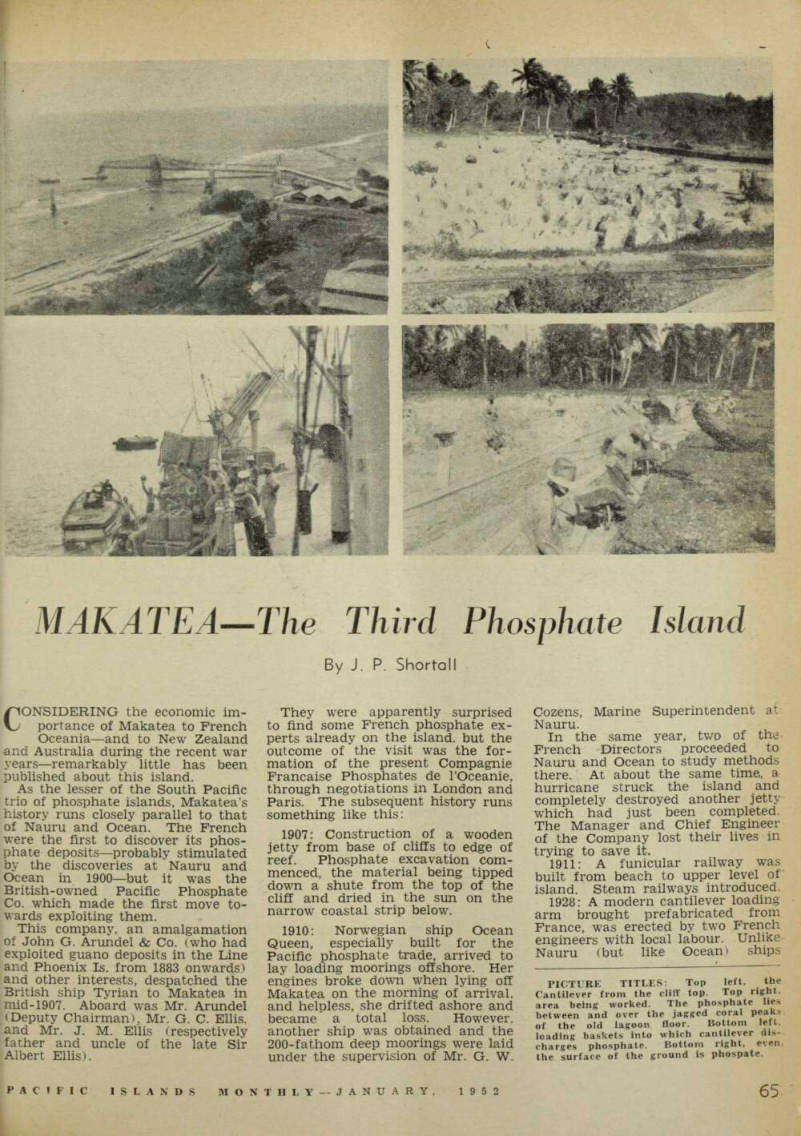
PICTURE TITLES; Top left, the Cantilever from the cliff top. Top right, area being worked. The phosphate lies between and over the jagged coral peak of the old lagoon floor. Bottom left, loading baskets into which cantilever dis charges phosphate. Bottom right, even the surface of the ground is phospate.
'cannot lie near this cantilever. Its only object is to convey the phos phate well clear of the reef-edge and surf. The basket-filled lighters lie below the end of the cantilever, their crews holding them in position with the aid of the many ropes which trail down from above.
Prior to the cantilever, all load ing of lighters had taken place from a shute at the outer end of the jetty, at the very edge of the reef. Work was impossible in all but the slightest swell.
The first Nauru cantilever came into use three years after the one at Makatea.
Makatea s output rose slowly from 120,000 tons per annum in 1926 to about 175,000 tons at Pearl Harbour Day, the Japenese taking 80 per cent, of the islands’ output. Last cargo for Japan left Makatea on the Yodogawa Maru on August 12, 1941. From then the British Phosphate Commissioners took the entire output. The Nauru cantilever had already been des troyed by German raiders in the previous December, together with much of the crushing and drying machinery, and after Nauru and Ocean Is. were occupied by the Japs in 1942, Makatea assumed a new importance, especially to N.Z., vitally dependant upon phosphate supplies for her heavily stocked fat lamb producing areas.
One of the great mysteries of the Pacific war was why no enemy action was ever taken against this most valuable and vulnerable target.
At no time did Makatea have any form of coastal defence. Certainly after December, 1942, when the Americans occupied Porapora, a patrolling Catalina circled Makatea twice each day, but up till then the island was an open and obvious target. If the machinery had been damaged it probably could not have been replaced until after the war.
Something like 798 000 tons of valuable phosphate left the island in 90 shiploads between Pearl Har bour and VJ-Day. Makatea phos phate is only 3 per cent, poorer than the Nauru-Ocean Is. product. A ton of it makes 1.8 tons of the super phosphate used by the farmer. New Zealand took most of it, and supplied the island with most of its 6,000 tons of coal required each year to operate the machinery.
With the Indo-Chinese labour source cut off, and insufficient labour offering in French Oceania, New Zealand permitted the Company to seek volunteer labour from the Cook Is. There they are keen to volunteer for a one or two-year term—in fact, so keen that those who have been given one term must stand down and give others a chance. Each year (except during the war when taken over by the French Navy) the Company’s 3-
masted schooner Oiseau des lies re turns the time-expired labour and recruits a further contingent from Rarotonga, Mangaia, Mauke or Mitiaro.
Makatea provides the Tahiti bud get with about 125 million francs each year. The annual exports are now in excess of 200.000 English tons.
ALTHOUGH loading is entirely
by ships' winches, baskets, and launch-drawn lighters, Maka tea can show the Australasian waterfront a thing or two.
Loading is frequently in excess of 200 tons per hour, and on one occasion 5,500 tons was loaded in a working day of 18 hours.
The hourly loading is posted in huge figures on the end of the can tilever so that the gangs on the ship can see them. Each time the figure exceeds 200 tons, the ship’s hooter is blown and a cheer echoes across the island. There is great friendly rivalry between the various Cook Is. gangs, each of which flies its own pennant from the British har bour master’s office during their particular shift.
Although Company officials insist that the Company is now entirely French, there obviously is a very close tie-up with the British Phos phate Commission, which has in sisted that the Harbour Masters —men experienced in the handling of the valuable deep-sea moorings, be of their choosing. Consequently the Harbour Master is always a Britisher.
The only ships capable of hand ling the deep moorings, for change and replacement, are the specially constructed BPC vessels with their powerful winch and overhanging bow. By agreement they perform this task at Makatea. Spare moor ings are kept ready on the wharf at Papeete.
MAKATEA, uninteresting in pro file, slightly humped and en circled by sheer cliffs rising in places to 150 feet lies 140 miles NE of Tahiti on the western fringes of the Tuamotu Group. It is the only island of raised coral formation in the area; its cave-pitted cliffs show the unmistakeable erosion of three distinct stages of elevation from the sea. The phosphate de posits all lie in what was clearly the ancient lagoon area, now high above sea level. The phosphate is thick with the petrified remains of the fish of this ancient lagoon, which occupies only one quarter to one third of the total land area.
In outline the island, 5 miles by 2h, is shaped somewhat like a curved sea slug—the concave side —Moumu Bay—facing north-east, into the prevailing wind. For this reason Noumu Bay was early abandoned as
a loading point, in favour of Temac on the more sheltered west coast At both these places there is £ narrow coastal lowland, with barelj room for the present crushers anc driers at Temao. Steam train; eject their contents into shutes be low the railway track at the clifl edge, directly into the crushers anc driers below. From here the phos phate is stored in silos and fed bj endless belt to the cantilever.
The small native population which shares the bounty of one franc per ton of phosphate ex ported, and 25 francs for each food tree (coconut, breadfruit, citrus) destroyed, lives mainly at the little village of Temao, or the quiet, al most abandoned old village oi Moumu. The five or six hundred employees of the Company live in and around Vaitepaua village on the upper level of the island.
As to the future, although the Company is very reluctant to dis cuss the subject, there are indica tions that probably three millior tons of easily workable deposits remain, and perhaps twice that quantity if it should be considered payable to carry out a more thor ough stripping of old areas and areas as yet unworked. The island should bt workable at present out put for at least another 20 years.
With Nauru again in production the output is once more being diverted to Japan and elsewhere, New Zealand’s and Australia’s wants being increasingly satisfied from British sources.
Mr. Ted Palmer has been officially appointed manager of BSIP Trade Scheme at Honiara. He takes over from Mr. Eric Lawson, who has be come manager of Fairymead Sugar Co., at Yandina. Mr. Palmer has been acting Manager of the Trade Scheme for some time.