Tropicalities
pp. 65-66 · Read in the full issue
l/fETICULOUSLY correct, in Lfl every detail, was the Pro gramme of the Inauguration )f the Legislative Council of Papua- Vew Guinea, compiled by the Ad ninistrator’s staff, and beautifully jroduced by the Government Printer. Every decoration was loted; every title observed.
At the saluting base at 3.15 pm, here were “His Excellency” the Administrator of the Common wealth, “His Honour” the Adminis rator of P-NG, and “The Honour ible the Minister.” And all through he six pages of programme which bllowed, “Excellency,” “Honour” md “Honourable” were scrupulously loted. Most proper and correct, of lourse, but wearisome.
The names and titles of the 29 lew Councillors filled a page. There vas not one Mister among them.
If a member could not be given a nilitary or a clerical title, he be :ame Esquire. There were 24 Ssquires.
It was singularly inconsistent on he part of the compiler to describe Doris Booth, OBE. as Mrs. while nsisting that all the Misters really vere Esquires. He should have been strong and taken the bit in his -eeth, and written “Doris R.
Booth, Esquiress, OBE.”
The compiler must have had leadaches over the three native Councillors. How were they to be entitled? In other Pacific Terri tories, leading natives are not idorned with European courtesy itles.
But in Papua-New Guinea, no ioubt, someone felt that to simply set out the native names under the sectional title of “Native Members,” vhile all the others were individu illy labelled Esquire, would be to nake the sort of distinction against vhich Government House has ’ought bitterly for years.
'So, in this impressive document, ve see “Aisoli Salin, Esq.” and ‘Simogen, Esq.” A little startling; jut, presumably, we must get used to it.
As they are Legislative Council ors, why couldn’t officialdom have called them all “Honourable” and seen done with it? Probably, be cause they really were not “Honour able” until they were sworn in. The nind of officialdom works that way.
Ship-Buying—Condomtnum
Style
LAST October reports were circu lating in Auckland that the
New Hebrides (Condominium) Government had bought a little ship there. The sale was completed —a skipper would be arriving any day to take delivery.
The vessel was the converted Fairmile La Reta, used for a time in the Cook Islands by the C.I.P.A. (Native Co-operative) but now tak ing fishing parties out into the Hauraki Gulf from Auckland.
In mid-December La Reta was still in Auckland.
The explanation: “Ah yes the French have bought the vessel —but the British have still got to buy her.
The French surveyed her and were very satisfied. But now the British have to survey her and repeat the lengthy inquiries. But some day she may get to Vila to start her new life as a general purpose Administration patrol vessel.”
We presume that the French and British skippers will take watch
and-watch.-
J.S.
Star Gazing Pay Off
YOU mightn’t believe it, in this atomic age, but some busi ness firms in Sydney pay up to 100 guineas to tame astrologers for star charts by which they con duct their businesses or so the quidnuncs say.
These commercial star-gazers in clude clothing firms, brokers, chocolate manufacturers and one soap-making outfit which, accord ing to the spokesman of a literary agency that places astrology matter, “directs its ships by the stars to pick up copra;” the firm is alleged to hold up its ships for days in Sydney if the stars are not right in their courses.
One wonders what happens if the business is carried back to its logical conclusion —the plantations —and what the labour line thinks of this magic belong master.
But interpreting the signs appears to be a highly exact science and a tame astrologer is a must if you are not to get things all balled up.
In race-course betting, for ex ample, you disregard the horses and “form” entirely but you need an astrological study of the jockeys, the owners and the ruling aspects of the day. Last Melbourne Cup day the favoured numbers were one, four and seven, the colours red, orange or cerise and the ruling
aspect was Sun-Uranus (with which are associated such things as light, heat, royalty, gases, wireless and Imagination). All a punter needed was one of these clues confirmed by another and he “couldn’t miss.”
November Story
As November came in, Suva was agog with a Story. (It usually is).
Everybody had it—Europeans in clubs; Indians in taxis, buses and shops; and Fijians everywhere.
A Fijian police sergeant, it was said, had landed £15,000 in an over seas lottery. Presumably a good many people were devising ways of getting down on part of the windfall, and because more than one earnest European was all set to offer to bank the £15,000 and hold it for the sergeant against all comers. But nobody seemed to
think of tracking down the afflu ent policeman, who was aghast at the commotion.
The plain fact was that he had received a letter stating that his ticket was duly included in a Maltese lottery. The rest was merely Suva gossip—which can do amazing things with plain facts.
s.
Deported—Almost!
THE case of Fijian George Jackson (PIM, December, page 25) re calls to a reader that another from those parts, with a well-known Fiji-Indian family-name, is at present enjoying illegal liberty in Australia.
The gentleman concerned deserted from the former LST Rawhiti at Sydney in early 1951. Duly appre hended, he spent six months in Long Bay gaol for desertion.
The normal procedure is for Australian Immigration Department officials, complete with deportation warrant, to weclome such aliens
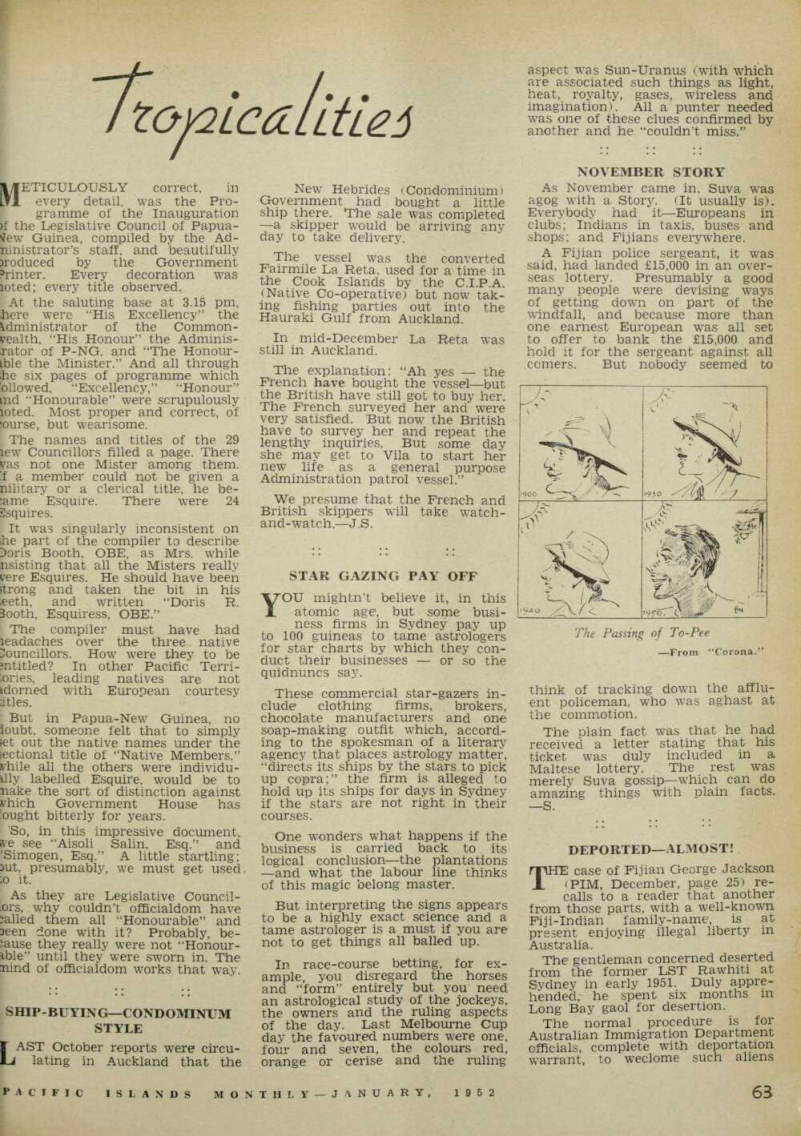
The Passing of To-Pee —From “Corona.”
back into civilian life as they step from the gaol.
But on this occasion the Immigra tion officials arrived exactly 24 hours late. Someone had got the date wrong, and the bird had flown.
The shipowner’s representative, eager to reclaim his £lOO bond on the illegal immigrant, was shocked to hear the news. But he suddenly recalled that the man from Fiji had met romance in Grafton on an earlier voyage. Perhaps he would head that way.
The Agent relates how, deciding to see the first express leave Sydney for Brisbane, he arrived at the station to find two trains due to leave at almost the same time from different platforms. He spent a busy half hour rushing from one to the other and finally, true to detective fiction, saw the wanted man rush onto the platform and leap aboard one train as it was moving out.
He could only notify the police.
First stop, Coffs Harbour—but back came word that the only slightly suspicious character aboard ap peared to be a French citizen.
The £lOO bond has still not been recovered.
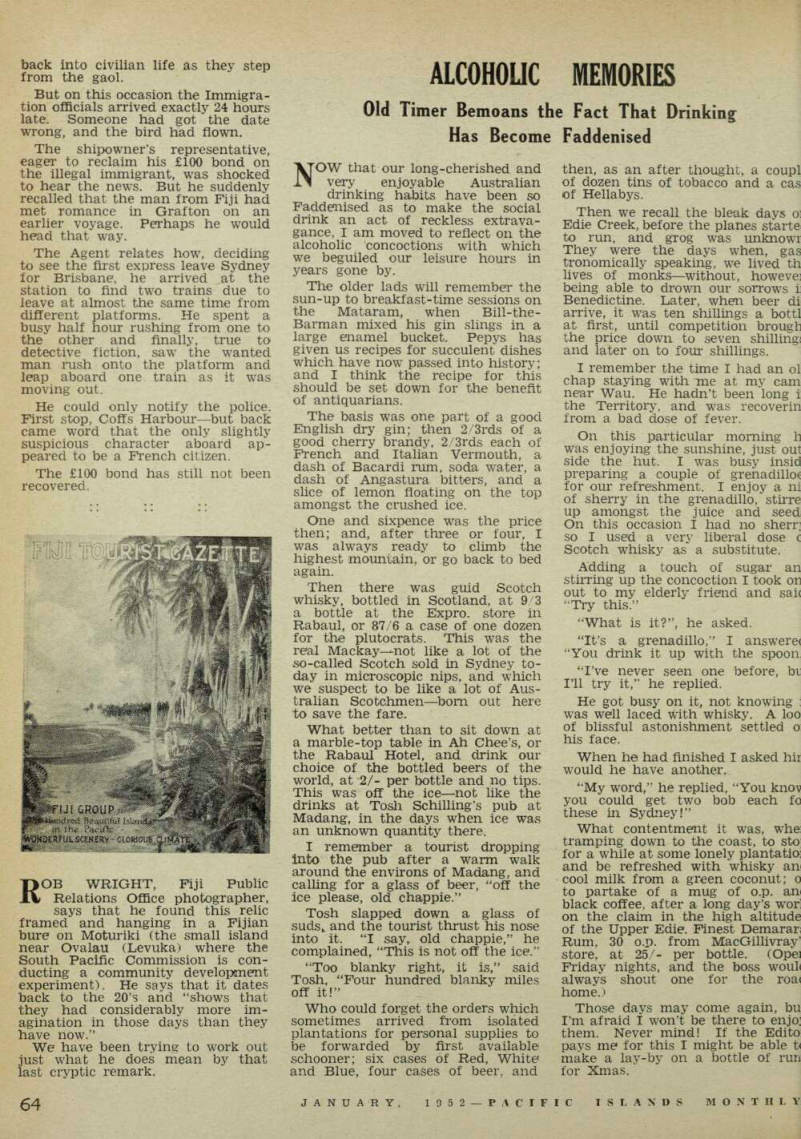
ROB WRIGHT, Fiji Public Relations Office photographer, says that he found this relic framed and hanging in a Fijian bure on Moturiki (the small island near Ovalau (Levuka) where the South Pacific Commission is con ducting a community development experiment). He says that it dates back to the 20’s arid “shows that they had considerably more im agination in those days than they have now.”
We have been trying to work out just what he does mean by that last cryptic remark.