TUSI COOKA (Cookery Book, to You)
p. 64 · Read in the full issue
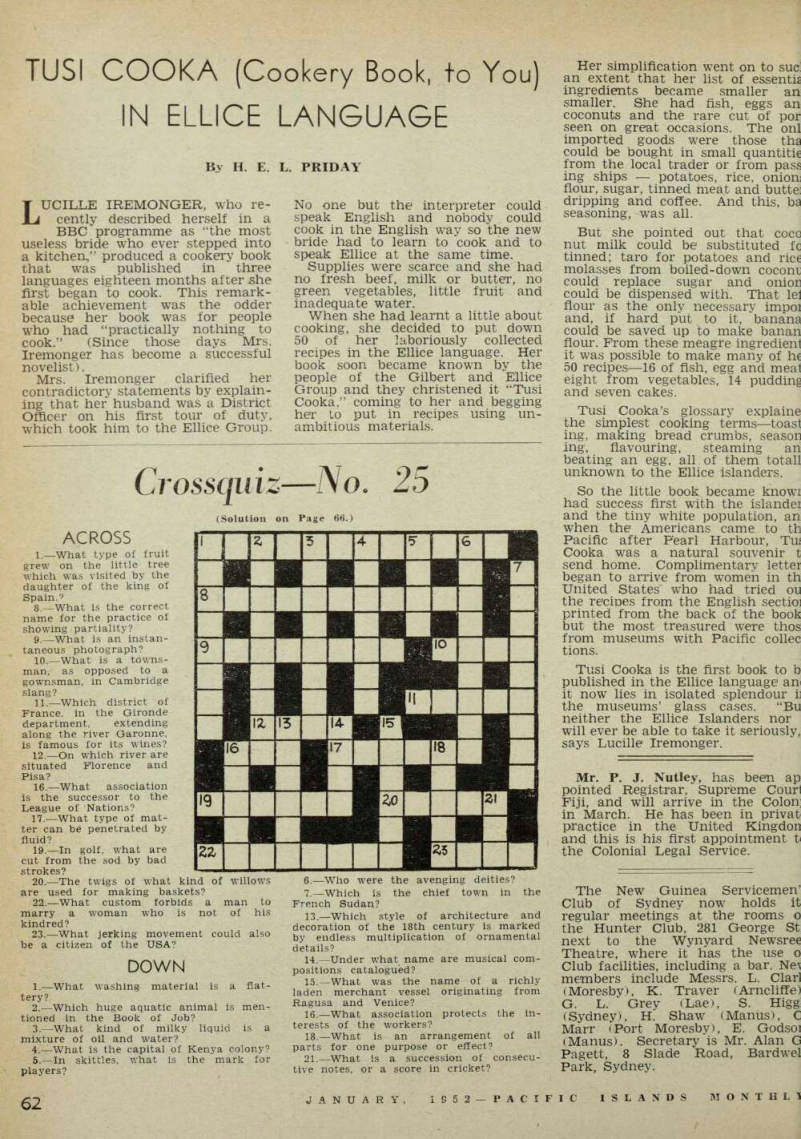
In Ellice Language
By H. E. L. Friday
Lucille Iremonger, Who Re
cently described herself in a BBC programme as “the most useless bride who ever stepped into a kitchen,” produced a cookery book that was published in three languages eighteen months after she first began to cook. This remark able achievement was the odder because her book was for people who had “practically nothing to cook.” (Since those days Mrs.
Iremonger has become a successful novelist).
Mrs. Iremonger clarified her contradictory statements by explain ing that her husband was a District Officer on his first tour of duty, which took him to the Ellice Group.
No one but the interpreter could speak English and nobody could cook in the English way so the new bride had to learn to cook and to speak Ellice at the same time.
Supplies were scarce and she had no fresh beef, milk or butter, no green vegetables, little fruit and inadequate water.
When she had learnt a little about cooking, she decided to put down 50 of her laboriously collected recipes in the Ellice language. Her book soon became known by the people of the Gilbert and Ellice Group and they christened it “Tusi Cooka,” coming to her and begging her to put in recipes using un ambitious materials.
Her simplification went on to sue! an extent that her list of essentia ingredients became smaller an smaller. She had fish, eggs an coconuts and the rare cut of por seen on great occasions. The onl imported goods were those tha could be bought in small quantitie from the local trader or from pass ing ships potatoes, rice, onion: flour, sugar, tinned meat and butte] dripping and coffee. And this, ba seasoning, was all.
But she pointed out that coco nut milk could be substituted fo tinned; taro for potatoes and rice molasses from boiled-down coconc could replace sugar and onion could be dispensed with. That lei flour as the only necessary impoi and, if hard put to it, banana could be saved up to make banan flour. From these meagre ingredient it was possible to make many of he 50 recipes—16 of fish, egg and meat eight from vegetables, 14 pudding and seven cakes.
Tusi Cooka’s glossary explaine the simplest cooking terms —toast ing, making bread crumbs, season ing, flavouring, steaming an beating an egg, all of them totall unknown to the Ellice islanders.
So the little book became knowi had success first with the islander and the tiny white population, an when the Americans came to th Pacific after Pearl Harbour, Tus Cooka was a natural souvenir t send home. Complimentary letter began to arrive from women in th United States who had tried ou the redoes from the English sectioi printed from the back of the book but the most treasured were thos from museums with Pacific collec tions.
Tusi Cooka is the first book to b published in the Ellice language an it now lies in isolated splendour i] the museums’ glass cases. “Bu neither the Ellice Islanders nor will ever be able to take it seriously, says Lucille Iremonger.
Mr. P. J. Nutley, has been ap pointed Registrar, Supreme Court Fiji, and will arrive in the Colon; in March. He has been in privat practice in the United Kingdon and this is his first appointment U the Colonial Legal Service.
The New Guinea Servicemen’
Club of Sydney now holds it regular meetings at the rooms o the Hunter Club, 281 George St next to the Wynyard Newsree Theatre, where it has the use o Club facilities, including a bar. Ne\ members include Messrs. L. Clarl (Moresby), K. Traver (Arncliffe) G. L. Grey (Lae), S. Higg (Sydney), H. Shaw (Manus), C Marr (Port Moresby), E. Godsoi (Manus). Secretary is Mr. Alan G Pagett, 8 Slade Road, Bardwel Park, Sydney.