MOF Sugar Price
p. 22 · Read in the full issue
Now Close To World Parity £38/10/-Stg Per Ton In 1952
npHE United Kingdom Ministry of X Food has agreed to an increase of £5/12/6 Stg. on the price per ton of sugar bought from Empire countries under the Sugar Agreement. The new price will be £3B TO/- Stg., c.i.f., UK. (It is pointed out that this is not a true c.i.f. price as under the Agreement the purchaser nays part of the freight).
The Empire countries covered by the agreement are Australia, British West Indies, British Honduras, East Africa, Fiji, Mauritius and South Africa. Each has been given a quota
which the MOF will buy at the fixed price (the price revised each year, in November), plus an additional tonnage which the producing country may sell at world market price. Fiji’s fixed price quota is 125,000 tons. They
may sell an additional 45,000 tons to UK or Canada at world prices.
This year’s agreement price is little less than world price. Cuban raw sugar is being sold at from £45 to £5O Australian, f.a.s. Cuban ports.
If British copra producers were faring as well as sugar producers from the MOF they would be happy.
Fiji cane farmers will share in the bigger price. A clause in their agreement with the CSR Company provides that the price of cane will rise in certain proportion to any rise in the price of sugar.
When, in 1951, the price of sugar rose by £2/7/6 Stg., Fiji cane growlers benefitted by about 10/per ton for their cane, bringing the price to something like 47/- Fijian, a ton.
Fiji mills because of adverse weather conditions during the cane growing period are expected to produce only about 110,000 tons this season well below the exportable limit.
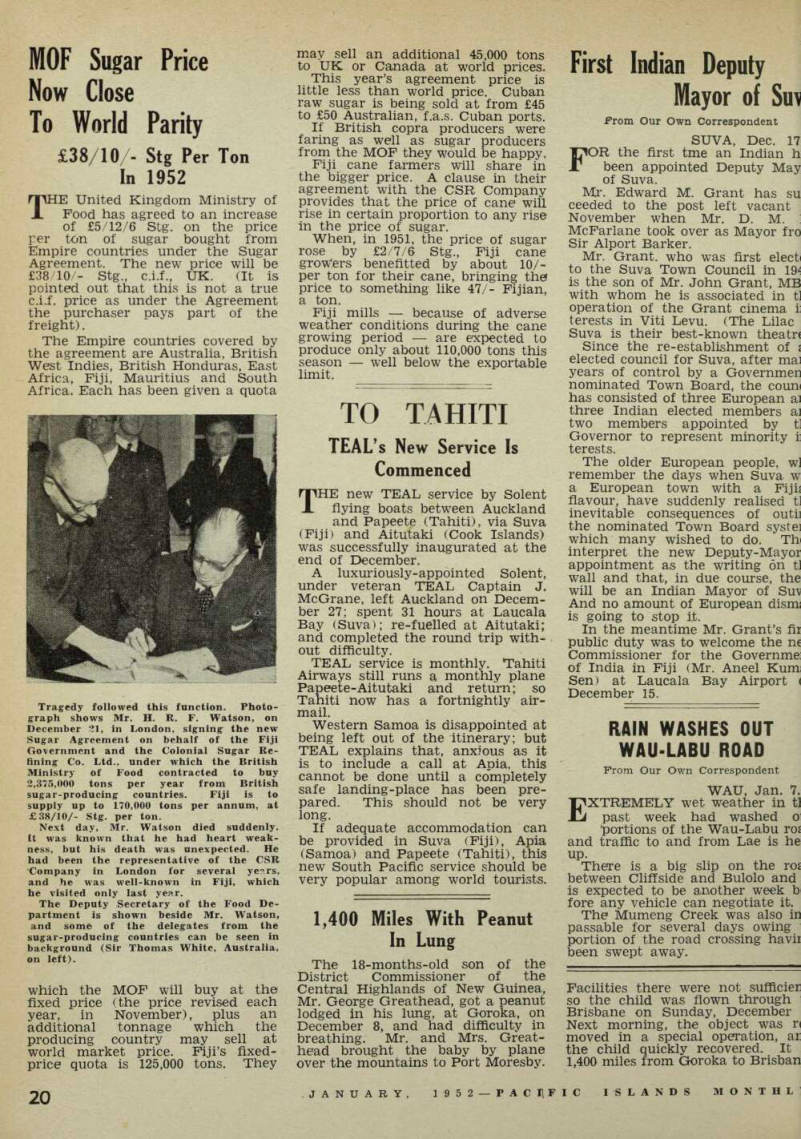
Tragedy followed this function. Photo graph shows Mr. H. R. F. Watson, on December 21, in London, signing the new Sugar Agreement on behalf of the Fiji Government and the Colonial Sugar Re fining Co. Ltd., under which the British Ministry of Food contracted to buy 2,375,000 tons per year from British sugar-producing countries. Fiji is to supply up to 170,000 tons per annum, at £38/10/- Stg. per ton.
Next day, Mr. Watson died suddenly.
It was known that he had heart weak ness, but his death was unexpected. He had been the representative of the CSR Company in London for several ye[?]rs, and he was well-known in Fiji, which he visited only last year.
The Deputy Secretary of the Food De partment is shown beside Mr. Watson, and some of the delegates from the sugar-producing countries can be seen in background (Sir Thomas White, Australia, on left).