Hurricane In N. Hebrides
p. 21 · Read in the full issue
Kills Over 100
From Our Own Correspondent
Noumea, Jan. 4.
ONE of the worst hurricanes ever recorded in this part of the world swept across the South east New Hebrides (Epi, Ambrym— vhich already had been devastated >y a volcanic eruption—and part of Malekula) on Christmas Day. It filled over 100 people and destroyed ill plantations and villages in its jath. Six small vessels were sunk, md three have disappeared, believed ost.
Both Santo and Vila weather stations, on December 24, gave naming of a hurricane. But iiese islands are accustomed to leavy blows at this period, and little lotice was taken.
Many boats were at sea at the ;ime, returning to their respective Blands the natives who wished to be n their villages for Christmas and ;he New Year.
On Tuesday, 25th, however, the lurricane went to the west and icross Epi, while showing a far nore rapid movement. In the ifternoon the wind began blowing it more than 100 mph.
Three boats remained at sea: the Pangona, Sainte-Therese, and a cutter belonging to some Indo chinese. None of them has yet >een found, and they are believed ost.
The Pangona was a 50-tons notor-ship owned by a Mr. Ohlen, nd commanded by Mr. Keromene, a European. There was one other European, Mr. Benebig, and a half caste Japanese, Tagawa, and 10 or L 5 natives in the ship.
It also has been reported that the Southern Cross, belonging to the 3DA Mission, sank at Port-Sand irich, Malekula.
Five other small vessels officially considered lost—sunk during the lurricane —include the Showa, ves sels owned by Messrs. Desgranges md Leroi, and one owned by the fcev. C. K. Crump, Presbyterian mis sionary at Mahe.
New Zealand aircraft based on Fiji joined many ships from Vila md Santo in a wide search for the missing vessels.
Over the islands, enormous iamage was caused to several plan tations, mostly at Ambrym, Epi and Malekula. Santo and Efate escaped damage. The productivity of the plantations is finished for many years.
At Epi, a landslide killed 49 latives who had just been evacuated from Ambrym, where it is now almost impossible to live because of the thick pumice mud from the newly-active volcano.
More natives have been killed by falling debris. Huts were carried away by the sea, and by the
enormous rivers of mud which de veloped in a few hours.
Government figures indicate that there are over 100 people killed and it is believed the death roll is 150, mostly natives.
Damage has not yet been esti mated.
At Cragove Catholic Mission, Epi, the church was flattened as well as the Mission house.
Early on Friday, December 28, after brief news of the disaster had reached Vila, the Condominium authorities sent key Government personnel to the devastated areas, to organise relief.
Major D. Fregard, British District Agent at Santo, left for the south on Mr. Oliver Stevens’ launch, Karachi, to inspect and report.
News reached Noumea on January 4 that utter devastation reigns over the whole area of Ambrym, Epi and the south eastern part of Malekula.
Nothing has been heard of Pente cost. Forests and villages have been swept away, leaving only a waste land of debris strewn with bodies.
Both Residents have cabled to their Governments. The deputy for New Caledonia and the New Heb rides has answered from Paris that he has asked the Metropolitan Gov ernment to take special measures as soon as possible.
Southern Cross
Although the report was persis tent that the well-known mission vessel Southern Cross had been
sunk in the New Hebrides by the hurricane, there was no confirma tion in Sydney up to January 9.
The explanation seems to be that a small vessel with a name like Southern Cross was lost; and, as the mission ship was in that area about that time, a wrong report was circulated.
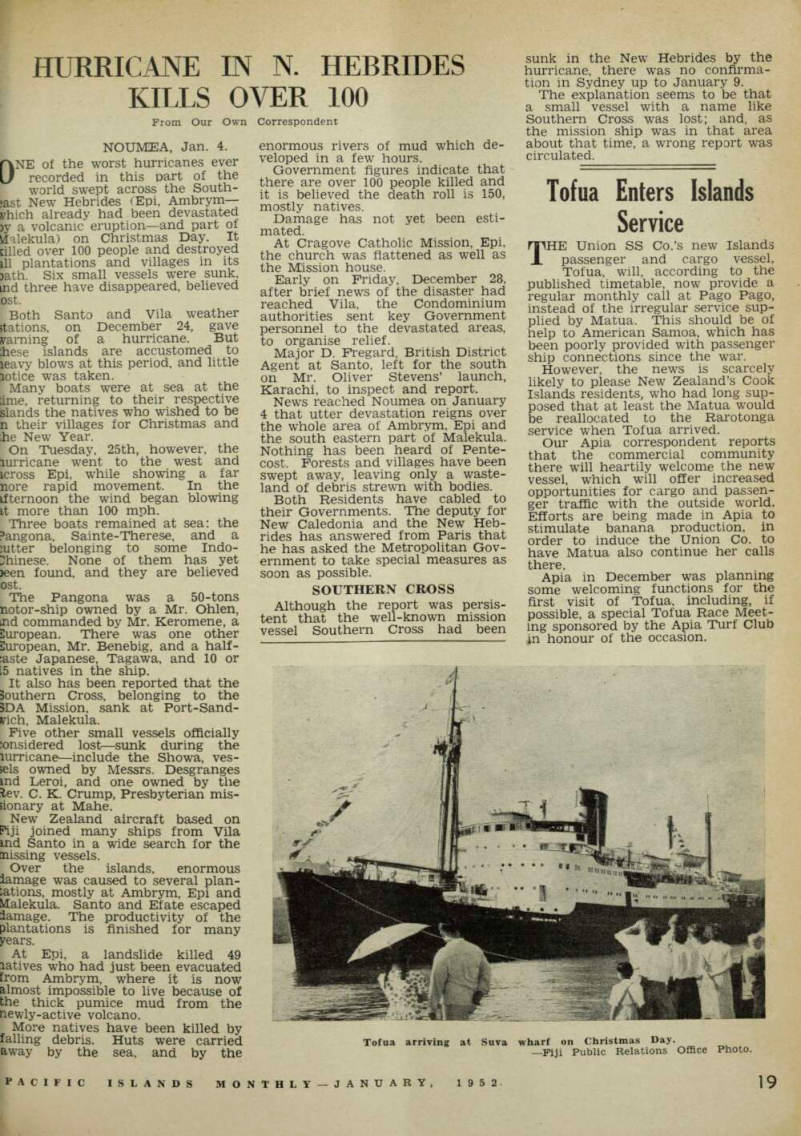
Tofua arriving at Suva wharf on Christmas Day. —Fiji Public Relations Office Photo.