Copra Rates
p. 18 · Read in the full issue
Canberra, Jan. 15.
OFFICIALLY announced that MOF copra contract readjust ment has been brought for ward two months, and will operate from January 1, 1952. The price goes up 10 per cent., plus 10 - re adjustment (making £6 Stg.)—from £53/15/- Stg. to £59/15/- Stg., Terri tory ports (equal to about £75 Aust.). P-NG Copra Board, after making usual deductions, will pay, for FMS copra, Territory ports, £63/10/- Aust. —plus £1 for hot-air dried or less 12/6 for smoke-dried.
This is about £7/10/- per ton for hot-air better than 1951; but about £3O Aust. per ton less than the free world market price.
The new Fiji price for top grade is £59/5/6 (see last page of this issue) which is equal to £66/13/6 Australian.
Meanwhile, it is interesting to note that the price of copra, as quoted in London on December 14 (by the Bank of NZ circular) was; Straits —£BB Stg. cif European port (having advanced from £94 early in October to £lO4, and then declined). Equal to about £lOB Australian.
Philippines. —l9s US dollars, cif.
Eaual to about £B5, Australian.
Even more interesting was the report that fairly
large parcels of East Indies copra are now being sold to West European ports at prices slightly under Straits rates. East Indies, owing to political troubles, have been slow in returning to copra export. Before the war, they were, next to the Philippines, the world’s biggest producer of copra.
The Mof
Contract
It is plain, from these reports, that Papua - New Guinea, Solomons, Fiji and Western Samoa, which bound themselves to the British Ministry of Food under a 9-years contract from the beginning of 1949, have been and are still receiving for their copra be
ween £2O and £3O Aust. per ton lea than the world market rates.
This is because the MOF contrac was made in Sterling and, late ir 1949, the British Socialist Govern' ment resorted to the device of valuing Sterling by about 30 pe: cent, in relation to the US dollar Although copra has an Internationa value, the MOF contract was no adjusted to the new value o Sterling. Ever since then, th< South Pacific planters have beer paid in Sterling, although then copra became, in basic value, wort! 30 per cent. more.
For the past two years, oui copra planters have been crying oui against this iniquitous contract but, because they cannot be inducec to unite, their protests have beer ignored.
A simple calculation shows that if they are losing only £2O per ton and their total production is 100,00( tons per annum, the coconul growers of Papua-New Guinea, Fiji Solomons and Samoa are each yeai making the British MOF a present of at least £2,000,000.
Why do the planters of all foul Territories not set up a central com mittee to hammer away against the devalued-£ side of this MOF con tract, until they get some conces sion? A revision equal to only £IC per ton would represent a substan tial gain to them.
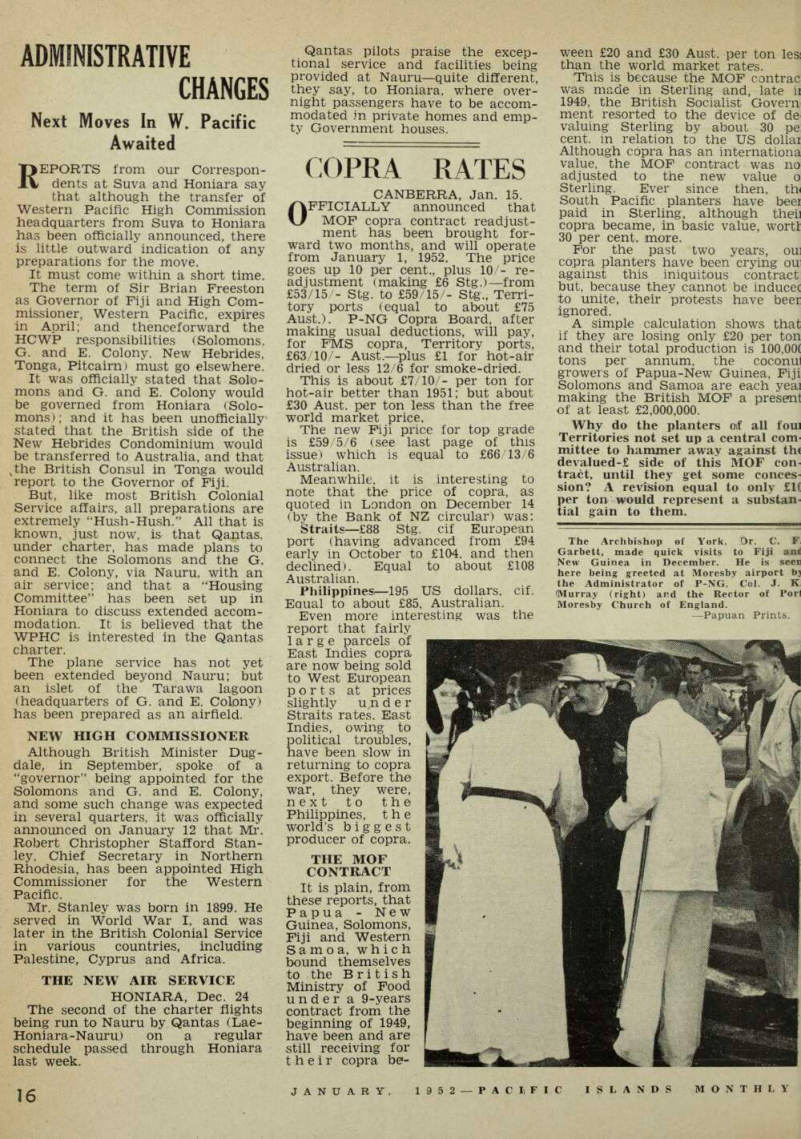
The Archbishop of York, Dr. C. F.
Garbett, made quick visits to Fiji and New Guinea in December. He is seen here being greeted at Moresby airport bj the Administrator of P-NG. Col. J. K.
Murray (right) and the Rector of Port Moresby Church of England.
Papuan Prints.