Around and About
pp. 66-69 · Read in the full issue
Written from Fiji in October by Judy Tudor.
ALTHOUGH the rubber planta tions of Mr. J. P. Bayly, beside the road somewhere between Navua and Sigatoka lie neglected, he has started a couple of saw mills in the same district.
The sawmills are sawing timber for banana cases and are therefore performing a useful service.
Samoa, on the other hand, im ports all its case timber and a banana case there, I am told, costs something like 7/- now.
The Bayly rubber trees were tapped during the war years, but not since, which is surprising when one reflects on the high price rubber has been bringing in recent years.
The trees which look old and ne glected, cover a good many acres near the main road.
Mr. And Mrs. Monk Who,
until a couple of years ago, owned the Sigatoka Hotel, now live about . five miles away down the road to Suva in a house surrounded by about two acres of gardens and trees—including some coconuts.
In the backyard is an erection which is called a vata in these parts—a sort of table used for dry ing copra.
Mrs. Monk —prefacing her con fession by saying that Heavens, it's worth over £SO per ton these days— admits that she does a bit of copra making in her spare time. Apart from nuts from her own trees she buys nuts from a neighbour at 10/a hundred.
SOMEWHERE close to Lautoka an Indian has a concession for working manganese. Appar ently this appears as a brown, rocky outcrop. The owner of the conces sion simply breaks it up, packs it in drums and sends it to Australia.
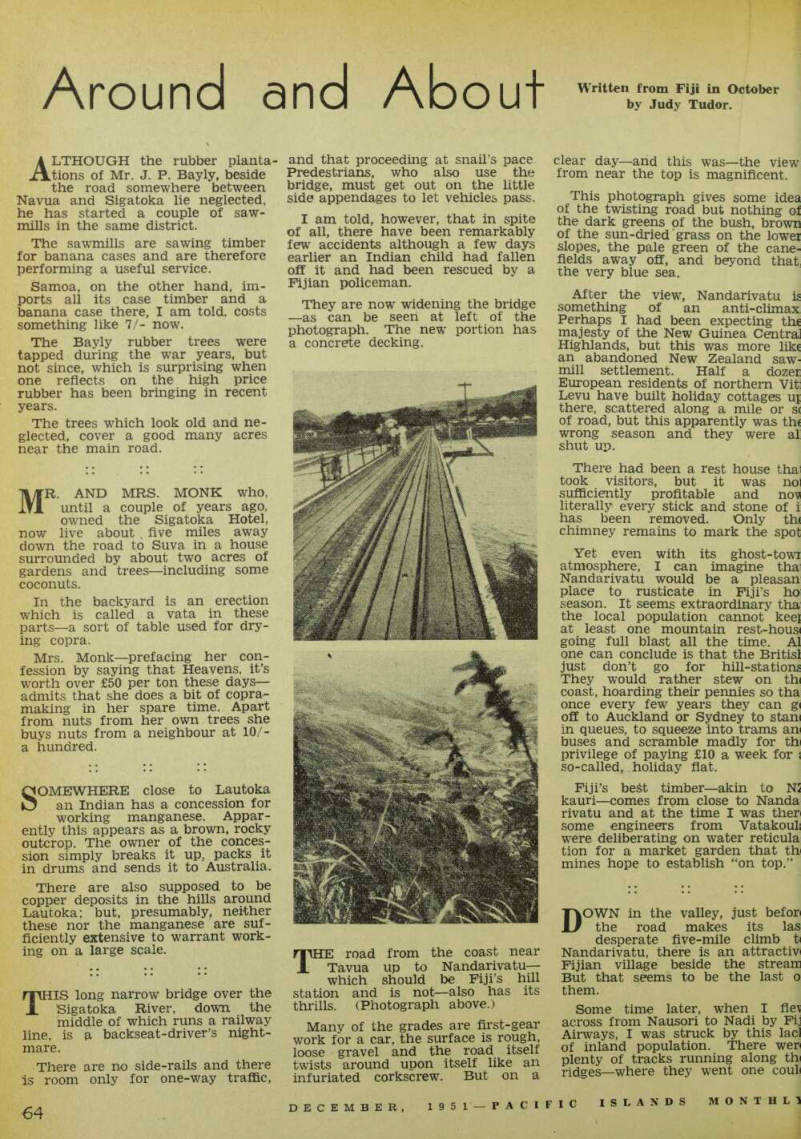
There are also supposed to be copper deposits in the hills around Lautoka; but, presumably, neither these nor the manganese are suf ficiently extensive to warrant work ing on a large scale. rIS long narrow bridge over the ’Sigatoka River, down the middle of which runs a railway line, is a backseat-driver’s night mare.
There are no side-rails and there is room only for one-way traffic,
and that proceeding at snail’s pace Predestrians, who also use the bridge, must get out on the little side appendages to let vehicles pass.
I am told, however, that in spite of all, there have been remarkably few accidents although a few days earlier an Indian child had fallen off it and had been rescued by a Fijian policeman.
They are now widening the bridge —as can be seen at left of the photograph. The new portion has a concrete decking.
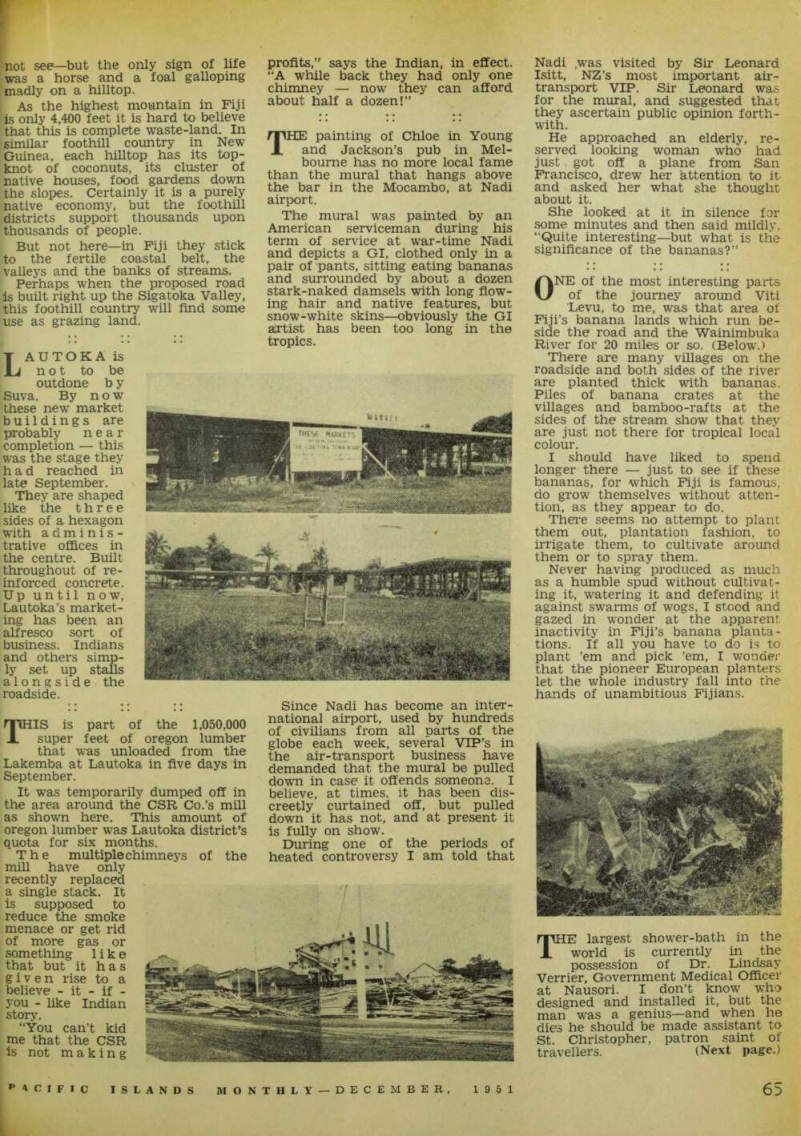
THE road from the coast near Tavua up to Nandarivatu— which should be Fiji’s hill station and is not—also has its thrills. (Photograph above.) Many of the grades are first-gear work for a car, the surface is rough, loose gravel and the road itself twists around upon itself like an infuriated corkscrew. But on a
clear day—and this was—the view from near the top is magnificent.
This photograph gives some idea of the twisting road but nothing of the dark greens of the bush, brown of the sun-dried grass on the lower slopes, the pale green of the cane fields away off, and beyond that, the very blue sea.
After the view, Nandarivatu is something of an anti-climax.
Perhaps I had been expecting the majesty of the New Guinea Central Highlands, but this was more like an abandoned New Zealand saw mill settlement. Half a dozer European residents of northern Viti Levu have built holiday cottages up there, scattered along a mile or s( of road, but this apparently was the wrong season and they were al] shut up.
There had been a rest house that took visitors, but it was no! sufficiently profitable and nov literally every stick and stone of i has been removed. Only the chimney remains to mark the spot Yet even with its ghost-towr atmosphere, I can imagine thal Nandarivatu would be a pleasam place to rusticate in Fiji’s hd season. It seems extraordinary thai the local population cannot keei at least one mountain rest-house going full blast all the time. Al one can conclude is that the Britisl just don’t go for hill-stations They would rather stew on the coast, hoarding their pennies so tha once every few years they can ge off to Auckland or Sydney to stane in queues, to squeeze into trams an< buses and scramble madly for the privilege of paying £lO a week for i so-called, holiday fiat.
Fiji’s be6t timber —akin to N 5 kauri—comes from close to Nanda rivatu and at the time I was then some engineers from Vatakouls were deliberating on water reticula tion for a market garden that tin mines hope to establish “on top.”
DOWN in the valley, just befon the road makes its las desperate five-mile climb t< Nandarivatu, there is an attractive Fijian village beside the stream But that seems to be the last o them.
Some time later, when I flev across from Nausori to Nadi by Fij Airways, I was struck by this lad of inland population. There wen plenty of tracks running along the ridges—where they went one coul<
not see—but the only sign of life was a horse and a foal galloping madly on a hilltop.
As the highest mountain in Fiji is only 4,400 feet it is hard to believe that this is complete waste-land. In similar foothill country in New Guinea, each hilltop has its top knot of coconuts, its cluster of native houses, food gardens down the slopes. Certainly it is a purely native economy, but the foothill districts support thousands upon thousands of people.
But not here —in Fiji they stick to the fertile coastal belt, the valleys and the banks of streams.
Perhaps when the proposed road is built right up the Sigatoka Valley, this foothill country will find some use as grazing land.
Lautoka Is
not to be outdone b y Suva. By now these new market buildings are probably near completion this was the stage they had reached in late September.
They are shaped like the three sides of a hexagon with adminis trative offices in the centre. Built throughout of re inforced concrete.
Up until now, Lautoka’s market ing has been an alfresco sort of business. Indians and others simp ly set up stalls alongside the roadside.
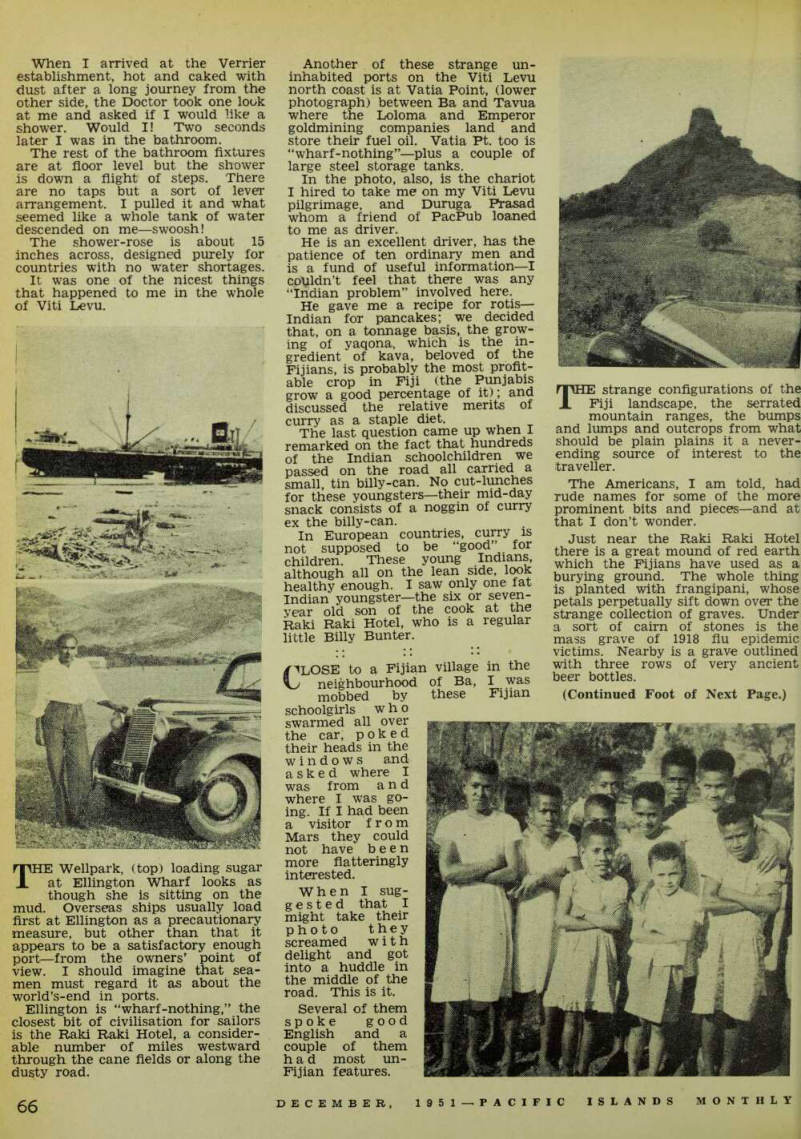
rpHIS is part of the 1,050,000 JL super feet of Oregon lumber that was unloaded from the Lakemba at Lautoka in five days in September.
It was temporarily dumped off in the area around the CSR Co.’s mill as shown here. This amount of Oregon lumber was Lautoka district’s quota for six months.
The multiple chimneys of the
mill have only recently replaced a single stack. It is supposed to reduce the smoke menace or get rid of more gas or something like that but it has given rise to a believe - it - if you - like Indian story.
“You can’t kid me that the CSR is not making
profits,” says the Indian, in effect.
“A while back they had only one chimney now they can afford about half a dozen!” riIHE painting of Chloe in Young A and Jackson’s pub in Mel bourne has no more local fame than the mural that hangs above the bar in the Mocambo, at Nadi airport.
The mural was painted by an American serviceman during his term of service at war-time Nadi and depicts a GI, clothed only in a pair of pants, sitting eating bananas and surrounded by about a dozen stark-naked damsels with long flow ing hair and native features, but snow-white skins—obviously the GI alrtist has been too long in the tropics.
Since Nadi has become an inter national airport, used by hundreds of civilians from all parts of the globe each week, several VlP’s in the air-transport business have demanded that the mural be pulled down in case it offends someone. I believe, at times, it has been dis creetly curtained off, but pulled down it has not, and at present it is fully on show.
During one of the periods of heated controversy I am told that
Nadi ,was visited by Sir Leonard Isitt, NZ’s most important air transport VIP. Sir Leonard was for the mural, and suggested that they ascertain public opinion forth with.
He approached an elderly, re served looking woman who had just got off a plane from San Francisco, drew her attention to it and asked her what she thought about it.
She looked at it in silence for some minutes and then said mildly.
“Quite interesting—but what is the significance of the bananas?”
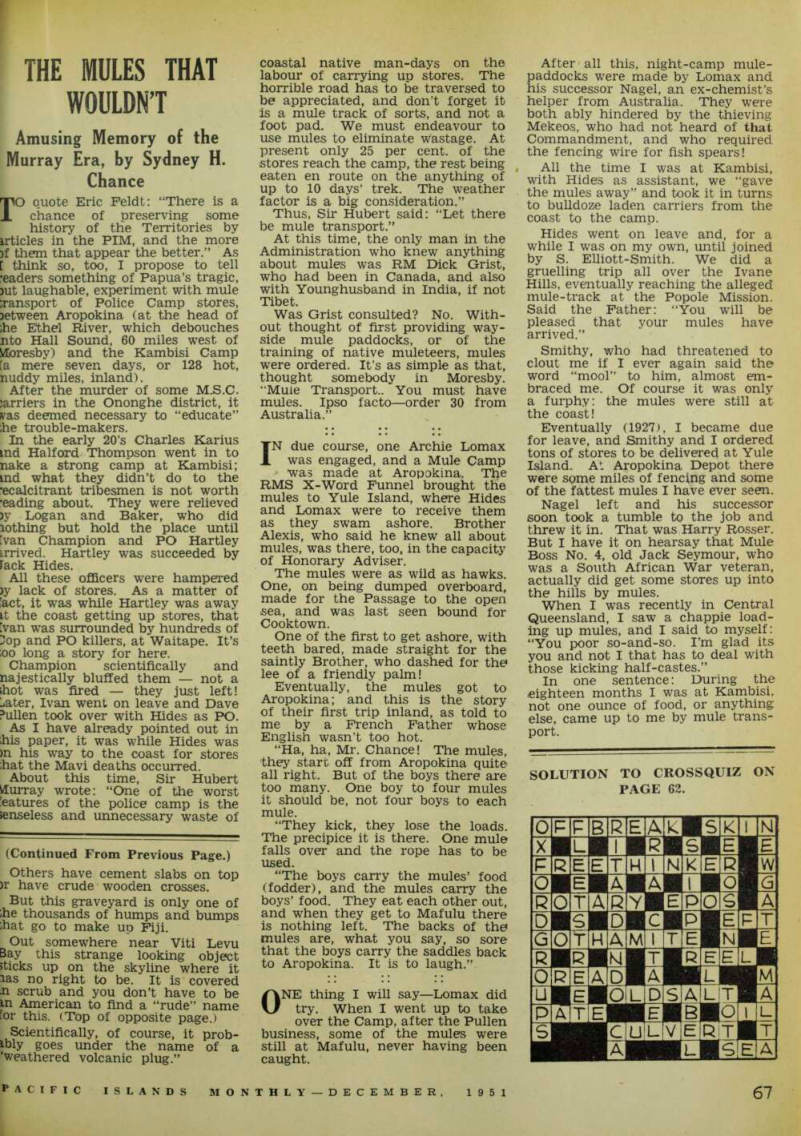
ONE of the most interesting parts of the journey around Viti Levu, to me, was that area of Fiji’s banana lands which run be side the road and the Wainimbuka River for 20 miles or so. (Below.) There are many villages on the roadside and both sides of the river are planted thick with bananas.
Piles of banana crates at the villages and bamboo-rafts at the sides of the stream show that they are just not there for tropical local colour.
I should have liked to spend longer there just to see if these bananas, for which Fiji is famous, do grow themselves without atten tion, as they appear to do.
There seems no attempt to plant them out, plantation fashion, to irrigate them, to cultivate around them or to spray them.
Never having produced as much as a humble spud without cultivat ing it, watering it and defending it against swarms of wogs, I stood and gazed in wonder at the apparent inactivity in Fiji’s banana planta tions. If all you have to do is to plant ’em and pick ’em, I wonder that the pioneer European planters let the whole industry fall into the hands of unambitious Fijians.
fTIHE largest shower-bath in the X world is currently in the possession of Dr. Lindsay Verrier, Government Medical Officer at Nausori. I don’t know who designed and installed it, but the man was a genius—and when he dies he should be made assistant to St. Christopher, patron saint of travellers. (Next page.)
When I arrived at the Verrier establishment, hot and caked with dust after a long journey from the other side, the Doctor took one look at me and asked if I would like a shower. Would I! Two seconds later I was in the bathroom.
The rest of the bathroom fixtures are at floor level but the shower Is down a flight of steps. There are no taps but a sort of lever arrangement. I pulled it and what seemed like a whole tank of water descended on me—swoosh!
The shower-rose is about 15 inches across, designed purely for countries with no water shortages.
It was one of the nicest things that happened to me in the whole of Viti Levu.
mHE Wellpark, (top) loading sugar X at Ellington Wharf looks as though she is sitting on the mud. Overseas ships usually load first at Ellington as a precautionary measure, but other than that it appears to be a satisfactory enough port—from the owners’ point of view. I should imagine that sea men must regard it as about the world’s-end in ports.
Ellington is “wharf-nothing,” the closest bit of civilisation for sailors is the Raki Raki Hotel, a consider able number of miles westward through the cane fields or along the dusty road.
Another of these strange un inhabited ports on the Viti Levu north coast is at Vatia Point, (lower photograph) between Ba and Tavua where the Loloma and Emperor goldmining companies land and store their fuel oil. Vatia Pt. too is “wharf-nothing”—plus a couple of large steel storage tanks.
In the photo, also, is the chariot I hired to take me on my Viti Levu pilgrimage, and Duruga Prasad whom a friend of PacPub loaned to me as driver.
He is an excellent driver, has the patience of ten ordinary men and is a fund of useful information—l couldn’t feel that there was any “Indian problem” involved here.
He gave me a recipe for rotis — Indian for pancakes; we decided that, on a tonnage basis, the grow ing of yaqona, which is the in gredient of kava, beloved of the Fijians, is probably the most profit able crop in Fiji (the Punjabis grow a good percentage of it); and discussed the relative merits of curry as a staple diet.
The last question came up when I remarked on the fact that hundreds of the Indian schoolchildren we passed on the road all carried a small, tin billy-can. No cut-lunches for these youngsters—their mid-day snack consists of a noggin of curry ex the billy-can.
In European countries, curry is not supposed to be “good” for children. These young Indians, although all on the lean side, look healthy enough. I saw only one fat Indian youngster—the six or seven year old son of the cook at the Raki Raki Hotel, who is a regular little Billy Bunter. to a Fijian village in the j neighbourhood of Ba, I was mobbed by these Fijian
schoolgirls who swarmed all over the car, poked their heads in the windows and asked where I was from and where I was go ing. If I had been a visitor from Mars they could not have been more flatteringly interested.
When I sug ges t e d that I might take their photo they screamed with delight and got into a huddle in the middle of the road. This is it.
Several of them spoke good English and a couple of them had most un- Fijian features.
mHE strange configurations of the JL Fiji landscape, the serrated mountain ranges, the bumps and lumps and outcrops from what should be plain plains it a never ending source of interest to the traveller.
The Americans, I am told, had rude names for some of the more prominent bits and pieces—and at that I don’t wonder.
Just near the Raki Raki Hotel there is a great mound of red earth which the Fijians have used as a burying ground. The whole thing is planted with frangipani, whose petals perpetually sift down over the strange collection of graves. Under a sort of cairn of stones is the mass grave of 1918 flu epidemic victims. Nearby is a grave outlined with three rows of very ancient beer bottles.
(Continued Foot of Next Page.)
(Continued From Previous Page.) Others have cement slabs on top >r have crude wooden crosses.
But this graveyard is only one of he thousands of humps and bumps hat go to make up Fiji.
Out somewhere near Viti Levu 3ay this strange looking object sticks up on the skyline where it las no right to be. It is covered n scrub and you don’t have to be m American to find a “rude” name or this. (Top of opposite page.) Scientifically, of course, it prob ably goes under the name of a ‘weathered volcanic plug.”