Papua-New Guinea
pp. 119-122 · Read in the full issue

Events
Peanuts : A Possible New Crop
Prom Our Own Correspondent
Port Moresby, Oct. 31.
A NOTHER profitable line of nL primary production has been demonstrated by a sample hipment of seven bags of peanuts ;rown on the Agricultural Station n the Mekeo area of Papua.
Although this sample was soil tamed, the brokers who handled he consignment in Australia said hey would be prepared to offer 1/6 >er pound, in the kernel, for com mercial shipments.
Peanuts were grown in the Terri ory before the war, but at a price JfK P er P° un d they were not •rofitable, and the industry was ever developed. Now there is a een demand throughout the world or peanuts, and at 1/6 per pound, i Australia, they could mean a seful form of new production for
he Territory.
The sample consignment was of 16 Virginia Bunch variety; but ie a S ric ultural officials recom- S^ nl i h Red ty P e as most ntable for the Sydney market. The apartment of Agriculture at Port
Moresby can supply some seed of this variety, and other stocks are available in Australia.
Peanuts grow well in practically any type of soil, although the best results are obtained from rich alluvial areas.
This crop, which involves no clearance of big areas of land, like rubber or copra, looks like a pro
position for the smaller man with limited capital.
More Australian
Hardwood
The topsy-turvy economy of this Territory was again in evidence in October, with the delivery of a million super feet of Australian hardwood by the vessel Hewsang.
There is urgent need for speeding up development of the Territory’s hardwood timber resources. This consignment represents only about six months’ requirements for Works and Housing Department.
However, between 300,000 and 500,000 suuer feet of Bulolo Valley pine were loaded at Lae to re-
complete the ship’s full cargo. This, with the remaining half-million of Australian hardwood, went to Manus for the big public works programme in that area. The three firms which supplied the Bulolo pine were the Bulolo Gold Dredging Co., New Guinea Goldfields Ltd., and Gold and Power Ltd.
Missing Out On Tourist
Publicity
Within the next few monthsr movie audiences overseas will bee watching two outstanding coloimx films of the Territory. One has beenj taken by the Fox Movietone people! on behalf of Qantas Empire Air-i ways, and the other by the Danishfi Galathea scientific expedition.
The Qantas film was made bye Mr. Sydney Wood, who has made! so many trips to the Islands thatc he is almost'a Territorian. The joWc took about three months, and her used a new type of colour filrm which has produced outstanding! results.
This film is to be screened on s world distribution basis, and em-n phasises the important part playecs by air transport in the Territory^ The second film, for the Galathesa records, will be shown extensively throughout Denmark, and will gog to other European countries anor Britain and America on an exx change system.
Mr. Peter Rasmussen, one of thirl Galathea photographers, says thd Central Highland films taken b:d the unit will be a sensation ini Europe. Although the expedition has visited many countries on itfi voyages during the past twelw months, including Africa and Indisi and has taken thousands of of film, the photographers say thaej nothing in their records so far cars
uch the Central Highland aterial they have secured.
With all this first-class publicity iroad, it is regrettable that the sential “bread and butter” jobs the Administration have so far ecluded any possibility of capital ng on the tourist possibilities of e Territory.
An organised tourist traffic could ormously help the Territory’s lances.
Accommodation and allied prob ns make tourist trade impossible the Territory at its present stage, it these difficulties could be over me if handled by experts. It is arly a job for private enterprise, irking with Administration co eration.
The Islands Regiment
Che first Commanding Officer of i Pacific Islands Regiment is sut.-Col. H. L. Babin, who took duty at the P.I.R. Taurama mp early in October, Colonel 3in knows the tough side of iitary service, as he was with the . Division in Malaya, and spent years in Japanese prison camps. :er he went to Japan with the stralian forces.
’Cb’S Shipping Troubles
’he Production Control Board orded both gain and loss on its pping activities in October. To nd out the record, it collected unwelcome tag-end of Sydney’s :erfront troubles, by having the 'ra tied up. (See article else sre.) larly in October, the 300-tonner tika managed to park herself on eef in Kimbe Bay, on the north st of New Britain; but got off larently undamaged. She con aed on to Witu to load copra.
J rescue job was done by the -tonner Tarra, with P.C.B. :ine experts aboard. [eanwhile the hull of the ill id Kelanoa is still perched on a pie of coral niggerheads on the >t of New Ireland. Since it went Dund in May it has been stripped mgines and fittings, and finally Board has called tenders for itever is left. othing much has been made lie as to why this ship went Dund, and the back-room boys e had several opinions on the stion of calling in a ship-salvag company to refloat her. But laps one of the big difficulties to get a salvage comnany to ler about such small fry. With lent-day costs, a refloated moa might have involved more mditure than she was worth, n the credit side was the re i of the 300-tonner Kelaua to ice after about two years await repairs. The Kelaua got itself med on a reef near Madang, was finallv towed to Rabaul, re she remained for nearly two ‘s. When PCB took over coastal >pmg, it was towed to Manus,
where the Navy then discovered it had no suitable slipway. There was another long tow to the Steamships
slip at Port Moresby; and at long last Kelaua is back on the coastal runs out of Rabaul.
This ship, with Tarra, will help considerably to overcome some of the shipping problems in that area.
They have a margin of gain over the loss of the Kelanoa.
World War Ii Memorial
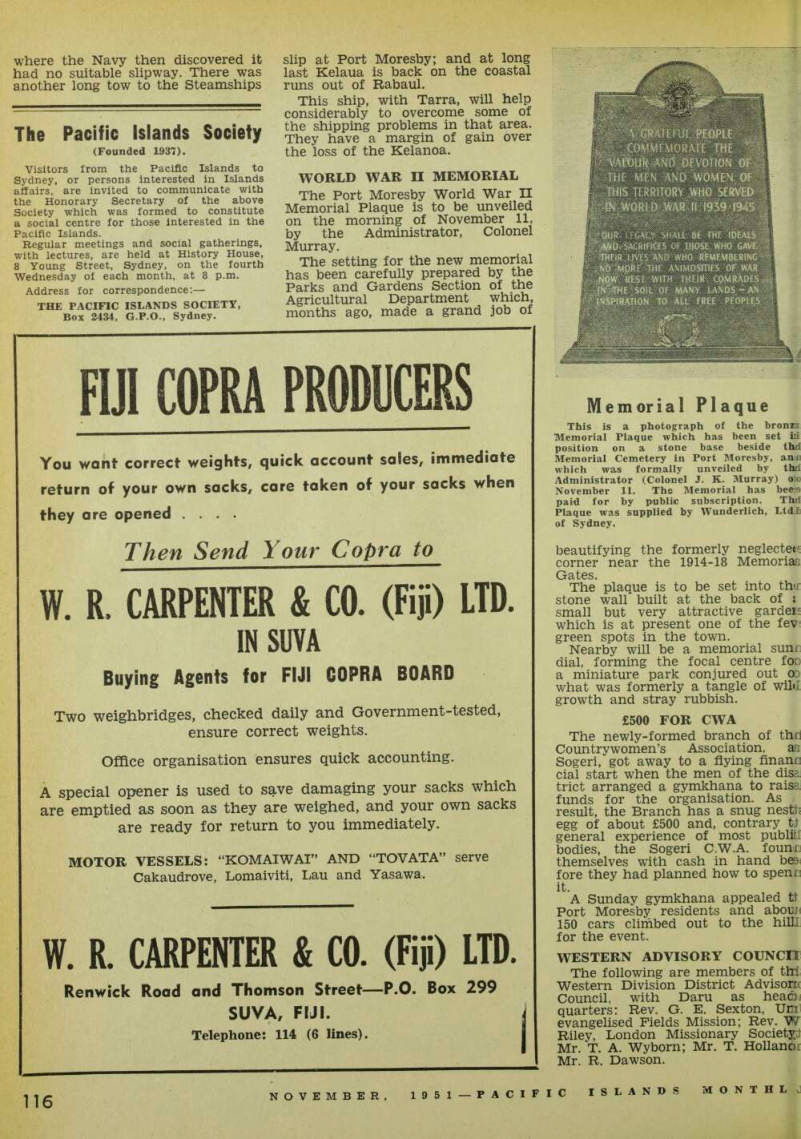
The Port Moresby World War II Memorial Plaque is to be unveiled on the morning of November 11, by the Administrator, Colonel Murray.
The setting for the new memorial has been carefully prepared by the Parks and Gardens Section of the Agricultural Department which, months ago, made a grand job of
beautifying the formerly neglected corner near the 1914-18 Memoriae Gates.
The plaque is to be set into thir stone wall built at the back of small but very attractive garden which is at present one of the green spots in the town.
Nearby will be a memorial sunn dial, forming the focal centre foo a miniature park conjured out oo what was formerly a tangle of wild, growth and stray rubbish.
£500 For Cwa
The newly-formed branch of thrl Countrywomen’s Association, as Sogeri, got away to a flying finann cial start when the men of the disaJ trict arranged a gymkhana to raisai funds for the organisation. As ; result, the Branch has a snug nestle egg of about £500 and, contrary tf general experience of most publiil bodies, the Sogeri C.W.A. found themselves with cash in hand be9( fore they had planned how to spenn it.
A Sunday gymkhana appealed ti Port Moresby residents and abourc 150 cars climbed out to the hilllj for the event.
Western Advisory Counch
The following are members of thl Western Division District Advisorrc Council, with Daru as heacn quarters: Rev. G. E. Sexton, Urn evangelised Fields Mission; Rev. W Riley, London Missionary Society;* Mr. T. A. Wyborn; Mr. T. Hollanor Mr. R. Dawson.
Memorial Plaque
This is a photograph of the bronz Memorial Plaque which has been set hi position on a stone base beside thd Memorial Cemetery in Port Moresby, and which was formally unveiled by thri Administrator (Colonel J. K. Murray) olo November 11. The Memorial has beera paid for by public subscription. Th Plaque was supplied by Wunderlich, Ltd,h of Sydney.