rasa—Where They Teach Fijians To Become Cane Farmers
pp. 97-99 · Read in the full issue
Become Cane Farmers
T the edge of a plateau about . six miles out of Lautoka. look ing out over a patchwork quilt cane lands, and the Lautoka air t, is a house occupied by Mr. 1 Mrs. Bruce Young and their mg son Geoffrey, t is a typically CSR Co. house, ginger-coloured walls and red f, but is no ordinary CSR estab iment. Behind the house, over es of green lawn, are two rows beautifully-built bures, each rounded by flowering trees and übs and paw-paw trees, a large tral hall and a football field, iltogether, it makes up what is bably the pleasantest spot in whole Lautoka district, t is called the Drasa Agricul al Training School; and here 80 ian students are currently being Lned to become cane-farmers. . Young is in charge of the ablishment. )rasa is, of course not new. The onial Sugar Refining Co. began school about 13 years ago. The a then was to give Fijians the ;essary training and, on gradua i, after three years, to give them le-blocks to farm under similar iditions to those afforded CSR lian tenant farmers, lowever, in more recent years supply of CSR cane-land for s purpose has run out and now trainees are chosen from those o can return and grow cane in ir own communities or those 0 have access to land where they 1 set up as cane farmers on their 2 account. twenty Fijian boys round about or 16 are chosen each year by * District Commissioners in the le districts. The Company clothes m, houses them, feeds them, >plies most of their amusement i sporting materials and gives
them 3/- a week pocket money.
They also receive lOd per day de ferred pay which they collect on graduation.
In return, the boys work the sugar lands which are part of the establishment, although profits from this do not cover the expense of training 80 students.
In addition to cane-farming the boys raise vegetables and poultry for their own use, and produce their own milk.
They live eight to a bure, fum
ished with mat floors, beds and mosquito nets and a multitudinous display of pin-ups ranging from European girls (well-clothed variet ies) through boxers and footballers to many coloured advertisements of this or that.
They play football and cricket in season, have boxing tournaments and dances, and in their spare moments play pranks on neighbour ing Indian farmers and wolf whistle their daughters, (Continued Next Page)
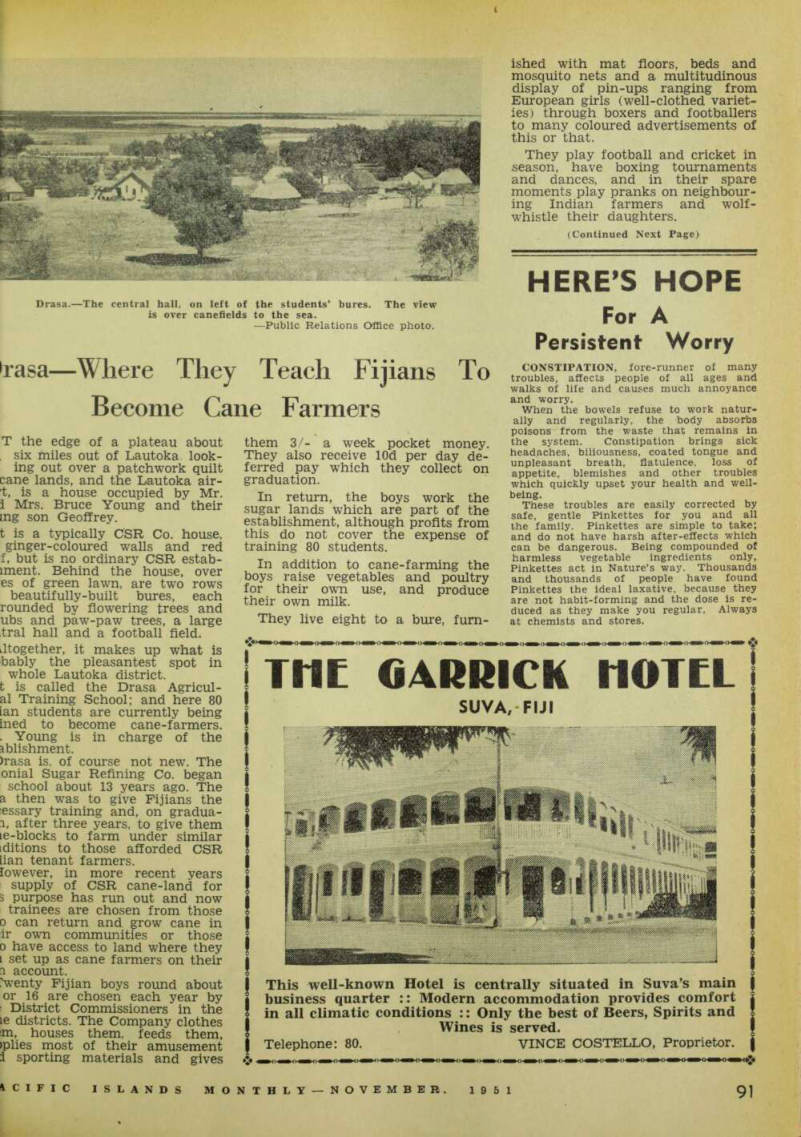
Drasa. —The central hall, on left of the students’ bures. The view is over canefields to the sea. —Public Relations Office photo.
rE ideal is a fine one but no one will try to persuade you that graduates of the school are ready to take over the cane farm ing business from the Indians.
The Indians are natural-born, good farmers. No labour is too tedious or too long. They look after their crops and their farm animals, they have large families and hunt
them into the canefields as soon as they can manage to pull up weeds, or wield a chipping hoe.
To spend days weeding a cane field, or cultivating between the rows, to finish only to begin with another field, is not a Fijian idea of having fun—and Fijians like to have fun.
It takes a considerable amount of
mental adjustment for them stick at it but the flourishing car fields around the school —and 1 attractiveness of the school itsel: are proof of what they can under supervision.
Results possibly have been a dr in the ocean of Fiji cane farmi: and the majority of graduates p< sibly have made an indiffen success of the business once tl return home, but here and the particularly where they h£ broken away from the traditio: communal set-up, there are Fij: cane growers of much merit.
It is felt that as long as so succeed the scheme is worth wh PRIDE of the school at the p sent time is the fact that tl contributed one representative the Fiji Rugby team which recer toured New Zealand with si success.
He joined the team in Suva at hour’s notice when one of originals dropped out. When n< came to Drasa, the Fijian sup intendent of the school strip] off his Sunday shirt and tie £ gave it to the chosen one on spot. A collection of warm clot followed and many inroads w made on the weekly pocket moi to send a cash donation after 1 to Suva.
Drasa’s representative had li English and only an imperl knowledge of European ways. ]
b stayed at the best hotels in NZ id on his return wound up at the >ecial welcome-home dinner for le team at Suva’s famous Grand acific Hotel.
After a triumphal journey, with any calls at villages, on the 150ile route from Suva to Drasa, he turned a much elevated hero, leaking fluent English.
Next day he had reverted to ijian and was back in the cane- Jlds.