Britain And The Copra Price
pp. 47-51 · Read in the full issue
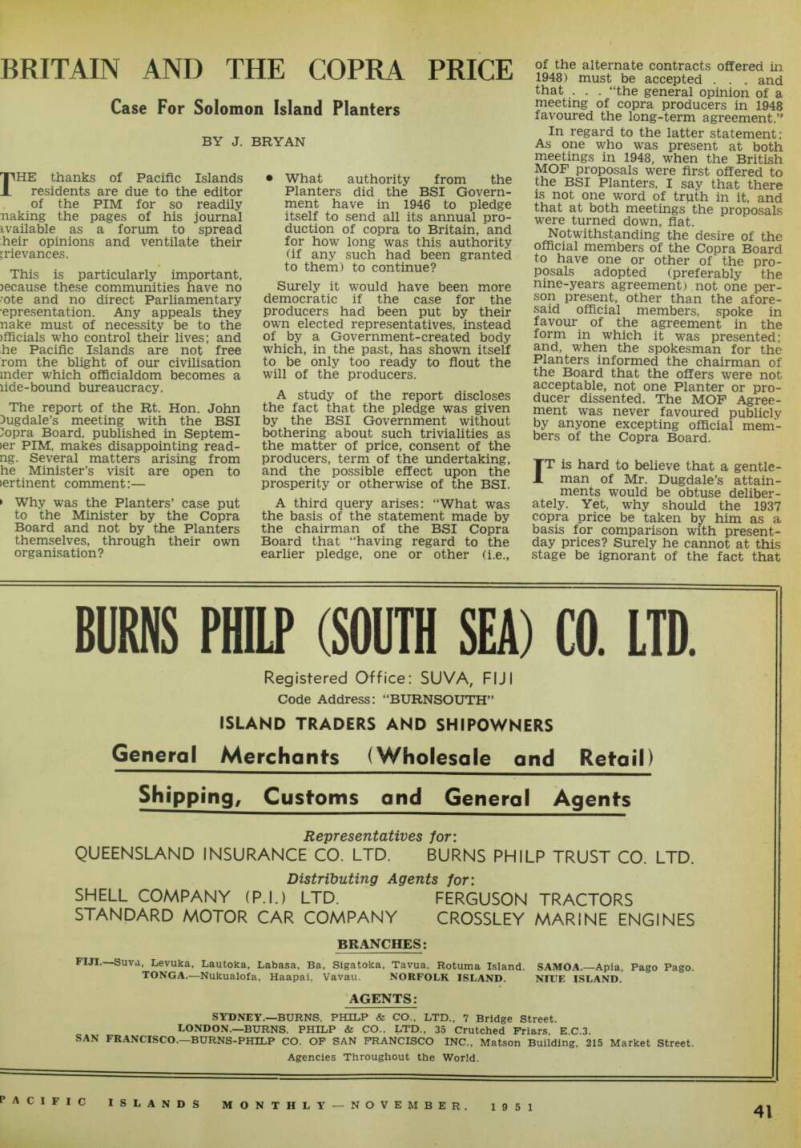
Case For Solomon Island Planters
By J. Bryan
TIHE thanks of Pacific Islands 1 residents are due to the editor , of the PIM for so readily naking the pages of his journal ivailable as a forum to spread heir opinions and ventilate their Grievances.
This is particularly important, lecause these communities have no rote and no direct Parliamentary •epresentation. Any appeals they nake must of necessity be to the >fficials who control their lives; and he Pacific Islands are not free rom the blight of our civilisation inder which officialdom becomes a lide-bound bureaucracy.
The report of the Rt. Hon. John Dugdale’s meeting with the BSI ?opra Board, published in Septemler PIM, makes disappointing readng. Several matters arising from he Minister’s visit are open to lertinent comment:— . > Why was the Planters’ case put to the Minister by the Copra Board and not by the Planters themselves, through their own organisation?
. What authority from the Planters did the ESI Govern ment have in 1946 to pledge Itself to send all its annual pro duction of copra to Britain, and for how long was this authority (if any such had been granted
0 tnem) t 0 contmue -
Surely it would have been more democratic if the case for the producers had been put by their own elected representatives, instead of by a Government-created body which, in the past, has shown itself to be only too ready to flout the will of the producers.
A , , „ .. , .
A study of the report discloses the fact that the pledge was given by the BSI Government without bothering about such trivialities as the matter of price, consent of the producers, term of the undertaking, and the possible effect upon the prosperity or otherwise of the BSI.
A third query arises: “What was the basis of the statement made by the chairman of the BSI Copra Board that “having regard to the earlier pledge, one or other (i.e.,
of the alternate contracts offered in 1948) must be accepted . . . and that . . . “the general opinion of a meeting of copra producers in 1948 favoured the long-term agreement.”
In regard to the latter statement: As one who was present at both meetings in 1948, when the British MOF proposals were first offered to the BSI Planters, I say that there is not one word of truth in it, and that at both meetings the proposals were turned down, flat.
Notwithstanding the desire of the official members of the Copra Board to have one or other of the pro posals adopted (preferably the nine-years agreement) not one per son present, other than the afore said official members, spoke in favour of the agreement in the form in which it was presented; and, when the spokesman for the Planters informed the chairman of the Board that the offers were not acceptable, not one Planter or pro ducer dissented. The MOF Agree ment was never favoured publicly by anyone excepting official mem bers of the Copra Board.
IT is hard to believe that a gentle man of Mr. Dugdale’s attain ments would be obtuse deliber ately. Yet, why should the 1937 copra price be taken by him as a basis for comparison with present day prices? Surely he cannot at this stage be ignorant of the fact that
1937 prices were far from normal.
So abnormal had they been over the depression years that the Cust odian of Expropriated Property in New Guinea had seen fit to declare a moratorium to save planters in the Mandated Territory of New Guinea from bankruptcy.
If a basis of comparison were re quired, why not the years from 1920 to 1928? They would corre spond more accurately with present conditions.
For the Minister to say that “If the copra price had fallen, pro ducers would have been glad to have had the security of the con
tract” is, to my mind, totally irrele vant.
The producers never indicated at any time that they wanted the con tract; and. at two meetings called by the Copra Board in an endeav our to entice them to accept the contract, they turned it down.
Why this tenacious effort to spread the belief that the producers accepted the contract and are now crying because it did not turn out in their favour?
When the Contract finally arrived from England for signature by the Copra Board in 1951, it required the casting vote of the chairman to
secure its adoption and signing. The unofficial members of the Board (from the time it was first offered in 1948) have consistently opposed its acceptance.
REVERTING to the address by the present chairman of the Board to the Minister: He stated that “when the Ministry of Food’s proposals were put forward in 1948 there was no alternative, short of the perfidious and un thinkable step of breaking with the United Kingdom, but to accept one or other of the Ministry’s pro posals.”
If there was no alternative, why were not the producers informed accordingly, there and then. Why the farce of calling two meetings in an endeavour (which proved un successful) to obtain their accept ance?
He further states: “A full public meeting was held to discuss this matter, and the consensus of opinion was that of the two alter natives, the nine-years agreement would be the most advantageous to the Protectorate as a whole, and
the Ministry of Food was informed accordingly.”
This is a complete distortion of facts. The consensus of opinion on the part of the producers present (who formed all the audience with the exception of the members of the Copra Board) was expressed by themselves to the meeting (and to a second meeting with the same purpose) by means of a fiat rejec tion of the MOF offers. Only official members of the Copra Board at any time expressed approval of one or other of the MOF offers in thq manner presented, and at the prices set forth.
THE chairman of the Board went on to speak of the disabilities incurred by copra-producers because of devaluation of sterling in 1949. If he honestly believed the producers were badly treated then, why did he not take the oppor tunity of ventilating this matter when the agreement finally arrived for signature (in 1951), instead of using his casting vote to impose acceptance upon the producers?
He said in his address to the Minister that “the price offering now under the Ministry of Food Agreement has got badly out of step with world parity in the copra market.” Copra prices were just as badly out of step at the time he affixed his signature to the Agree ment.
He further states: “We feel that the present position is very largely attributable, not to ordinary com mercial trends which any business man accepts as normal, but to the effects of the deliberate devaluation af the £ sterling in 1949.”
One could go further than this and say the present position in the BSI is due to the Copra Board ising its plenary powers to impose its views on the copra producers in face of the strong remonstrances and warnings given by the pro ducers. It is one of the signs of :he times that politicians and Gov jmment officials throughout the British Commonwealth believe they can run a man's business better :han the businessman can run it limself! 1/|R. DUGDALE, in his reply to ill the meeting, stated that “the price of things is three times ip and the MOF was paying four and a quarter times the 1937 price.”
What are the facts? 1. Rice has increased from a pre var price of approximately £l5 per ion to £lOO/16/- per ton at the Government store, Honiara. 2. Tinned ration-meat has in creased from approximately Bd. per cin to approximately 3/- per tin, for an inferior quality. 3. Other essential plantation com modities, such as biscuits, flour,
lap-laps, copra bags, freights, etc., have increased in similar or greater proportions. 4. Wages have increased from 10/- per month to a minimum of £2 per month, and it is not disputed that the efficiency of labour has been reduced tremendously.
These figures do not substantiate Mr. Dugdale’s statement regarding costs.
Two matters stand out as a result f t h f e aPP™aches to the Minister and study of the history of the cas6, • It appears that the unofficial members of the Copra Board of the BSI (appointed by the Goveminent) have been used merely
to provide a “front,” and that their efforts to secure a measure of fairplay and justice have been to be) thwarted through their inability to outvote the official members, The development of the BSIP is subservient to the require ments of the MOF to obtain cheap copra, and the BSIP Gov ernment’s need of funds will re present crmn C w^axaUon°whJch conditions in any other copra producing country, and which cannot fail, if continued, in in tensifying stagnation and retro gression, with a corollary that investors in the future will avoid
the Solomons as they would the plague.
Editorial Note
i LL the indications were that the \ South Pacific copra producers would get no review of the ritish Ministry of Food copra mtract price while the British ocialist Government was in power.
The latter has shown, in many milar cases, that it will, if it can, it an advantage for the consumers l Britain (in trouble largely owing » Socialist misgovernment) at the cpense of overseas producers.
However, a general election
changed all that. The British people on October 25 turned out the Socialists and put into office men with some real sense of responsi bility. The South Pacific copra pro ducers should lose no time in again seeking a review of their case.
The BSI producers have a special case—they never accepted the Agreement. The New Guinea, Fiji and Samoan producers did accept it; and their plea for review, there fore, should be based, not on the operation of the Agreement, but on the fact that the Socialists, by the trick of devaluing Sterling, have robbed the producers since late 1949 of from £2O to £3O per ton.