—And in Other
pp. 43-44 · Read in the full issue
Islands
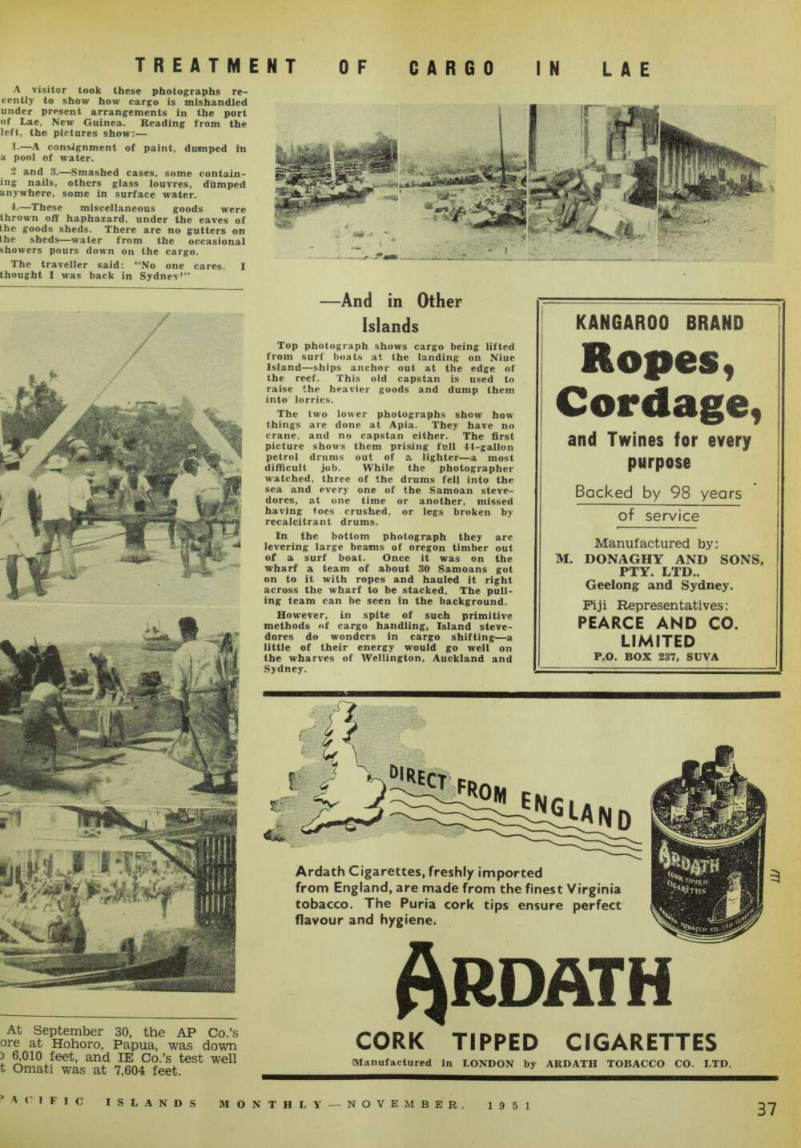
Top photograph shows cargo being lifted from surf boats at the landing on Niue Island—ships anchor out at the edge of the reef. This old capstan is used to raise the heavier goods and dump them into lorries.
The two lower photographs show how things are done at Apia. They have no crane, and no capstan either. The first picture shows them prising full 44-gallon petrol drums out of a lighter—a most difficult job. While the photographer watched, three of the drums fell into the sea and every one of the Samoan steve dores, at one time or another, missed having toes crushed, or legs broken by recalcitrant drums.
In the bottom photograph they are levering large beams of Oregon timber out of a surf boat. Once it was on the wharf a team of about 30 Samoans got on to it with ropes and hauled it right across the wharf to be stacked. The pull ing team can be seen in the background.
However, in spite of such primitive methods of cargo handling. Island steve dores do wonders in cargo shifting—a little of their energy would go well on the wharves of Wellington, Auckland and Sydney.
Mr. J. D. Rankine, CMG, Chief Secretary, Kenya, who has been appointed British Resident, Zanzi bar, was bom in Suva while his father, Sir Richard Rankine, was serving with the Western Pacific High Commission. He was seconded to Fiji in 1942 as Assistant Colonial Secretary and was appointed Co lonial Secretary, Barbados, in 1945, and Chief Secretary, Kenya, in 1947.
The motor-launch Orthona, bought in Sydney by Captain Legras for the use of the Noumea pilot service, arrived in Noumea in charge of a scratch crew in mid- October. The voyage took seven days—the last 36 hours in very stormy weather. Captain and Madame Legras, who have many friends in Sydney, later returned to New Caledonia.