Not Now So Savage
pp. 39-40 · Read in the full issue
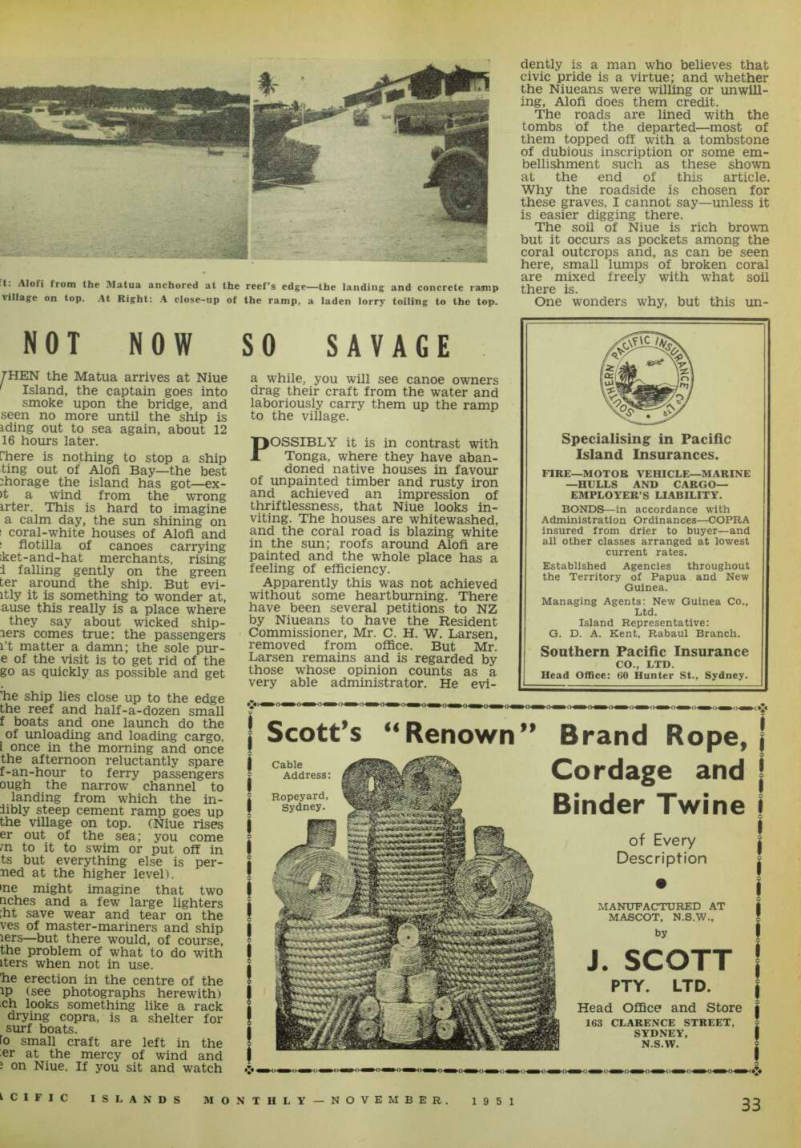
J HEN the Matua arrives at Niue 1 Island, the captain goes into smoke upon the bridge, and seen no more until the ship is iding out to sea again, about 12 16 hours later. there is nothing to stop a ship ting out of Alofi Bay—the best ffiorage the island has got—ex »t a wind from the wrong irter. This is hard to imagine a calm day, the sun shining on coral-white houses of Alofi and flotilla of canoes carrying ket-and-hat merchants, rising 1 falling gently on the green ter around the ship. But evi itly it is something to wonder at, ause this really is a place where they say about wicked ship lers comes true: the passengers I’t matter a damn; the sole pur e of the visit is to get rid of the go as quickly as possible and get ’he ship lies close up to the edge the reef and half-a-dozen small f boats and one launch do the of unloading and loading cargo, I once in the morning and once the afternoon reluctantly spare f-an-hour to ferry passengers ough the narrow channel to landing from which the in libly steep cement ramp goes up the village on top. (Niue rises er out of the sea; you come m to it to swim or put off in ts but everything else is per ned at the higher level). •ne might imagine that two nches and a few large lighters :ht save wear and tear on the ves of master-mariners and ship lers —but there would, of course, the problem of what to do with iters when not in use. he erection in the centre of the ip (see photographs herewith) ch looks something like a rack drying copra, is a shelter for surf boats.
Fo small craft are left in the er at the mercy of wind and ' on Niue. If you sit and watch
a while, you will see canoe owners drag their craft from the water and laboriously carry them up the ramp to the village.
POSSIBLY it is in contrast with Tonga, where they have aban doned native houses in favour of unpainted timber and rusty iron and achieved an impression of thriftlessness, that Niue looks in viting. The houses are whitewashed, and the coral road is blazing white in the sun; roofs around Alofi are painted and the whole place has a feeling of efficiency.
Apparently this was not achieved without some heartburning. There have been several petitions to NZ by Niueans to have the Resident Commissioner, Mr. C. H. W. Larsen, removed from office. But Mr.
Larsen remains and is regarded by those whose opinion counts as a very able administrator. He evi
dently is a man who believes that civic pride is a virtue; and whether the Niueans were willing or unwill ing, Alofi does them credit.
The roads are lined with the tombs of the departed—most of them topped off with a tombstone of dubious inscription or some em bellishment such as these shown at the end of this article.
Why the roadside is chosen for these graves, I cannot say—unless it is easier digging there.
The soil of Niue is rich brown but it occurs as pockets among the coral outcrops and, as can be seen here, small lumps of broken coral are mixed freely with what soil there is.
One wonders why, but this un
promising looking terrain seems to be capable of growing excellent coconuts and bananas, vegetables and even good timber.
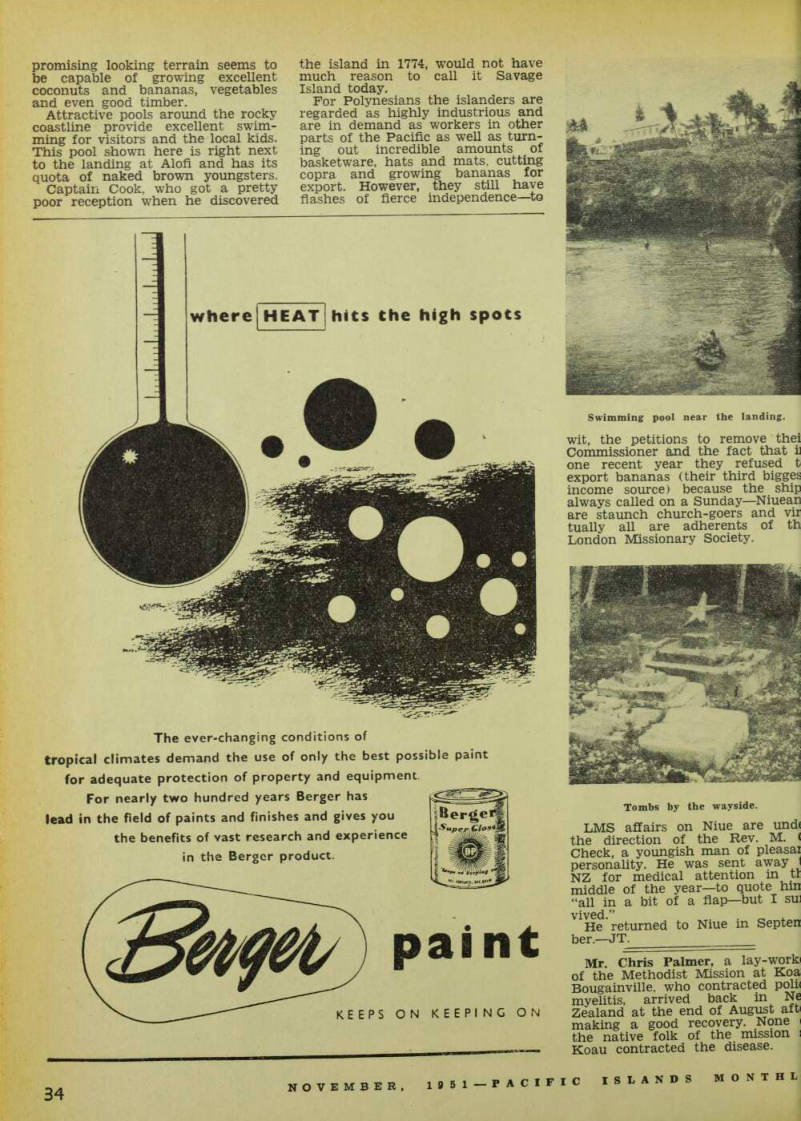
Attractive pools around the rocky coastline provide excellent swimming for visitors and the local kids.
This pool shown here is right next to the landing at Alofi and has its quota of naked brown youngsters.
Captain Cook, who got a pretty poor reception when he discovered
the island in 1774, would not have much reason to call it Savage Island today.
For Polynesians the islanders are regarded as highly industrious and are in demand as workers in other parts of the Pacific as well as turn ing out incredible amounts of basketware, hats and mats, cutting copra and growing bananas lor export. However, they still have flashes of fierce independence to
wit, the petitions to remove thei Commissioner and the fact that ii one recent year they refused t export bananas (their third bigges income source) because the ship always called on a Sunday—Niuean are staunch church-goers and vir tually all are adherents of th London Missionary Society.
LMS affairs on Niue are und( the direction of the Rev. M. ( Check, a youngish man of pleasar personality. He was sent away 1 NZ for medical attention in tr middle of the year—to quote hm “all in a bit of a flap—but I sm vived.”
He returned to Niue in Septen ber.—JT.
Mr. Chris Palmer, a lay-work( of the Methodist Mission at Koa Bougainville, who contracted poh( myelitis, arrived back in Ne Zealand at the end of August afh making a good recovery. None ( the native folk of the mission !
Koau contracted the disease.
Swimming pool near the landing.
Tombs by the wayside.