Fiji's Growing Land
p. 29 · Read in the full issue
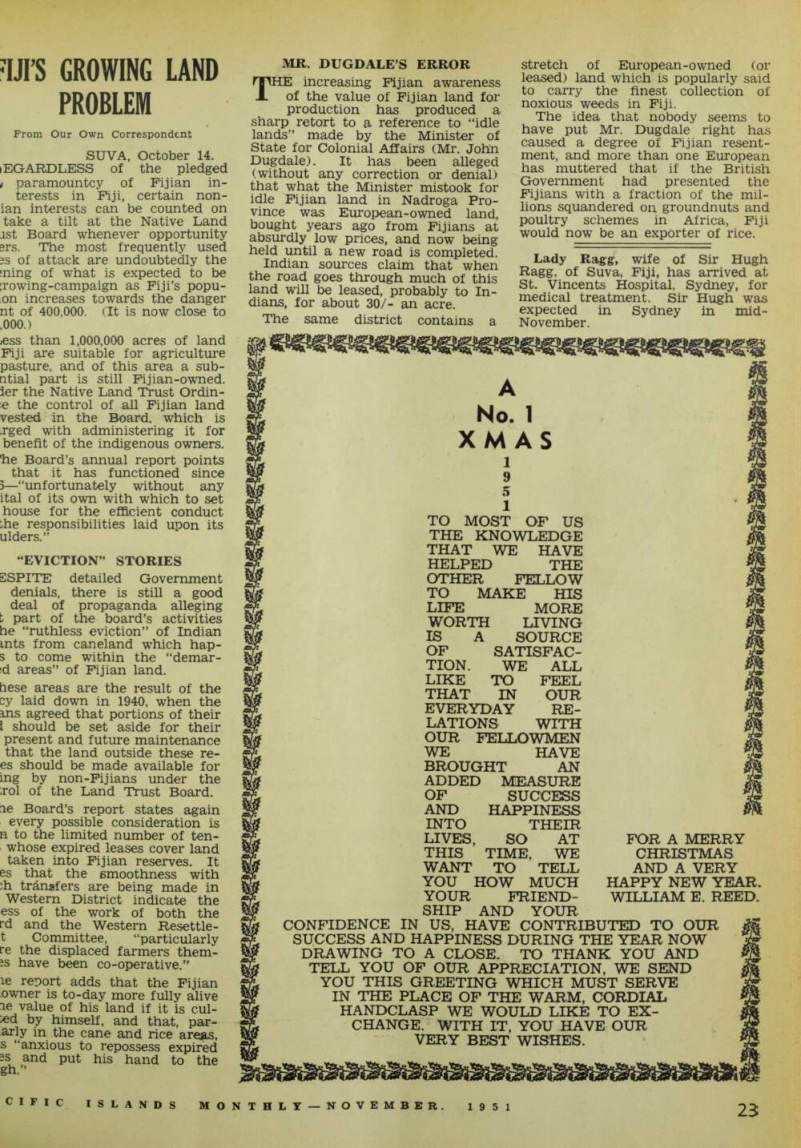
Problem
From Our Own Correspondent SUVA, October 14. »EG ARDLESS of the pledged t paramountcy of Fijian in terests in Fiji, certain non ian interests can be counted on take a tilt at the Native Land ist Board whenever opportunity srs. The most frequently used 3S of attack are undoubtedly the ming of what is expected to be [rowing-campaign as Fiji’s popu on increases towards the danger nt of 400,000. (It is now close to ,000.) ess than 1,000,000 acres of land Fiji are suitable for agriculture pasture, and of this area a sub ntial part is still Fijian-owned, ler the Native Land Trust Ordin e the control of all Fijian land vested in the Board, which is ,rged with administering it for benefit of the indigenous owners, he Board’s annual report points that it has functioned since 3 —“ unfortunately without any ital of its own with which to set house for the efficient conduct ;he responsibilities laid upon its ulders.”
“Eviction” Stories
ESPITE detailed Government denials, there is still a good deal of propaganda alleging t part of the board’s activities he “ruthless eviction” of Indian mts from caneland which hap s to come within the “demar id areas” of Fijian land. hese areas are the result of the cy laid down in 1940, when the ans agreed that portions of their I should be set aside for their present and future maintenance that the land outside these re es should be made available for ing by non-Fijians under the ;rol of the Land Trust Board. le Board’s report states again every possible consideration is n to the limited number of ten whose expired leases cover land taken into Fijian reserves. It es that the smoothness with ’h transfers are being made in Western District indicate the ess of the work of both the rd and the Western Resettle t Committee, “particularly re the displaced farmers them es have been co-operative.” ie report adds that the Fijian owner is to-day more fully alive ie value of his land if it is cul led by himself, and that, par tly in the cane and rice areas, s “anxious to repossess expired 2S and put his hand to the gh.”
Mr. Dugdale’S Error
THE increasing Fijian awareness of the value of Fijian land for production has produced a sharp retort to a reference to “idle lands’' made by the Minister of State for Colonial Affairs (Mr. John Dugdale). It has been alleged (without any correction or denial) that what the Minister mistook for idle Fijian land in Nadroga Pro vince was European-owned land, bought years ago from Fijians at absurdly low prices, and now being held until a new road is completed.
Indian sources claim that when the road goes through much of this land will be leased, probably to In dians, for about 30/- an acre.
The same district contains a
stretch of European-owned (or leased) land which is popularly said to carry the finest collection of noxious weeds in Fiji.
The idea that nobody seems to have put Mr. Dugdale right has caused a degree of Fijian resent ment, and more than one European has muttered that if the British Government had presented the Fijians with a fraction of the mil lions squandered on groundnuts and poultry schemes in Africa, Fiji would now be an exporter of rice.
Lady Ragg, wife of Sir Hugh Ragg, of Suva, Fiji, has arrived at St. Vincents Hospital, Sydney, for medical treatment. Sir Hugh was expected in Sydney in mid- November.