Fijian Battalion For Malaya
pp. 23-24 · Read in the full issue
Public Opinion in Colony is Sharply Divided
Prom Our Own Correspondent
Suva, Nov. 5
Overshadowing even the Melbourne Cup—normally an overwhelming preoccupation in Suva in early November—the official decision to sent a Fiji native battalion to assist the British troops against terrorists in Malaya has produced the biggest contro versy of its kind in Fiji’s recent history.
Every indication, whether open or behind the scenes, seems to lead to the conclusion that responsible European opinion is rigidly opposed to the move.
IN an official statement that Fijian Forces would take part in the campaign against terrorists in Malaya it was said that the decision arose out of the offer by the Fiji Council of Chiefs that their services were always available to serve the King and that they appreciated the danger to the British Empire from communist activities.
The Imperial authorities there upon indicated that assistance could best be given by the services of a battalion of the FMF in Malaya.
A battalion of troops with a small number of NZ officers, warrant officers and NCO’s will be raised in the Colony immediately and will go to Malaya early in 1952 to complete their special jungle training before going into action.
They will serve in Malaya for two years. Cost of their training and maintenance will be borne by the Imperial authorities. Two battalions of the King’s African Rifles from East and Central Africa are also going to Malaya for similar service. fITHE Government’s moral right to X call upon the Fijians at a time when the Fijian people are battling to work out a system for their economic and social future is questioned, and serious doubts have been expressed in the Methodist Church, to which the majority of Fijians belong.
There has never been any doubt about the Fijian response to the appeal. The Government has been doing its best to weed out the army of prospective recruits so that the withdrawal of young men is spread as fairly as possible throughout all the provinces.
MOST of the Indian political leaders have been silent, but a very obvious uneasiness can be noted among the better type of youhg Indians.
Some Indians maintain that a straight forward gesture now might
help to rehabilitate the Indian Community in the eyes of both Fijians and Europeans who re member only too clearly the, disastrous Indian campaign of disaffection and sabotage in the Pacific War.
Many Indians probably resent the bluntness of Europeans who openly declare that no Fijian should be sent overseas because of the menace of pro-Communist elements in Fiji; but any resent ment remains unexpressed.
There have been Indian sugges tions for a call for Indian recruits and, at times, signs of a rather pathetic eagerness to do sorriething to earn a share of the Empire-j Wide praise that rightly goes to the Fijians.
But any suggestion of Ipdian soldiers being sent from Fiji runs into two formidable snags. The first is the racial and political tangle especially in south-east Asia and the Middle East and the second is the apparent inability of Indian youth in Fiji to produce reliable soldiers.
In the last year or so, three or four dozen Indians have volun teered for Territorial service. Most of them were quite unable to con form to Army discipline and routine, and their argumentative attitude and inexplicable psychology left a trail of wrecked tempers among the more tolerant Fijians and Europeans who, for the most part, genuinely did their best to
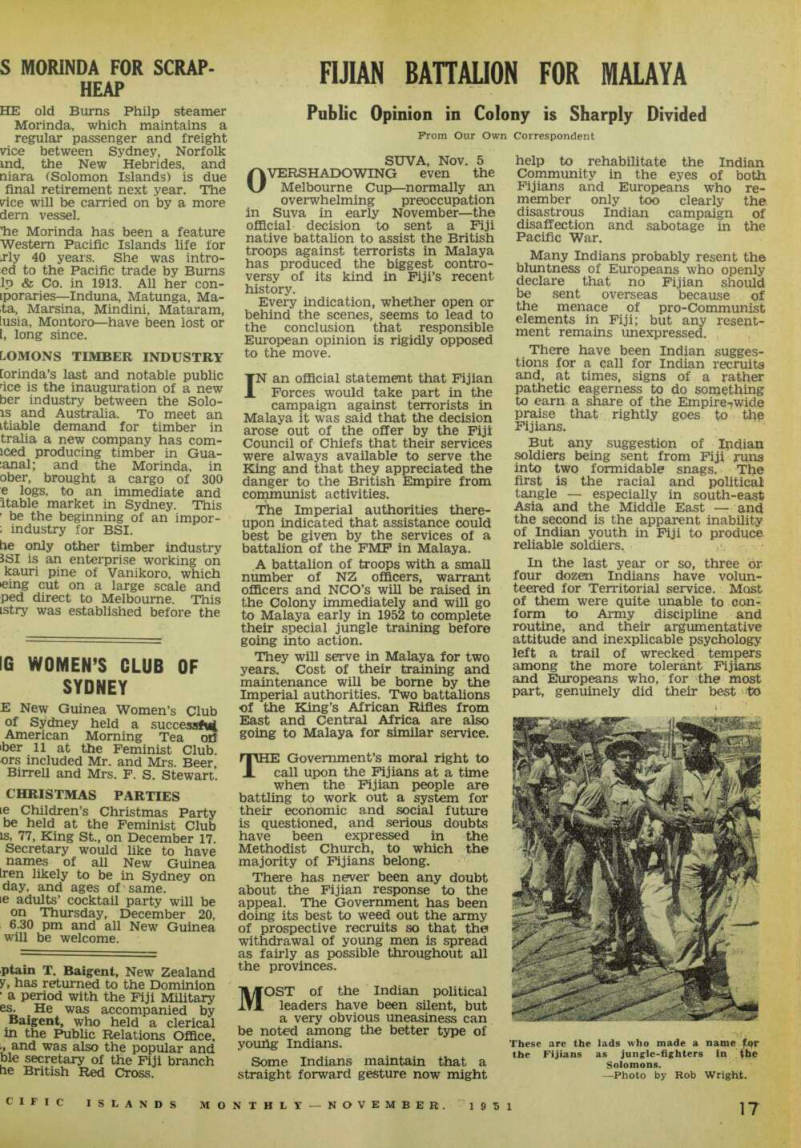
These are the lads who made a name for the Fijians as jungrle-fighters in the Solomons. —Photo by Rob Wright.
cope with the situation. (There is a story of a Fijian instructor who equably told an Indian section; “I’m doing my best for you, but it mightn't last if you go on like this!”) A late rumour is that Indian volunteers may be sought for a labour force to go to Suez. Like all Suva tales, it is to be treated with extreme reserve.
THERE is European support (mostly without public ex pression) for Mr. A. A. Ragg, a former elected member of the Legis lative Council, who has stated that although Fijian co-operation is invariably given to the Government, nothing adequate has been done to recognise, reward and preserve Fijian loyalty.
Other critics maintain that in view of the world situation in general and of the situation of Fiji in particular, the sending of well trained Fijian troops overseas may prove to be a major blunder.
Nothing has yet been said about how the recruits offering are to be weeded out. It is not known whether men in responsible posts in the Government service, including the Police and other essential services, are to be taken. Outside the Government, many industrial concerns are perturbed at the possible loss of key men for two years.
There is an angry undertone in discussions about the inability of the Federation of Malaya to put up a better show than has been apparent in the last four years, and it is frequently asked if the recent assassination of the High Com missioner (Sir Henry Gurney) has been the cause of a sudden Imperial scurry.
Such comment may be unreason able, but when it is voiced by responsible people who do not stand to lose anything either way, it indi cates a trend new to Fiji.
HOWEVER, as far as Fijian youth is concerned there is an all-out scramble to get into the Battalion. There is some evidence, however, that European criticism finds an echo among the older people.
Whether the Fiji Government has made a brilliant gesture of Empire solidarity or has committed a major blunder remains an open question.
But it has, at least, stirred up more feeling than has been evident at any time since the Pacific War. Criticism can be summed up in the query: Why must every appeal for sacrifice of any kind go first to the Fijians?
Mile. Paula Buard, of Noumea, who has been studying English and music in Sydney for three years, celebrated her 21st birthday with a party in October.