W Thi l^v,r?, t rriS? n I b^ ra ‘ iu
pp. 65-66 · Read in the full issue
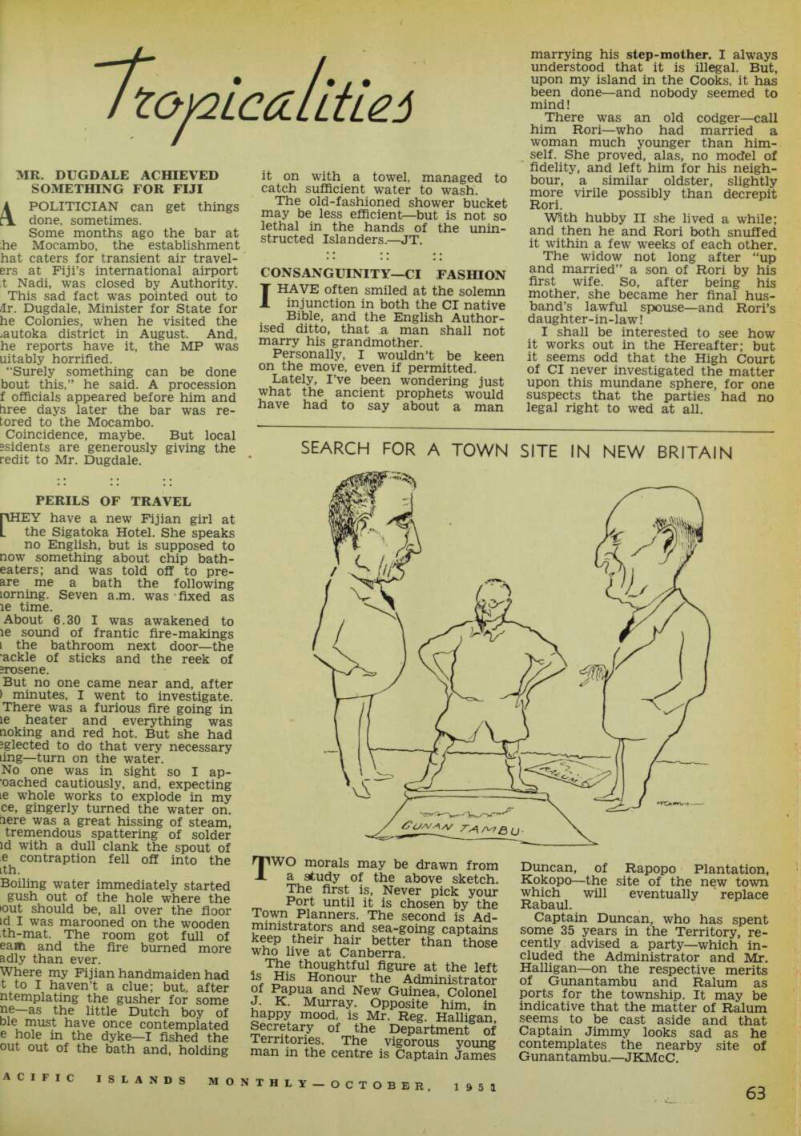
SEARCH FOR A TOWN SITE IN NEW BRITAIN
rpWO morals may be drawn from -*■ study of the above sketch.
The first is, Never pick your Port until it is chosen by the Planners. The second is Administrators and sea-going captains Srh/? i??o eir f h J^ ir better than th ose W Thi l^v,r?, t rriS? n I b^ ra ‘ iu *io thoughtful figure at the left S ooS„ Hon( i u L th ® Administrator 01 Papua and New Guinea, Colonel hannv pp gf lte him, in Secret n rv°°nf ¥ ri Reg V Hall i gan ’ tSSc of ™ he Department of Territories. The vigorous young man in the centre is Captain James
Duncan, of Rapopo Plantation, Kokopo—the site of the new town which will eventually replace Rabaul.
Captain Duncan, who has spent some 35 years in the Territory, re cently advised a party—which in eluded the Administrator and Mr.
Halligan—on the respective merits of Gunantambu and Ralum as ports for the township. It may be indicative that the matter of Ralum seems to be cast aside and that Captain Jimmy looks sad as he contemplates the nearby site of
Gunantambu.-
Jkmcc.
Next thing, someone will be marrying his mother-in-law!—ETl.
Five-Toed Pigs
ACCORDING to Mr. Leo Austen (writing in the Star, Lismore, NSW), Papua has a unique species of pig—one with five toes.
Pigs, since time immemorial, have had a cloven hoof, and Mr. Austen believes that the five-toed variety, which he has seen in the limestone country of Papua, has descended from a freak pig which by inter breeding had produced a static species. According to local accounts the breed has been there for cen turies and although there has been much controversy as to whether the Papuan pig came from Sumatra or is a modified form of European domesticated pig, there is no doubt about the part played by the animal In the social life of the Papuans.
Pork, says Mr. Austen, is con sidered the most delectable of all flesh —except here and there where human flesh occasionally forms the piece de resistance —and even when sago-grubs abound, pork is con sidered the best food for warriors and elderly wise men.
Flying Wedding
SOMETHING of a world’s record must have been created when a complete wedding party arrived in Norfolk Island by the Skymaster service at the end of September—they had flown 900 miles so that the ceremony could be performed in the beautiful old Melanesian chapel here.
The party consisted of the bride, Miss Norma Bailey, daughter of Mr. and Mrs. George Bailey (form erly of NI); the bridegroom, Mr. O.
Judd, of Sydney; the best man, Mr.
Micky Bailey; groomsmen Baker McCoy and Bernie Bailey, formerly of NI and now of Sydney; Miss Ruth Christian, bridesmaid; and the bride’s mother, father and younger brother Leonard. —G.
No Glass Beads, Please
THIRTY members of the NZ Rugby League football team complained bitterly when they found that oranges in Pitcairn Island —where they called en route for England—were threepence each.
Bananas were eight-a-shilling.
They said that they were “staggered” and had expected to buy oranges by the case and bananas by the bushel “more or less for nothing.”
Probably none of the 30 foot ballers have ever grown any kind of fruit, tropical or otherwise, and lived under the delusion that one can buy anything in a distant land for a few glass beads.
The footballers were surprised that the islanders not only could all speak English but were aware of
the value of money.
It is said that more Pitcairners now reside in NZ than on their island so maybe neither accom plishment can be regarded as sur prising.—AJS.
The Murrays Of Papua
A SYDNEY writer recently com mented on the fact that four Murrays have been promin ently connected with Australia’s tropical territories.
Sir John Hubert Murray was the distinguished Lieut.-Governor of Papua—he died “with his boots on” in 1940.
His nephew, Mr. Hubert Leonard
Murray, was his successor in Papua until the Japanese invasion forced evacuation in 1942; and he was later prevented from returning to his office by the Socialist Minister, Ward.
Mr. George Murray was in the Papua service before he became Director of Agriculture in New Guinea. He was in Rabaul when the Japs invaded, and he lost his life in the Montevideo Maru.
Mr. Jack Keith Murray, a formei Queensland Professor of Agricul ture, was appointed by Mr. Ward tc be Administrator of the combined Territories of Papua-New Guinea and he is still at the head of th( Administration.