Magazine Section
pp. 63-64 · Read in the full issue
We Plough the Fields —and Scatter
By Judy Tudor
yVER been chased over a bumpy i field by a wild-eyed Indian, driving a tractor behind which, eked up like a bustle, is a sixsc harrow? in a sentence, that is an agriculral field-day and machinery demstration in Fiji.
That is the kind of hazard one jst expect in the tropics these ys-and it is a mighty far call )m the tropics of our greatgrandbhers.
Those other-day tropics! Where e sat on a shady verandah, a ig, cold and stimulating drink at nd. And, outside in the blazing n, a long line of willing dusky wants who produced the food and 3W the coconuts that brought pros to the bank account.
Alas, there are no countries of eap labour force these days sn in Fiji, where there is a plenul supply of (a) Indians and (b) jians. The machine is doing m’s more laborious chores there Jr— and (something else grandpop 1 not calculate on either) tb* niri sky servants are in the agriculre busmess for themselves, and the market for tractors and wer-post-hole diggers and man- B " s P r G3-hers.
Well, after the demand for ichmes, there come the men , me men to
sell them; and, after that, the De partment of Agriculture to whip up a field-day, where farmers can gather and size up the relative merits of the various gadgets.
And that is what we had on Mr.
L. L. Hunt’s farm at Tailevu, at the end of August. 1 JUDGE this area has an annual rainfall of somewhere around 120 inches, but this day was fine and hot with a sun that blazed down and blistered. Gathered to see the five types of tractors and all their attachments (operated by wild Indians and some Fijians) were Suva bank managers, Directors of Agriculture, veterinary officers, Dis trict Officers and plain farmers— European, Indian and Fijian—in shirts and shorts and sulus and turbans, Australian digger hats, and straw sombreros, and Simple-Simon felts, and large mops of hair.
A pretty dull day, you might imagine, for the layman. And, in
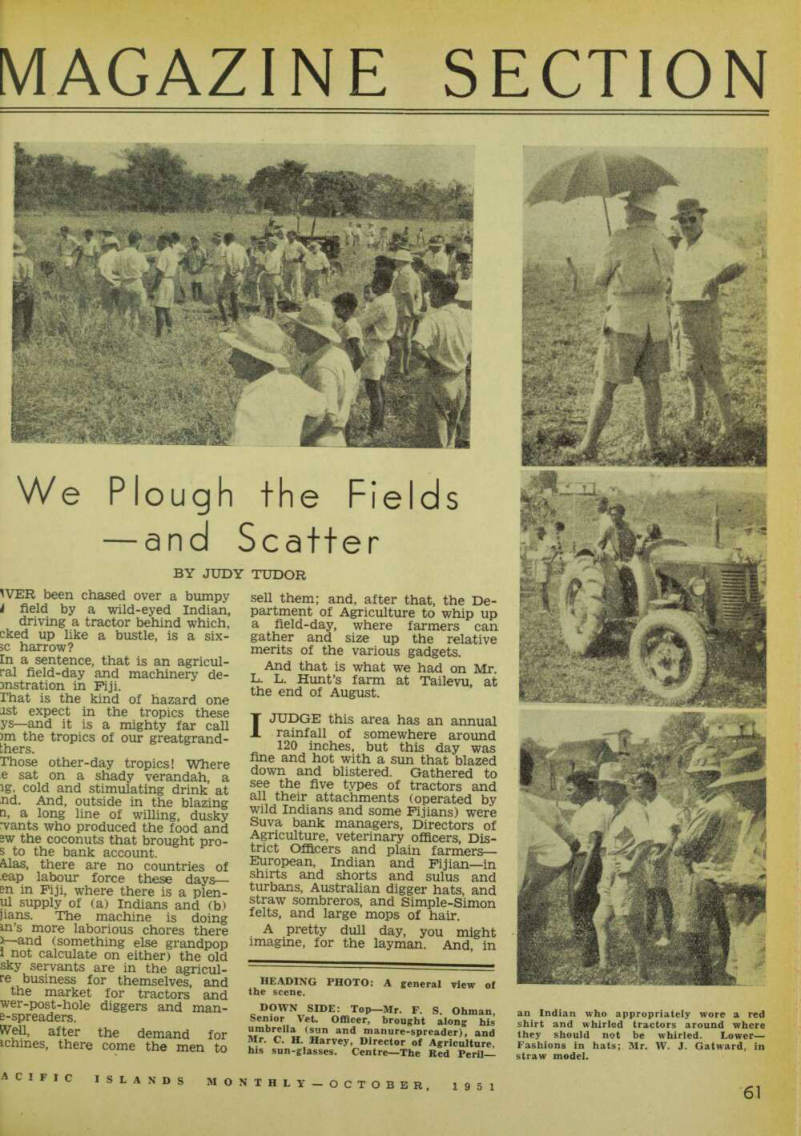
HEADING PHOTO: A general view of the scene.
DOWN SIDE: Top—Mr. F. S. Ohman, Senior Vet. Officer, brought along his umbrella (sun and manure-spreader), and Mr. C. H. Harvey, Director of Agriculture, his sun-glasses. Centre—The Red Peril
an Indian who appropriately wore a red shirt and whirled tractors around where they should not be whirled. Lower— Fashions in hats; Mr. W. J. Gatward, in straw model.
the ordinary course of events, you would probably be right.
But all blood sports are at least stimulating: and get into a small paddock with six Indians loose on tractors, which are trailing various lethal instruments, and you can take it from me that you won’t have a dull moment.
The average Indian, given a piece of machinery that does something, immediately develops the bright eyes of a fanatic and proceeds to do all possible with it, at full speed, regardless of what or who happens to be in the way.
Pick out what seems a safe place, and stand in it, and immediately a mad Indian charges up on a tractor and proceeds to cut a swathe of grass from that very place. You move smartly out of range, only to encounter another fanatic who suddenly waltzes his outfit round like a top, forgetful of the disc plough or whatnot sticking six feet out at the rear.
For a while I stuck close in the shadow of Mr. C. H. Harvey, on the mistaken theory that they wouldn’t dare mow down the Director of Agriculture.
It was no safer than any other spot. Nehru himself would not be safe in that bunch.
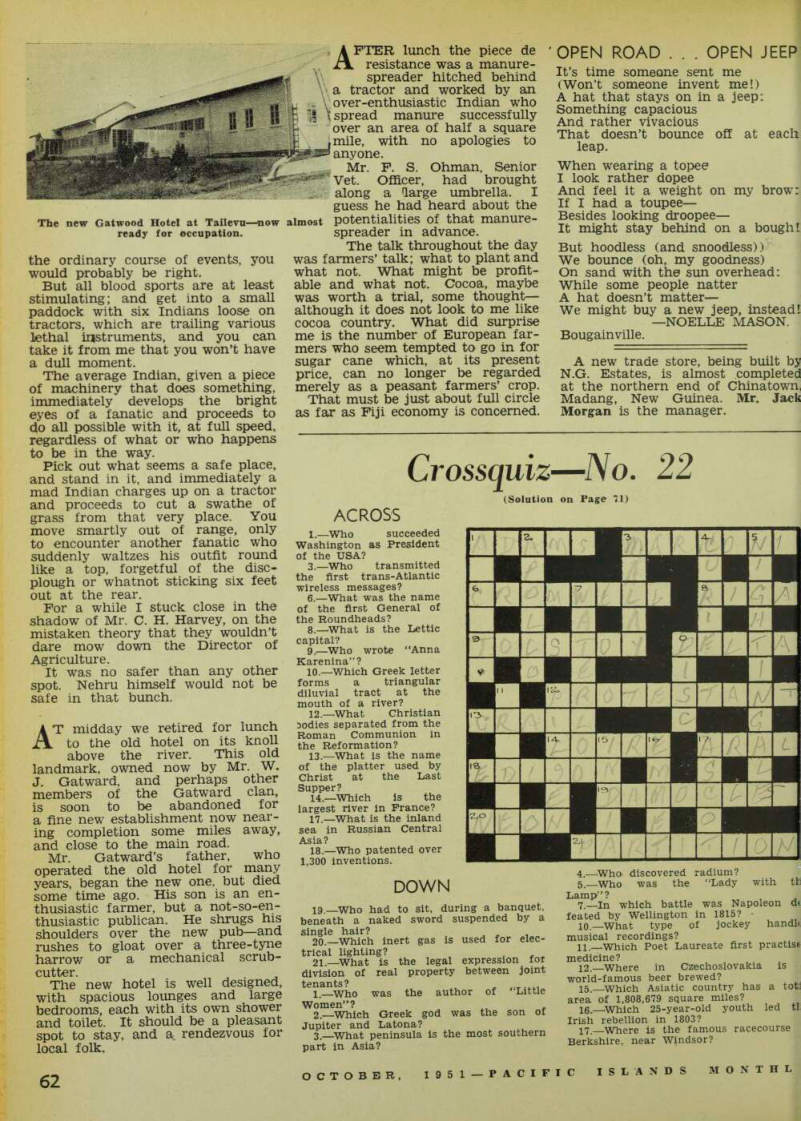
AT midday we retired for lunch to the old hotel on its knoll above the river. This old landmark, owned now by Mr. W.
J. Gatward, and perhaps other members of the Gatward clan, is soon to be abandoned for a fine new establishment now near ing completion some miles away, and close to the main road.
Mr. Gatward’s father, who operated the old hotel for many years, began the new one, but died some time ago. His son is an en thusiastic farmer, but a not-so-en thusiastic publican. He shrugs his shoulders over the new pub—and rushes to gloat over a three-tyne harrow or a mechanical scrub cutter The new hotel is well designed, with spacious lounges and large bedrooms, each with its own shower and toilet. It should be a pleasant spot to stay, and a rendezvous for local folk.
AFTER lunch the piece de resistance was a manure spreader hitched behind a tractor and worked by an over-enthusiastic Indian who spread manure successfully over an area of half a square mile, with no apologies to anyone.
Mr. P. S. Ohman, Senior Vet. Officer, had brought along a large umbrella. I guess he had heard about the potentialities of that manure spreader in advance.
The talk throughout the day
was farmers’ talk; what to plant and what not. What might be profit able and what not. Cocoa, maybe was worth a trial, some thought— although it does not look to me like cocoa country. What did surprise me is the number of European far mers who seem tempted to go in for sugar cane which, at its present price, can no longer be regarded merely as a peasant farmers' crop.
That must be just about full circle as far as Fiji economy is concerned.
OPEN ROAD . . . OPEN JEEP It’s time someone sent me (Won’t someone invent me!) A hat that stays on in a jeep: Something capacious And rather vivacious That doesn’t bounce off at each leap.
When wearing a topee I look rather dopee And feel it a weight on my brow: If I had a toupee— Besides looking droopee— It might stay behind on a bought But hoodless (and snoodless)) We bounce (oh, my goodness) On sand with the sun overhead: While some people natter A hat doesn’t matter — We might buy a new jeep, instead!
Noelle Mason.
Bougainville.
A new trade store, being built by N.G. Estates, is almost completed at the northern end of Chinatown, Madang, New Guinea. Mr. Jack Morgan is the manager.
The new Gatwood Hotel at Tailev u—now almost ready for occupation.