Snap Impressions Of
pp. 29-31 · Read in the full issue
Nukualofa
BY
Judy Tudor
AT
Nukualofa
Sept. 8
FNGA has two shortages at the moment —rain and . currency.
The first is an act of God and the second seems to be an act of ofiicialdon—which of them is em barrassing the residents more is a matter of opinion.
At this date there has been little Dr no rain for over two months; and as Tongatabu, at least, is a flat, streamless island, tank water is practically exhausted and wells are getting down to bedrock.
Vegetable gardens, which were planted enthusiastically after the NZ shipping strike and consequent food hold-up, have been ruined by the continuing dry weather.
THE why and wherefor of the currency shortage is a com plete mystery to most residents.
You are told on one hand that be cause of good copra prices there is “plenty of money”; and, on the Dther, that there is none at all —and that two weeks ago even the local Sopra Board had to suspend buying Dperations because there was not enough paper money to pay for it.
When you exclaim that the money must be somewhere —unless they have taken to burying it in the ground as the United States does Its gold reserve—all you get is a look of blank despair.
The most likely explanation seems to be that Tonga, unlike other countries, has not increased her note issue to keep pace with her growing population and the pros perity that copra and fruit has Drought in the last few years.
It is suggested that this is Offi cialdom’s measure for preventing indue inflation—and those who sub scribe to the theory that most of Australia’s inflation problems stem from the swollen note issue of the war years, that was not recalled when peace came, will probably see merit in it.
However, a little moderation is always a good thing and the curbed lote issue in Tonga has apparently now reached a state of embarrass ment for most people.
Trading firms have reached the stage where they cannot get enough currency into their stores to pay the iuty on imported goods and so re plenish their stocks.
Tongans—who, like most Islan ders, believe that money was made bo spend—are hanging on to their cash, just in case there is no more where that came from.
Just what officialdom’s answer to ill this is, I cannot say. The Matua bias made a week-end visit to Nu kualofa this time.
TONGA has its own paper money, but uses Australian silver. The Tongan £, like Australia’s, is 25 per cent, under Sterling.
The first question residents ask an Australian is, when is he going to revalue his £. They feel that if the Australian £ were revalued, the Tongan £ would automatically follow and imports would immediately cost less.
Why the Tongan £ should be tied to Australia is a complete mystery to me. The local explanation is
that ‘‘we buy most of our goods from Australia.” Which seems no reason at all.
Australia must take exceedingly little from Tonga. And purchases of flour, canned meat, etc. from Aus tralia would be less costly if Tonga had the same rate of exchange as Fiji or Samoa.
There are many things that Aus tralia does not supply—building materials, for one example—and these are at an exorbitant price here.
At present, they are unloading a great quantity of United Kingdom cement in drums, the landed cost of which is about £3O Tongan per ton. Most of the timber I have
seen about is Oregon, from Canada, which also is extraordinarily dear.
The high price of these materials is probably the reason why Tongan houses are in the last stages of dilapidation.
Presumably, years ago, imported timber and galvanised iron were very cheap and were used in pre ference to native reeds and thatch.
Not a thing has been done to them for years and, consequently, these paintless, wobbly structures give an impression of extreme squalor.
In defence of rusty galvanised iron in place of thatch, it can be said, of course, that it is an essen tial in a place where the only water supply comes from roof catchments.
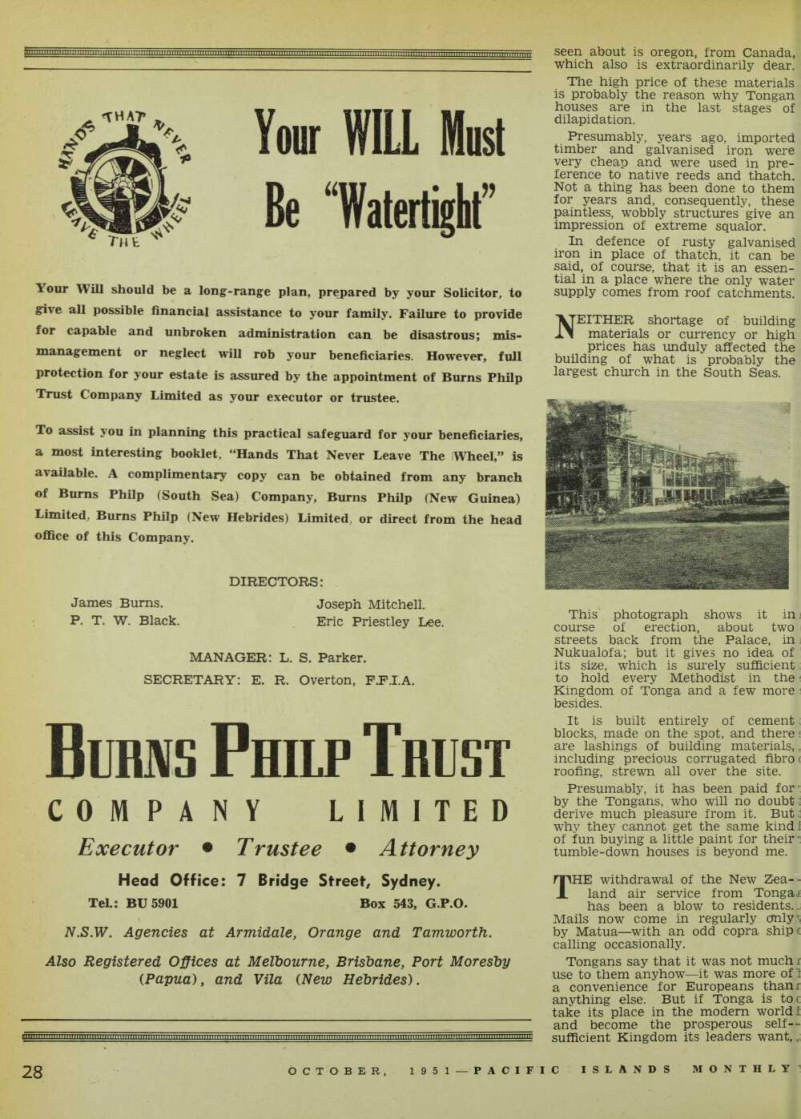
NEITHER shortage of building materials or currency or high prices has unduly affected the building of what is probably the largest church in the South Seas.
This photograph shows it in j course of erection, about two < streets back from the Palace, in j Nukualofa; but it gives no idea of its size, which is surely sufficient to hold every Methodist in the Kingdom of Tonga and a few more besides.
It is built entirely of cement; blocks, made on the spot, and there e are lashings of building materials,, including precious corrugated fibro( roofing, strewn all over the site.
Presumably, it has been paid for by the Tongans, who will no doubt ; derive much pleasure from it. But i why they cannot get the same kindl of fun buying a little paint for their *3 tumble-down houses is beyond me.
THE withdrawal of the New Zea land air service from Tongas has been a blow to residents..; Mails now come in regularly by Matua —with an odd copra shipc calling occasionally, Tongans say that it was not much r use to them anyhow—it was more off a convenience for Europeans thanr anything else. But if Tonga is toe take its place in the modem world! and become the prosperous self sufficient Kingdom its leaders want,.;
ting its air link seems a retro de step. [owever, the £lO,OOO per annum uired by the NZ Government a fortnightly service seems ex sive and probably is beyond the ources of the Kingdom, lie hope that TEAL’S new ser e through Cook Islands to hiti would make a call there ms unlikely to come to anything, ler.