Hunting Down
pp. 67-77 · Read in the full issue
the Head-Hunters
A. P. Lyons, formerly of Papuan Service, tells of the 25 years’ campaign against the Tugeri.
NEW GUINEA was long known as the land of the head hunters; and the most notor ious of them, so far as British New Guinea (Papua) was concerned, were the Tugeri.
Until after Sir William Macgregor assumed charge of the administra tion of British New Guinea, almost nothing was known of the Tugeri.
The Queensland Government officers at Thursday Island received occasional reports of raids on the natives of Torres Strait Islands close to the New Guinea coast — particularly Boigu Island which were within the Extra Territorial boundary of Queensland; but it was not known who the raiders were and where they lived.
They made their raids during the North-west monsoon—January to April—and returned home with the South-east trade wind. They came in large numbers, by large war canoes without outriggers, and poles and paddles were used for propul sion. They raided both coastal and inland villages.
It is historically known that they reached Mawatta, which is about 150 miles east of the Dutch bound ary, and about 15 miles west of the present Government Station on Daru Island. No-one knows how far along the Dutch coast these raiders went; but we may be sure they did so, as there was no Dutch Govern ment post for upwards of 100 miles west of the boundary to oppose them.
Until Macgregor explored the coast and rivers of British New Guinea, west of the Tauri River, practically nothing was known about them.
What follows is, more or less, a chronological history of the Tugeri as recorded in the Annual Reports af British New Guinea, and my own
private diary.
REPORT for 1886, compiled by Mr. G. S. Fort, records the Proclamation of the Protec torate of British New Guinea on November 14, 1884, at Port Moresby, by Commodore J. E. Erskine, R.N., and the appointment of Mr. Romilly as Deputy Assistant Commissioner to represent the Special Commis sioner until his arrival in the Pro tectorate.
HM Special Commissioner, Sir Peter Scratchley, arrived at Port Moresby on August 22, 1885. He im mediately appointed the Hon. John Douglas, Queensland Government Resident at Thursday Island, to the additional office of Assistant Deputy Commissioner, for the pur pose of “exercising control over the Western portion of the Protector ate.”
Annual Report for part of 1886 compiled by Mr. Douglas, records the death of Sir Peter Scratchley on December 2, 1885, the appoint ment of Mr. John Douglas as HM’s Special Commissioner for the Pro tectorate of British New Guinea, and of Mr. H Millman (Queensland Government Resident at Thursday Island) as having authority to act for the Special Commissioner for the purpose of visiting the adjacent coasts of New Guinea.
Report for 1887 records Mr. Mill man’s report of periodical attacks on native inhabitants in the locality of Saibai Island by a marauding tribe who came from the westward.
He could find out little about these ■‘piratical warriors.”
On page 36 of 1888 Report men tion is made of “Togari” as the hostile tribe which had been raid ing around about the Wassi-Kussa and Mai-Kussa Rivers, by Mr. C. E.
Strode Hall, who had been sent from Thursday Island to check up on Captain John Strachan’s so called explorations. Incidentally, on nage 6, Mr. Douglas records that these rivers were “navigated and defined by Mr. Chester in 1877.”
Mr. Strode Hall records finding an old “Togari canoe on the beach at Boigu Island, that it was made out of a kind of cedar, and that he was told the name of the wood was ‘Togari’.”
Returning to Boigu from the rivers he found that the natives had fled to Dauan Island, as they feared another Togari raid.
Sir William Macgregor. Adminis trator, arrived at Port Moresby on September 4, 1888; proclaimed the Protectorate a Crown Colony, and assumed charge.
The Report for 1889-1890, page 18: Mr. J. B. Cameron, who was a qualified surveyor, having been appointed Resident Magistrate of
the Western Division, selected Mabudauan. at the mouth of the Pahoturi River, as the site for the first Government Station in the west end of the Possession. He accompanied Sir William Mac erregor along the coast to the Anglo - Dutch boundary. Though several groves of coconut trees and some deserted villages were seen, no natives were ecountered.
A river was found which Sir William named the Morehead, and up which they proceeded a short distance. The countryside was de serted.
Sir William goes on to say that the natives living on the coast, from the boundary to Mabudauan, dis perse into the bush during the North-west monsoon, when the Tugeri make their raids along the
(Continued on Page 72)
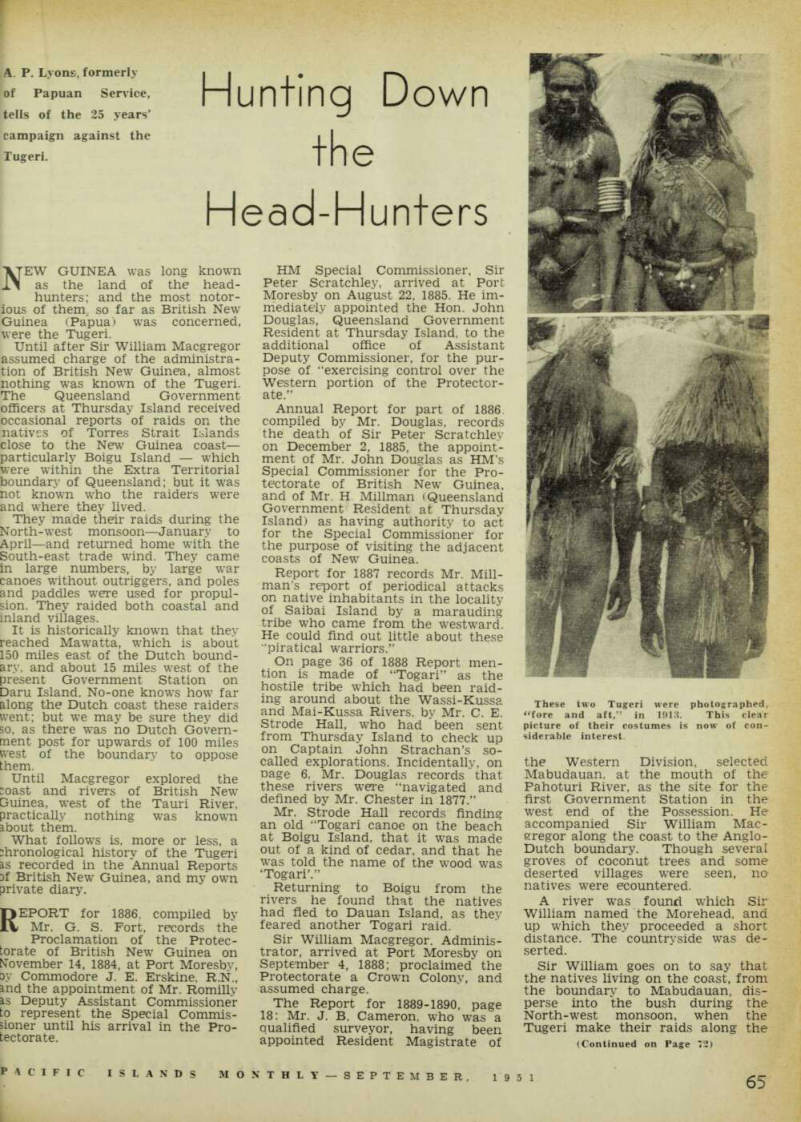
These two Tugeri were photographed, “fore and aft,” in 1913. This clear picture of their costumes is now of con siderable interest.
coast. Little or nothing is known of these raiders, he says, but this is certain: They are war-like and numerous, and they come from the west in large canoes without out riggers.
Continuing, he records that last (1890) Northwest season they went along the coast of the Possession as far as the village of Kadawa (about 3 mile from Mawatta) and there killed a man named Martin —a European.
He says that Captain John Strachan, from the account given in his book, seems to have been attacked by at least 1,000 of them In the Mai-Kussa River, and he and his men, firing on them with Win chester rifles at 150 to 200 yards, failed to intimidate them, and had ;o abandon their vessel.
In his despatch, on page 69, Sir William gives a full account of the Fugeri he saw beyond the Anglo- Dutch boundary, their mode of iress, their canoes, etc., and of his efforts to establish friendly rela ;ions with them. [N his despatch on page 42 of 1891 Report, Sir William reports sending Commandant of Police Wriford, with constabulary, to Mabudauan to reinforce that station, owing to disquieting rumours is to the danger of this station :rom Tugeri raiders. He emphasises ;he necessity of HM Government naking representations to the Gov ernment of the Netherlands on the subject of restraining the Tugeri.
Mternatively, he recommends that i strong post be established near ;he Anglo-Dutch boundary to re strain the marauders from proceed ng further into the Possession.
Mr. B. A. Hely, R.M., replaced Mr.
Cameron in charge of the Western Division. Sir William records on page 22 of 1892 Report that on June 5, 1892 it was reported at Port Moresby that the Tugeri tribe had nvaded the Western end of the Possession and penetrated as far is Mabudauan.
He made a hurried visit to that station, and found that the Tugeri lad come along to that place, but led when they saw the constabu ary turn out armed. Their traces vere followed by a strong party, put the flight of the Tugeri had seen so precipitate that their re turn camp at Thompson Bay (near the Morehead River) appeared to lave been occupied about a week >r 10 days before it was reached py us.
Sir William gives a lengthy and ietailed account of this episode on Page 50. He vigorously protests igainst the apathy of the Nether lands Government, and points out that the remedy is the establish
merit by the Dutch of a Station in the Tugeri country, and that some natural boundary should be laid down between the two Sovereign ties.
On page 22 of 1893 Report it is recorded that the Government Station for the Western Division was shifted from Mabudauan to Daru Island (where it has remained to this day). The Tugeri did not appear to have visited the coast during the year.
Sir William records meeting Dutch Resident Bensbach at Thurs day Island, on board the Dutch Government vessel “Zeemeeuw,” and discussing the delimitation of the boundary between British and Dutch New Guinea. Afterwards they visited the coast of New Guinea and there agreed to make certain recommendations to their respective Governments.
These recommendations, which provided for the boundary as it exists today, were adopted, with the Bensbach River as the commencing point on the South coast. Thus, nobody could be in doubt as to whether the Tugeri, or anyone else, had crossed the boundary, if they had passed the Bensbach River.
ON page 19 of 1896, Sir William records that tribes on the Morehead River had been attacked and dispersed by the Tugeri, their villages having been burned down, and many people killed.
He remarks that, following the settlement of the Anglo-Dutch
boundary, some effort seems to have been made by the Dutch authorities to settle these (Tugeri) tribes, but their endeavours did not appear to have been renewed after they attacked the Magistrate posted among them, and made his removal necessary.
On page 52 of this Report, Sir William gives a lengthy account of leading a large party of Govern ment officers and native constabu lary to the Wassi-Kussa River, there encountering and dispersing a large war party of Tugeri in their canoes.
He used the steam launch “Ruby,” which was well boarded in so as to be almost arrowproof, and two ■whaleboats. Fifty-eight large canoes which the Tugeri had abandoned were captured and destroyed.
The Tugeri fled westwards over land, leaving a large number of bows and arrows, paddles, etc., be hind. Some canoes escaped, but Sir William says that 500 or 600 Tugeri
would h3ve to find their way home through interminable mangrove swamps along the shore.
Sir William Macgregor left in September, 1898, and Mr. G. R.
LeHunte, as Lt.-Govenor, took charge on March 22, 1899. On page 5 of 1899 Report, Mr. LeHunte re ports having received from Mr.
Wood, sub-collector of Customs at Daru, a written statement by an Austrian named Dammkohler, of an affray he, himself, had had with a Tugeri raiding party on the Morehead River, and of his escape overland to Buji, from where he was taken to Daru. Mr. LeHunte appears to have been sceptical as to the truth of Dammkohler’s story.
However, the sequel appears in the next Report.
On page 19 of 1900, Mr. LeHunte reports having visited the Morehead River, and records: “I threw some doubt as to the credence that ought to be attached to the story (of Dammkohler).
What was our surprise on landing at the spot we had selected to camp at, to find a tree with W.D, over 1898 carved in large and well de fined figures and letters. It is due to Mr. Dammkohler to say that we subsequently found his story con firmed as far as what happened to him on the Morehead and after wards, and I owe him an apology.”
Mr. LeHunte records on page 19 of 1901 that discussions between the Foreign Offices of Great Britain and the Netherlands regarding the Tugeri had been inconclusive, as the Dutch Government declined to ad mit that any or sufficient proof had been afforded that the raiders came from their Territory.
However, the Dutch facilitated matters by sending Mr. J. A.
Kroesen, in the cruiser “Serang,” with instructions to place himself in communication with the British authorities at Port Moresby. He met Lieut.-Governor LeHunte at Thursday Island and then Mr.
Kroesen, with Mr. G. Murray, the Resident Magistrate of the Western Division, visited the Morehead River.
Murray sent six of his native con stabulary on ahead from Daru, with, instructions to await his arrival at the mouth of the Morehead River.
The police party were attacked at night by a Tugeri raiding party which had come down the River.
The Tugeri were driven off by the police, who captured some war canoes, in one of which three re cently decapitated heads were found.
This fortuitous incident was all that was needed to provide sufficient proof for Mr. Kroesen (who, with Mr. Murray, arrived at the mouth of the Morehead River the follow ing day) to satisfy him that the raiders were Dutch subjects.
The party proceeded up the river in the hope of capturing some of the raiders who, however, had fled overland to their own country, leav ing some of their canoes behind.
But what the Dutch Resident did find were the headless bodies of 15 men and women at the scene of slaughter. Two boys had been taken away into captivity by the Tugeri..
Mr. Kroesen arranged for the payment of compensation to the ■ survivors of this massacre.
Subsequently, Mr. Kroesen was appointed by the Dutch Government to be Resident in charge of Dutch Territory which . adjoins the British Possession. Thus the Dutch Settlement of Merauke ■ was founded.
Sir Frances Winter, Acting Ad ministrator, records on page 16 of 1902 that, during the year, the Western Resident Magistrate had visited the Morehead River, and learned that the Tugeri had again been on a marauding expedition up that river. A village had been attacked, and some of its inhabi tants killed. As the Tugeri were canoeing down the river, they were seen and attacked by a large hunt ing party of local natives, and put to flight with the loss of some of their warriors and all of their canoes.
No further raids by the Tugeri were recorded in subsequent Annual Reports. However, there was another raid, which is recorded in my private diary.
I was Resident Magistrate at Daru during 1913. In October, I made an extensive patrol of the country between the Wassi-Kussa and Bensbach Rivers. After re crossing the Morehead River, I fell in with some local natives at a small village named Tonda.
They informed me that a Tugeri raiding party had visited the More head River a short time previously, had killed two women, taken away two children into captivity, and had wounded the mother of these child ren.
I saw the mother. Her body had been pierced by an arrow, and the consequential wounds had not yet
healed. I treated the wounds with my emergency supplies of medicines and dressings. The Tonda people said that they had seen a vessel high and dry on the beach at Walata Point, on Gerai Bay.
In the river, not far from their village, was an old Tugeri canoe.
This the police patched, and attached an outrigger. In this canoe I took a small party down the river and, from a place on the east bank, we walked overland to Gerai Bay.
At Walata Point, I found the cutter “Mabuiag.” Some of its planks had been hacked through with an axe, and the mast had been cut down. The vessel had been thoroughly ransacked.
After Lieut.-Governor J. H. P.
Murray received my report, he de cided that a police patrol should be established on the Morehead. I again visited the Morehead River district, overland from the Wassi- Kussa River, and established the police camp at Tonda Village with a native corporal in charge.
I visited this camp every 3 or 4 months, replenishing stores. The police kept up a round of patrols, visiting most of the villages be tween the Bensbach and Wassi- Kussa Rivers. For a short time, I placed Patrol Officer Flint in charge of the camp. He carried out vigor ous patrolling. At a village close to
the Bensbach River, he met two Tugeri men, and made friends with them, and took their photograph, which is reproduced here.
This police camp was maintained at Tonda all the time I remained in the Western Division.
The Dutch established a second station, this one being situated at Assiki, many miles up the Diguel River.