NZ Defends Its Anti-Polynesian Law
pp. 30-32 · Read in the full issue
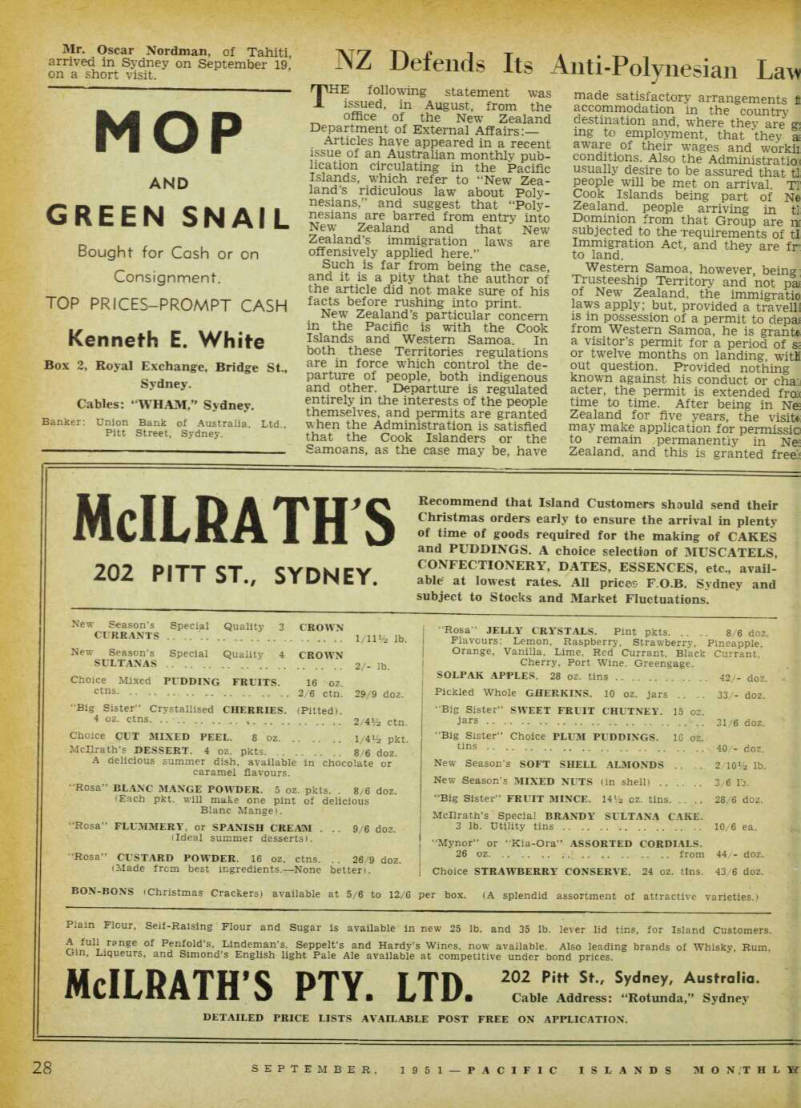


THE following statement was
issued, in August, from the office of the New Zealand Department of External Affairs:— Articles have appeared in a recent issue of an Australian monthly pub lication circulating in the Pacific Islands, which refer to “New Zea land’s ridiculous law about Poly nesians,” and suggest that “Poly nesians are barred from entry into New Zealand and that New Zealand’s immigration laws are offensively applied here.”
Such is far from being the case, and it is a pity that the author of the article did not make sure of his facts before rushing into print.
New Zealand’s particular concern in the Pacific is with the Cook Islands and Western Samoa. In both these Territories regulations are in force which control the de parture of people, both indigenous and other. Departure is regulated entirely in the interests of the people themselves, and permits are granted when the Administration is satisfied that the Cook Islanders or the Samoans, as the case may be, have
made satisfactory arrangements ft accommodation in the country destination and, where they are g* mg to employment, that they at aware of their wages and workii. conditions. Also the Administration usually desire to be assured that tl people will be met on arrival. Tl' Cook Islands being part of Ne Zealand, people arriving in tl: Dominion from that Group are nr subjected to the Tequirements of tl Immigration Act, and they are fr to land.
Western Samoa, however, being’
Trusteeship Territory and not pa* of New Zealand, the immigratio laws apply; but, provided a travelll is in possession of a permit to depan from Western Samoa, he is grant*, a visitor’s permit for a period of s? or twelve months on landing, witH out question. Provided nothing known against his conduct or chaj acter, the permit is extended frox time to time. After being in Nes Zealand for five years, the visit* may make application for permissio to remain permanently in NeE Zealand, and this is granted freet
if nothing is known adverse to the applicant’s character or conduct.
In the case of Tongans, visitors’ permits are granted if the travellers are sponsored by the Tongan Gov ernment. f In the case of Fijian visitors, they pay a deposit on landing, and this is applied if necessary to payment of the return fare by air or any medical [expenses incurred while in New
Zealand.
Students’ permits are freely granted on the sponsorship of the Government concerned, and in New Zealand schools and even Univer sities there are numerous students from all parts of the South Pacific.
It will be agreed, in view of the above explanation, that Polynesians are NOT barred from entry into New Zealand, nor is our immi gration law offensively applied against them.
New Zealand, and the Treatment of Polynesians
THE journal which is referred to by New Zealand so mincingly as “an Australian monthly publication circulating in the Pacific islands” is, of course, the Pacific Islands Monthly; and this is the Pacific Islands Monthly’s formal and editorial reply.
In the manner so typical ©f the bureaucrat and the politician, the “statement” quite cleverly dodges the real point at issue.
Our argument is that New Zea land, as a Polynesian country, and as the home of a large part of the Polynesian race, should not dis criminate in any way against non resident Polynesians or part-Poly nesians.
No doubt, there is justification for laws which will prevent large num bers of Polynesians from Cook Islands, Samoa and Tonga settling permanently in New Zealand —as they have an inclination to do. But why place embarrassing restrictions generally upon Polynesians and part-Polynesians, who have the status of Europeans, when they wish to visit New Zealand?
We have innumerable instances of people being subjected to humiliat ing interrogations by curt and tact less officials of the lower orders, simply because they truthfully des cribe themselves as of part-Poly nesian race, or because the officials think they are not entitled to call themselves Europeans.
The position, as it affects part- Folynesians, is especially embar rassing. There are thousands of such people in the South Pacific— there are some 5,000 in Samoa alone —and their numbers are steadily in creasing, as marriage between Europeans and Polynesians or part- Polynesians becomes more common.
These people mostly are educated, and live as Europeans, and yet when they come to the ports of Australia and New Zealand they find that a sharp distinction is made between them and Europeans.
Australia is not in the same cate gory as New Zealand. Australia has little to do with Polynesia. New Zealand is the home of 100,000 Poly nesians, and is the administrator and protector of many thousands more, in the Cook Islands and Samoa.
Our plea is that the New Zealand Government should display suf
ficient imagination and vision to give to all Polynesians, so far as New Zealand is concerned, the same status and privileges as are accorded Europeans—with, of course, the
obvious proviso that precautions be taken against migration of full blooded Cook Islanders and Samoans (Continued on Next Page)
to permanent settlement in New Zealand.
The result would be that the Polynesian race would regard New Zealand as their cultural and spiritual home, as well as their administrative and commercial headquarters. These are an attrac tive people, non-aggressive, friendly and loyal to Europeans, and well worth cultivating. Generally, they have not the slightest wish to per manently leave their Islands homes.
But even if they did—even if every Polynesian and part-Polynesian in Samoa, Cooks, Tonga and Tahiti went and settled permanently in New Zealand—there would not be enough of them to seriously disturb either the racial or the economic balance in that Dominion.
A few years ago, a bumble-footed Australian Minister for Immigration classified New Zealand Maoris as Polynesians (as, of course, they are) and placed upon them, at Australian ports, the restrictions that are placed upon many races, including Poly nesians. The howl from New Zea land echoed across the earth. The New Zealand Government, at that time, was being kept in office by the votes of four Maori members. The Australian Government hastily re moved the restriction from New Zealand Maoris; and the NZ Gov ernment retired, still growling.
If the NZ Government insists on Australia giving a special status to Polynesians born in New Zealand, why does it, itself, refuse to provide a similar status for the non-New Zealand Polynesians for whose wel fare NZ is responsible? The fact that the non-New Zealand Poly nesians have no vote would, of course, have nothing to do with the case!