‘Racialism’?
pp. 7-8 · Read in the full issue
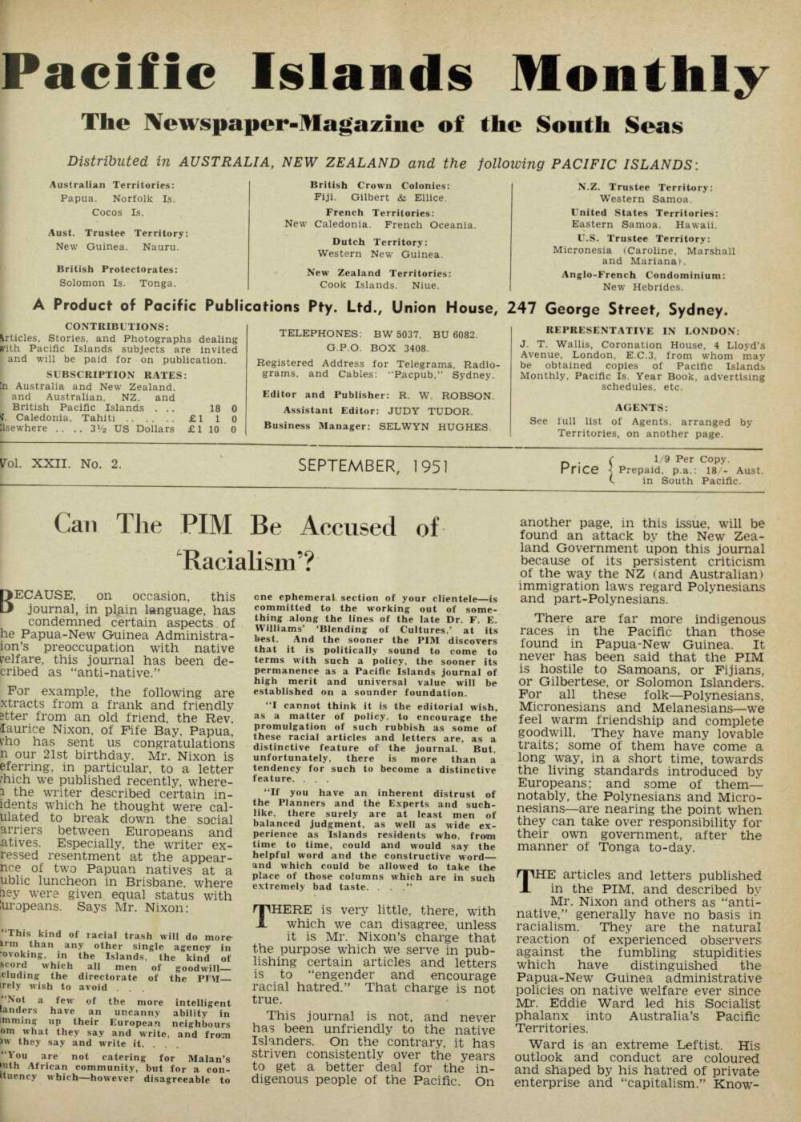
Can The PIM Be Accused of ‘Racialism’?
BECAUSE, on occasion, this journal, in plain language, has condemned certain aspects of he Papua-New Guinea Administra ion’s preoccupation with native welfare, this journal has been de cribed as “anti-native.”
For example, the following are xtracts from a frank and friendly Btter from an old friend, the Rev. laurice Nixon, of Fife Bay, Papua, rtio has sent us congratulations n our 21st birthday. Mr. Nixon is eferring, in particular, to a letter rhich we published recently, where i the writer described certain in idents which he thought were cal ulated to break down the social arriers between Europeans and atives. Especially, the writer ex ressed resentment at the appear nce of two Papuan natives at a üblic luncheon in Brisbane, where hey were given equal status with luropeans. Says Mr. Nixon: “This kind of racial trash will do more irm than any other single agency in •ovoking, in the Islands, the kind of scord which all men of goodwill eluding the directorate of the PI'VI irely wish to avoid .
“Not a few of the more intelligent landers have an uncanny ability in imming up their European neighbours om what they say and write, and from »w they say and write it. . .
“You are not catering for Malan’s >uth African community, but for a con ituency which—however disagreeable to
one ephemeral section of your clientele—is committed to the working out of some- SS? al ° n *U t . be * ines °I the late Dr - F - E ?,( lam 1 s Biendmg of Cultures,’ at its that it "is pouticaUy r sound™.! JJSTS terms with such a policy, the sooner its permanence as a Pacific islands journal of high merit and universal value will be established on a sounder foundation.
“i cannot think it is the editorial wish, as a , ma “ er of policy, to encourage the J distinctive feature of the journal.’ But. unfortunately, there is more than a tendency for such to become a distinctive
feature. .
‘‘ lf you have an inherent distrust of til', u," "r S"iS^' , l..’n e Vf balanced judgment, as well as wide ex perience as islands residents who, from time to time, could and would say the helpful word and the constructive word— and which could be allowed to take the SSST s “' h • vttl ...
THERE is very little, there, with
which we can disagree, unless is Mr. Nixon’s charge that P ur P° s< ; which we serve in pub- Ashing certain articles and letters 1S . “engender and encourage racial hatred.” That charge is not true.
This journal is not, and never InTir'Z has been unfriendly to the native Islanders. On the contrary, it has striven consistently over the years to get a better deal for the in digenous people of the Pacific. On
another page, in this issue, will be found an attack by the New Zea land Government upon this journal because of its persistent criticism of the way the NZ (and Australian) immigration laws regard Polynesians and part-Polynesians.
There are far more indigenous races in the Pacific than those found in Papua-New Guinea. It never has been said that the PIM is hostile to Samoans, or Fijians, or Gilbertese, or Solomon Islanders.
For all these folk —Polynesians, Micronesians and Melanesians—we feel warm friendship and complete goodwill. They have many lovable traits; some of them have come a long way, in a short time, towards the living standards introduced by Europeans: and some of them— notably, the Polynesians and Micro nesians—are nearing the point when they can take over responsibility for their own government, after the manner of Tonga to-day.
THE articles and letters published in the PIM, and described by Mr. Nixon and others as “anti native,” generally have no basis in racialism. They are the natural reaction of experienced observers against the fumbling stupidities which have distinguished the Papua-New Guinea administrative policies on native welfare ever since Mr. Eddie Ward led his Socialist phalanx into Australia’s Pacific Territories.
Ward is an extreme Leftist. His outlook and conduct are coloured and shaped by his hatred of private enterprise and “capitalism.” Know
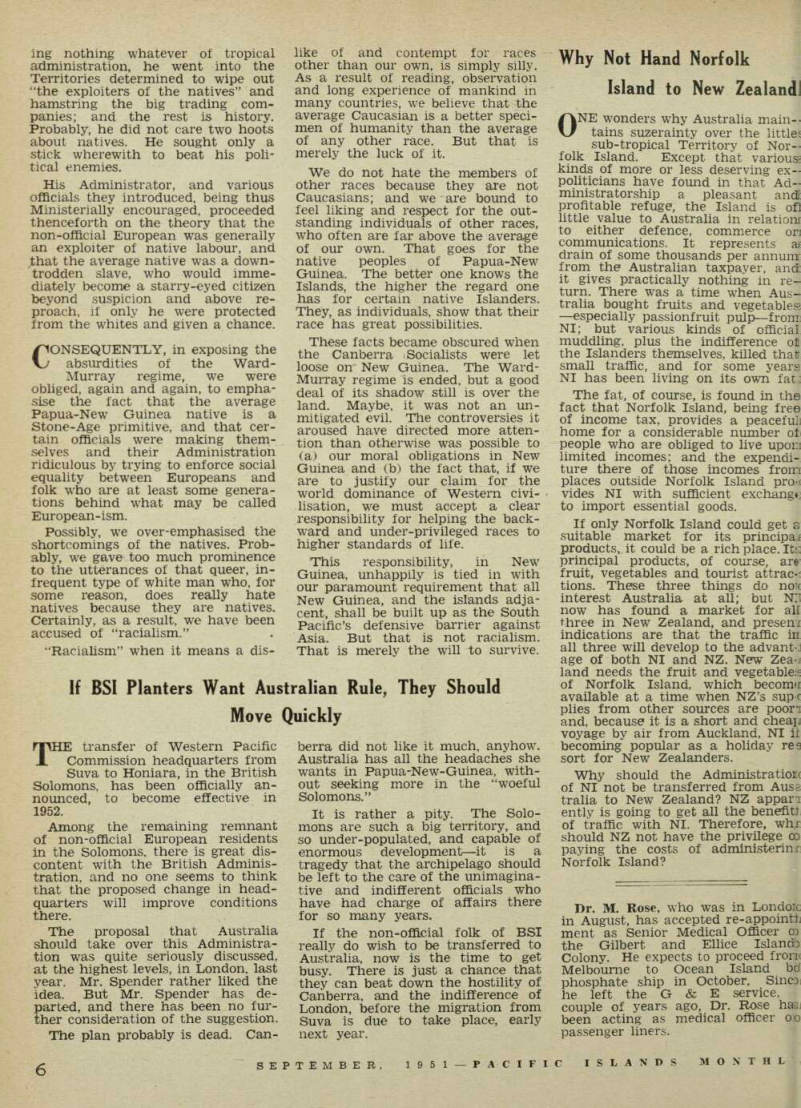
ing nothing whatever of tropical administration, he went into the Territories determined to wipe out “the exploiters of the natives” and hamstring the big trading com panies; and the rest is history.
Probably, he did not care two hoots about natives. He sought only a stick wherewith to beat his poli tical enemies.
His Administrator, and various officials they introduced, being thus Ministerially encouraged, proceeded thenceforth on the theory that the non-official European was generally an exploiter of native labour, and •that the average native was a down trodden slave, who would imme diately become a starry-eyed citizen beyond suspicion and above re proach, if only he were protected from the whites and given a chance.
CONSEQUENTLY, in exposing the absurdities of the Ward- Murray regime, we were obliged, again and again, to empha sise the fact that the average Papua-New Guinea native is a Stone-Age primitive, and that cer tain officials were making them selves and their Administration ridiculous by trying to enforce social equality between Europeans and folk -who are at least some genera tions behind what may be called European-ism.
Possibly, we over-emphasised the shortcomings of the natives. Prob ably, we gave too much prominence to the utterances of that queer, in frequent type of white man who, for some reason, does really hate natives because they are natives.
Certainly, as a result, we have been accused of “racialism.”
“Racialism” when it means a dis
like of and contempt for races other than our own, is simply silly.
As a result of reading, observation and long experience of mankind in many countries, we believe that the average Caucasian is a better speci men of humanity than the average of any other race. But that is merely the luck of it.
We do not hate the members of other races because they are not Caucasians; and we are bound to feel liking and respect for the out standing individuals of other races, who often are far above the average of our own. That goes for the native peoples of Papua-New Guinea. The better one knows the Islands, the higher the regard one has for certain native Islanders.
They, as individuals, show that their race has great possibilities.
These facts became obscured when the Canberra Socialists were let loose on New Guinea. The Ward- Murray regime is ended, but a good deal of its shadow still is over the land. Maybe, it was not an un mitigated evil. The controversies it aroused have directed more atten tion than otherwise was possible to (a) our moral obligations in New Guinea and (b) the fact that, if we are to justify our claim for the world dominance of Western civi lisation, we must accept a clear responsibility for helping the back ward and under-privileged races to higher standards of life.
This responsibility, in New Guinea, unhappily is tied in with our paramount requirement that all New Guinea, and the islands adja cent, shall be built up as the South Pacific’s defensive barrier against Asia. But that is not racialism.
That is merely the will to survive.