"All-round Tourists"
pp. 60-61 · Read in the full issue
By A. M. Eaton
SHORTLY before the visiting steamer comes shuffling into our Island port, a regrettable change in the be haviour of the locals is noticed.
Definite signs of strain are manifested by a slight twitching of the eyelids, a tendency to speak in throaty Pidgin is observed, while our efforts to cultivate an “uncivilised” expression, and a strong desire to drape ourselves “sarong wise” in the most gaudy material we can find, is a sure indication that we are not our selves.
Do not be alarmed—we are merely pre paring for our roles as “island curios” and “white savages,” which have been forced upon us by the All-Round Tourists, for whose benefit we now enact them.
Many a heartfelt groan has been uttered by the Islanders at having to face another batch of these creatures who mostly are on a gay little jaunt to view the strange whites inhabiting the Out posts of Empire. But now we have de cided to make all the world our stage and play our parts so successfully that the ART’s really do have something to talk about back in “civilisation.”
OUR verbal bouts with Tourists usually take place in the dining saloon and commence quite amiably (on our part), working up to a crescendo of mutual dislike, until the Tourist retires hastily beyond range of contamination, muttering darkly about “those peculiar Island types.”
Here are accounts of three meetings with typical ART’s, in the happy days when we were unsuspecting and natural.
When we first viewed Miss A (the Lady from the Library) she was draped languidly over the steamer rail, patting her permanent and gazing with rapidly disintegrating interest at the natives un loading copra on the wharf. As our bat tered jeep trundled up to the gangway, she recoiled visibly and retired behind a ventilator to watch unobserved our pro gress to the cabin of the Captain, who is a friend of ours.
We next saw her when we sallied into the saloon for lunch, where she was al ready seated, sandwiched stiffly in bet ween the Captain and me. For the next half-hour, Miss A effortlessly conveyed the impression that she had already had the islands and everybody in them, and was very upset at being in such close proximity with, and having to speak to, such peculiar people as we seemed to be.
To my mother’s pleasant query as to whether she was enjoying her trip, Miss A balanced a potato belligerently on her fork, glared at the ceiling and murmured in a voice of pained surprise, “Of course.”
Having delivered herself of this agree able reply, she lowered her eyes to the left until they encountered those of the Captain, with an expression that indicated her astonishment and disgust at having to answer such questions.
I then threw myself into the breach, j “I understand you work in a library, Misse A,” I said, chattily. “I think that mustl be very interesting.”
Heaving a weary sigh, Miss A. focussed! her eyes on my plate and informed iti that I was quite mistaken but —here shee regarded me with acute distaste —no doubt 3 I should just adore working in a library..
So absorbed was I in working out thee logic of this crack, that I only vaguely \ heard the next few gems, which fell I wearily from Miss A’s twisted lips. These 6 included a few highly personal broad- sides directed at the behaviour of a dear • old lady opposite who was inoffensively sipping a glass of beer; and, in reply to< my mother’s remark—to the Captain— that we had recently received a gramo phone, a loudly expressed opinion that no doubt we played our records to com plete rags for lack of something better to do.
She finally arose, after kindly explain ing to the whole table that she would leave us to talk to the Captain, as she i could always talk to him to-morrow!
So much for Miss A! May she flourish long and happily in the environment in which such wit is appreciated—if there is such a one.
WE fell into the large laps of Mr. and Mrs. B when we visited the following steamer—to find them ensconced in the Captain’s cabin, quaffing beer and waiting to meet Islands types.
It appeared they had emerged from the dim depths of a chemist shop to swell the dubious ranks of the ART’s, and as their conversation was conducted in tones of continual rapture, well peppered with en dearments, they seemed to be a most charming couple.
“Darlings!” they howled in unison as we sidled bashfully round the door, “come and tell us all about The Life Up Here.”
This we did, to their apparent delight— although we were a little taken aback at Mrs. B’s habit of staring raptuously at each of in turn and then demanding of Mr. B, “Aren’t they too marvellous?” (We are relieved to be able to record that he seemed to agree.) Our suggestion that we take them to our house for a quick supper was re ceived with hysterical joy (“How divine to see a genuine Island Home, darling!”); and it was during this hilarious meal that Mrs. B offered to send us some Shampoos and a Nailbrush from The Shop—these being rather urgent neces sities at the time.
To my mother’s remark that we would give them a cheque for the things there was an immediate howl of protest.
“Angel,” yooped Mrs. B, through a mouth ful of soup, “not another word! We wouldn’t dream of taking money after all your kindness. You can have thous ands of Shampoos and Nailbrushes, you poor pets!”
In spite of our protests, this was the amiable note on which we parted at the wharf.
“Expect the parcel by next steamer, dears!” yelled Mrs. B. gesticulating from the gangway; and, as the ship drew away into the darkness, a faint screech was wafted back on the breeze: “Good bye, darlings, it was Palmolive, wasn’t it?”
That was six months ago, and the Sham poos and Nailbrush have not yet materialised out of the scented mists of the chemist shop, and we rather doubt, now, that they will.
A charming couple, but a little forget ful!
OUR encounter with Mr. and Mrs. C was short and snappy (short on our part and snappy on theirs) but I feel it is worth recording, being typical of
Art’S.
My mother, who had not yet benefited from her many rebuffs, finding herself seated next to Mr. C at lunch, inquired if they were doing the Round Trip.
Mr. C laid down his knife and fork, regarded the ceiling (a favourite spot) and snapped—“Yaas, we are Round Tourists! ”
In the ensuing silence we breathlessly awaited the inevitable, “So what!”; but somewhat to our surprise Mr. C merely sneered into his plate and recommenced feeding operations.
My mother made no further attempt at conversation, but being an old fashioned and polite woman, she later on inquired of Mrs. C if she objected to her smoking.
Permission was timidly granted; where upon Mr. C, who was then wallowing in custard, heaved three loud sighs, flung his napkin onto his plate, drummed his fingers angrily on the table and glared at his unfortunate wife with an expres sion that consigned all Islanders to the very depths of hell. However, he made no remark; and was soon blown from the table by the angry cigarette fumes of my mother who, like all of us, was by now thoroughly annoyed.
I can only assume that Mr. C was either in severe pain, or was merely pre senting a perfect example of the manners displayed by the ordinary All-Round Tourist!
No, an Islander’s impression of a tourist is not a happy one. It is asso ciated mainly with vilely-cut slacks, ex pensive cameras, sneers thinly veiled in cigarette smoke, and “clever” remarks — like that lovely one made by the suave sophisticate who, when asked (by my poor mother) the age of her little girl, drawled affectedly, “I reahlly couldn’t say. I’ve been on this ship so long I’ve forgotten whether she’s six or seven!”
And so on.
A little less sneering in the future and the ART’S will find that beneath our tat tered stockings there beats a heart of gold!
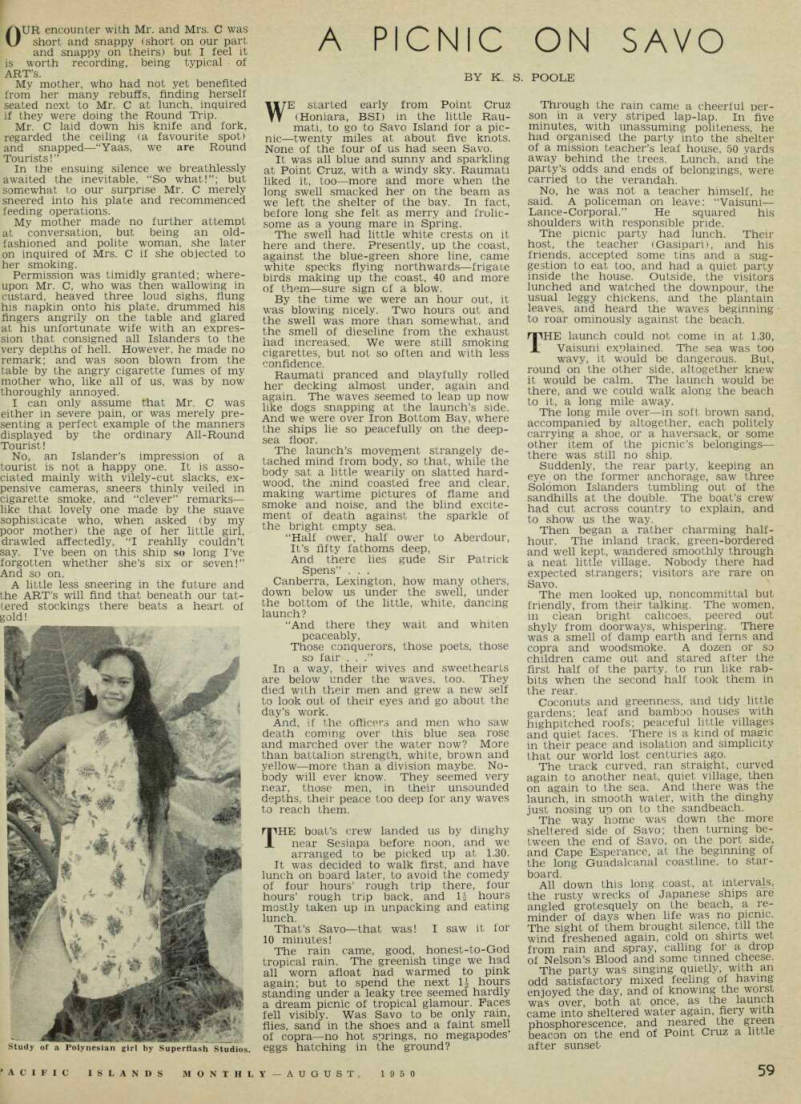
Study of a Polynesian girl by Superflash Studios.