Pearls
p. 57 · Read in the full issue
At A
Price
SOMETIME this month, the worst of the monsoon over, 90-odd pearling lug gers will leave Thursday Island after their annual refit and set sail for the pearling grounds of Torres Strait.
Old-timers will tell you that pearling in the North is not what it was, since the Japs have gone and there are only Torres Strait islanders to take their place as divers. But, in the 1949 season, pearlshell from the Torres Islands alone (sold at an average price of £4OO per ton) brought £500,000. As most of it goes to the United States, that means a million dollars for the Empire dollar pool.
Pearls themselves are just a by-product of the pearling industry. A diver who finds a pearl keeps 75 per cent, of what it brings on the market and the lugger owner gets the rest. That, at any rate, is the theory. In practice most of the pearls found in oysters opened by divers later turn up on the Continent and the lugger owner is no wiser, and certainly no richer.
However, there were some beautiful gems (total value £8,325) turned in dur ing the last season—including those shown in photographs here. The tear drop pearl was found by a Torres Islander employed on one of Burns Philp’s luggers.
It weighs 40 carats and was sold for
£Boo.
The other is a freak pearl (or pearls) which has been called Neptune’s Cup— but which could have been called with even more aptness, Neptune’s Flask.
The lower pearl has a jet-black band around its top, forming a cup. The top pearl, which forms the stopper for the “flask” or cup, is a flawless gem of beau tiful lustre. When found, the pearls were resting just as they are shown in the pnotograph. They are not for sale—for the time being. They are a museum piece.
ONE post-war development, a direct re sult of the Pacific war, is the estab lishment by the CSIRO of a pearl culture research station at TI. Artificial pearl culture, formerly one of Japan’s most closely guarded secrets, will be tried out there, under the direction of Mr. L.
T. Craig who has been two years in Japan studying just how to make young oysters convert a piece of grit into a valuable pearl.
THE Japs, who were our Allies in the 1914-18 war, put the North Australian pearling industry on its feet between the wars after it had been languishing for many years when the shallow grounds had been worked out.
During the Second World War these Japs were interned and later denorted
and the Torres Strait pearling industry was suspended. This five years’ rest for the pearling beds was a blessing in dis guise, however, and when pearling re commenced in 1946 they were well stocked with shell. Pearling boomed—mostly to supply the starved American pearl-button trade, and prices zoomed up to £7OO per ton for shell. In the last season they had fallen to between £3OO and £4OO per ton which meant that many of the new chum, get-rich-quick pearlers quit the industry and went back down South.
But the well-being of the industry de pends primarily upon the calibre of its divers and the good-natured Torres Islanders are not the men that the Japs were, nor have they the careless disregard for life that characterised the Nipponese —a sight to see in the Thursday Island cemetery are the rows of graves of Jap victims of the pearler’s worst hazard— the paralysis (usually referred to as the “bends”) that overtakes the deep-sea diver when brought too quickly to the changed atmospheric pressure of the sur face.
About 80 feet is the limit to which the Islander will dive. The best Jap divers frequently (and, apparently, eagerly) went down four times that depth for good shell.
Japan would like to come back to Aus tralia’s pearling grounds but even the master-pearlers of Thursday Island, who have a profound respect for the Nip as a deep-diver, are not keen on that. Yet the shallow pearling grounds of Torres Strait are fast being worked out. Who will open up the deep pearling grounds, of which, in the past, the Japs alone have been masters?
A small shipment of Fiji timber has been sent to London by air to be used in making a conference table for the new House of Commons. The table, which has been designed by the architect, Sir Giles Gilbert Scott, is to be of English oak, edged with an inlay of woods from the Colopies. Light and dark woods will be used alternately in the design.
Five pieces of timber have been col lected by the Fiji Conservator of Forests.
The light-coloured timbers are Rosawa and Dakua and the dark timber is Yaka, which is light with darker streaks.
Arrangements have already been made for the presentation, by Fiji, of a silver ink-pot for the use in the room of the Secretary of State for the Colonies in the new building. The ink-pot will be made from silver mined in the Colony.
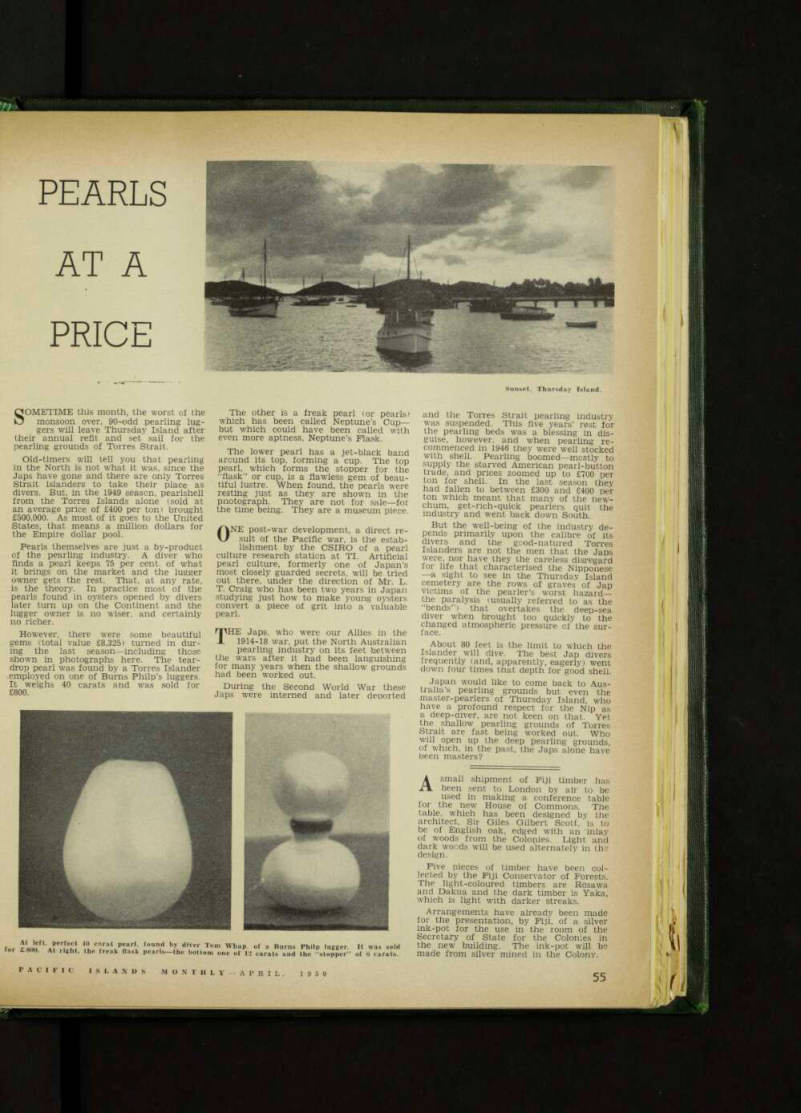
Sunset, Thursday Island.
At left, perfect 40 earat pearl, found by diver Tom Whap, of a Burns Philp lugger. It was sold for £800. At right, the freak flask pearls—the bottom one of 12 carats and the “stopper” of 6 carats.