Native Health
pp. 19-21 · Read in the full issue

Research in New Guinea
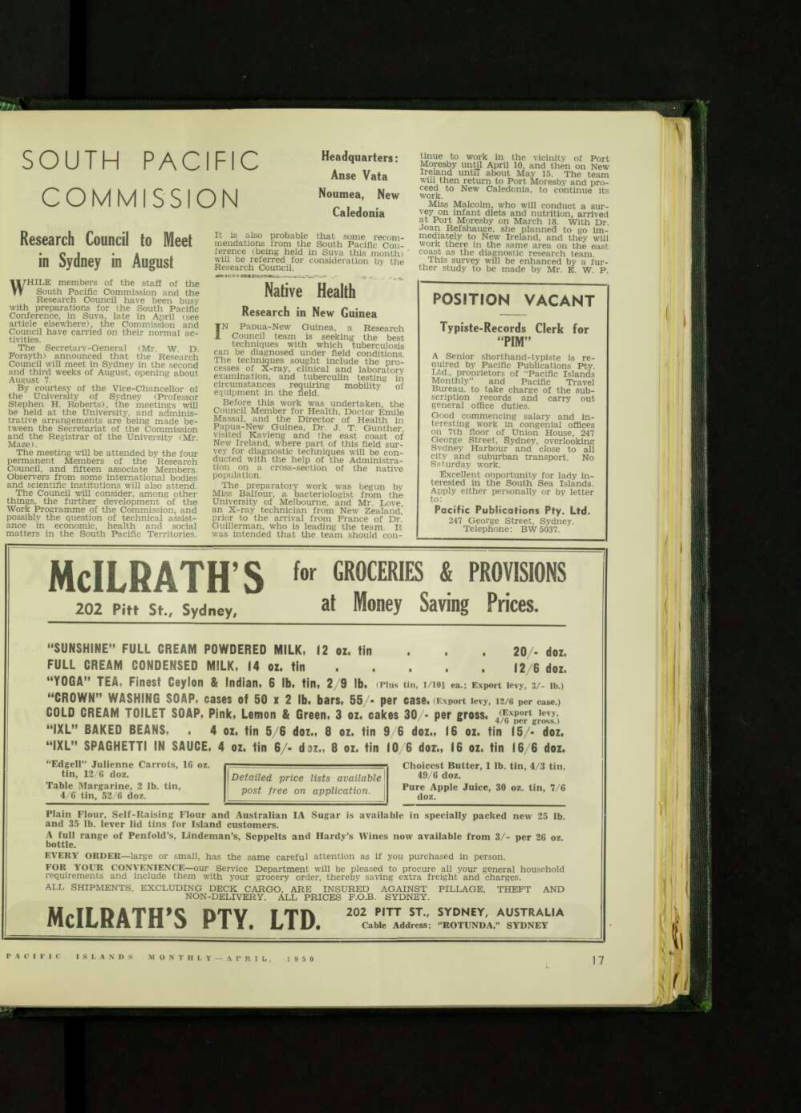
IN Papua-New Guinea, a Research Council team is seeking the best techniques with which tuberculosis can be diagnosed under field conditions The techniques sought include the pro cesses of X-ray, clinical and laboratory examination, and tuberculin testing in circumstances requiring mobility of equipment in the field.
Before this work was undertaken, the Council Member for Health, Doctor Emile Massal, and the Director of Health in Papua-New Guinea, Dr. J. T. Gunther visited Kavieng and the east coast of New Ireland, where part of this field sur vey for diagnostic techniques will be con ducted with the help of the Administra tion on a cross-section of the native population.
The preparatory work was begun by Miss Balfour, a bacteriologist from the University of Melbourne, and Mr. Love, an X-ray technician from New Zealand, prior to the arrival from France of Dr.
Guillerman, who is leading the team. It was intended that the team should con
tmue to work in the vicinity of Port Moresby until April 10, and then on New Breland until about May 15. The team will then return to Port Moresby and pro ceed to New Caledonia, to continue its work.
Miss Malcolm, who will conduct a sur vey on infant diets and nutrition, arrived at Port Moresby on March 18. With Dr Joan Refshauge, she planned to go im mediately to New Ireland, and they will work there in the same area on the east coast as the diagnostic research team.
This survey will be enhanced by a fur ther study to be made by Mr. E. W P
Chinnery, former Director of District Services in New Guinea, who made a similar demographic survey of the East Coast peoples 20 years ago, and has re turned to the Territory for a comparative investigation in the same area.
After some months, Miss Malcolm will proceed to the Trobriands to continue her work on nutrition.
Dr. Massal returned to Noumea at the end of March, after discussions at Can berra about the work of the Commission
with Dr. Brock Chisholm, Director- General of the World Health Organisa tion.
Filariasis IN the filariasis research programme, the first step was the collection and cor relation of results of all the work done previously in the South Pacific area, including the investigation carried out during the war years by the US Navy De partment.
The Commission is now conducting its own survey in New Caledonia. The ob ject of this work is to find areas where there is sufficient infection to warrant further research. This research will be done so. that the best methods can be employed in its future investigations throughout the South Pacific region.
Social Development
Seeking A Vehicle For Teaching
of Natives
Mr. a. L. MOORE, MA, BEd, completed his tour of the Central and Eastern Territories, and returned to Sydney on March 29, having visited New Cale donia, Fiji, Tonga, Western and American Samoa, Cook Islands and New Zealand.
He has been engaged on Project S 2, for a survey of visual means of education to promote literacy.
In each of the Territories, he gave demonstrations of the most modern methods of visual teaching to teachers and others, and gathered a comprehen sive amount of information for a report to the Commission. Mr. Moore is now engaged in completing his recommenda tions, which are expected to be tendered to the Commissioners in June.
It seems likely that his experience of visual aids required in the various Ter ritories may suggest the need for the organisation of a Film Production Unit, for the common use of Administrations, and also for the institution of a central film and film-strip library for the South Pacific.
Mr. A. R. Derrick, MBE, AMISE, com menced the SI Project, for technical training, on April 1. Arrangements were made for Mr. Derrick to visit the King dom of Tonga, the Gilbert and Ellice Islands Colony, and New Zealand before
attending the South Pacific Conference, after which he will visit Western and American Samoa, and the Cook Islands during May, and make a comprehensive tour of the Western Pacific.
Dr. A. Capell, PhD, a well-known authority on Pacific languages, has re turned to Australia after making a fie and survey, in connection with Project S 6, of the Northern New Guinea coastlands from Madang to Hollandia. It is hoped that this will fill in the main gaps in the knowledge of New Guinea languages. He is now engaged on his renort, which will have special reference to the best method of recording a language in written form consideration of the method of teaching the reading and writing of it, and the de velopment of a literature which will sup ply the basic needs of the neople.
In March, the Member for Social De velopment, Mr. H. E. Maude, was pre paring his report and recommendations to the Research Council second meeting.
During the latter part of the month, he conducted surveys of community develop ment work and research activity in the South Pacific, Miss Helen Shields, of the University of Sydney, who was recently on the staff of the Australian School of Pacific Ad ministration, and editor of the publica tion, “South Pacific,” has been appointed a temporary assistant in the Social Development Section.
Islands Economics
Some Problems of Production
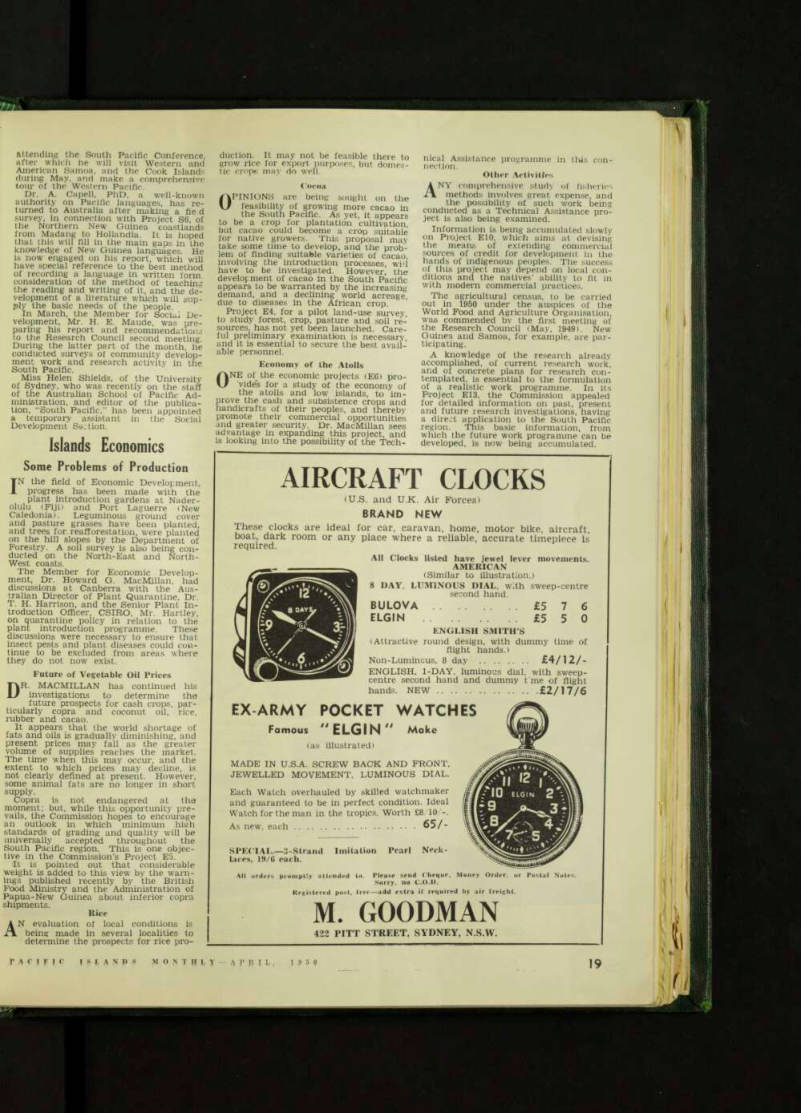
IN the field of Economic Development, progress has been made with the plant introduction gardens at Nader olulu (Fiji) and Port Laguerre (New Caledonia). Leguminous ground cover and pasture grasses have been planted, and trees for. reafforestation, were planted on the hill slopes by the Department of Forestry. A soil survey is also being con ducted on the North-East and North- West coasts.
The Member for Economic Develop ment, Dr. Howard G. MacMillan, had discussions at Canberra with the Aus tralian Director of Plant Quarantine, Dr.
T. H. Harrison, and the Senior Plant In troduction Officer, CSIRO, Mr. Hartley, on quarantine policy in relation to the plant introduction programme. These discussions were necessary to ensure that insect pests and plant diseases could con tinue to be excluded from areas where they do not now exist.
Future of Vegetable Oil Prices DR. MACMILLAN has continued his investigations to determine the future prospects for cash crops, par ticularly copra and coconut oil, rice, rubber and cacao.
It appears that the world shortage of fats and oils is gradually diminishing, and present prices may fall as the greater volume of supplies reaches the market.
The time when this may occur, and the extent to which prices may decline, is not clearly defined at present. However, some animal fats are no longer in short supply.
Copra is not endangered at the moment; but, while this opportunity pre vails, the Commission hopes to encourage an outlook in which minimum high standards of grading and quality will be universally accepted throughout the South Pacific region. This is one objec tive in the Commission’s Project E 5.
It is pointed out that considerable weight is added to this view by the warn ings published recently by the British Food Ministry and the Administration of Papua-New Guinea about inferior copra
shipments.
Rice AN evaluation of local conditions is being made in several localities to determine the prospects for rice pro
duction. It may not be feasible there to grow rice for export purposes, but domes tic crops may do well.
Cocoa OPINIONS are being sought on the feasibility of growing more cacao in the South Pacific. As yet, it appears to be a crop for plantation cultivation but cacao could become a crop suitable for native growers. This proposal may take some time to develop, and the prob lem of finding suitable varieties of cacao, involving the introduction processes, wi'l have to be investigated. However, the development of cacao in the South Pacific appears to be warranted by the increasing demand, and a declining world acreage due to diseases in the African crop.
Project E 4, for a pilot land-use survey to study forest, crop, pasture and soil re sources, has not yet been launched. Care ful preliminary examination is necessary, and it is essential to secure the best avail able personnel.
Economy of the Atolls ONE of the economic projects (E 6) pro vides for a study of the economy of the atolls and low islands, to im prove the cash and subsistence crops and handicrafts of their peoples, and thereby promote their commercial opportunities and greater security. Dr. MacMillan sees advantage in expanding this project, and is looking into the possibility of the Tech
nical Assistance programme in this con nection.
Other Activities ANY comprehensive study of fisheries methods involves great expense, and the possibility of such work being conducted as a Technical Assistance pro ject is also being examined.
Information is being accumulated slowly on Project ElO, which aims at devising the means of extending commercial sources of credit for development in the hands of indigenous peoples. The success of this project may depend on local con ditions and the natives’ ability to fit in with modern commercial practices.
The agricultural census, to be carried out in 1950 under the auspices of the World Food and Agriculture Organisation, was commended by the first meeting of the Research Council (May, 1949). New Guinea and Samoa, for example, are par
ticipating,
A knowledge of the research already accomplished, of current research work, and of concrete plans for research con templated, is essential to the formulation of a realistic work programme. In its Project El 3, the Commission appealed for detailed information on past, present and future research investigations, having a direct application to the South Pacific region. This basic information, from which the future work programme can be developed, is now being accumulated.