Shipwrecks In French
pp. 69-72 · Read in the full issue
Oceania Grim Record of 75 Years
Prom Our Own Correspondent
Papeete, Dec. 31.
THE following list of wrecks in the South Eastern Pacific has been sup plied by Mr. Julien Levy, a retired master-mariner, of Tahiti, to whom grate ful acknowledgement is made. It was compiled at the request of the local Bureau of Information. It does not in clude French ships.
As will be noted, most of these disas ters occurred around the Dangerous Archipelago (Paumoto Islands) whose bad reputation among mariners earned for them their unenviable name. 1875.—British three-masted barque Ada Iredale, after catching five of the Mar quesas, was some weeks later picked up some six miles off Paea, and was towed to Papeete and refitted. After sailing to San Francisco she was some years later pur chased by Captain William Matson, and became the four-masted auxiliary schooner, Annie Johnson. Being put on the Mahukona-San Francisco sugar run, she was sold to Captain Ozanne and re named the Bretagne, under French registry. Later, becoming waterlogged, she was abandoned at sea, 1926. 1902.—British four-masted barque, Pyrenees, caught fire at sea and was beached in the harbour of Rikitea, Man gareva Island. Refloated, she was brought to Papeete, refitted, and sailed for San Francisco, where she was renamed the Mangareva, under American registry. She was lost in World War I when on a voyage from America to England. 1902.—Danish three-masted barque, Vernande, struck the reef as she entered Papeete Lagoon. Assisted by the French Navy vessels, Durance and Zelee, she was towed free at high tide and anchored off the British Consulate. That night at 11 o’clock she sank and for many days there after presented a desolate sight, her hull only being submerged and her masts rising high above the water. 1903.—British three-masted barque John Gamble, laden with sugar, ran on the reef at Arue, Tahiti, while the cap tain was ashore, and became a total loss.
1904.—Union SS Co.’s steamer, Mawera, ran on the reef at the island of Apataki, and became a total loss. 1906. —British four-masted ship, County of Roxburg, was thrown on top of the reef during a cyclone and still is a pro minent landmark on the island of Takaroa. 1909. About this year, a three-masted barque, flying the Chilian flag, was picked up some hundred miles from Papeete and towed to port. She proved to be the former vessel, Eaton Hall, British built, which had been dismantled in a gale.
After being anchored in Papeete harbour for some time, during World War I, she was towed outside the reef and used for target practice. Having drifted back, she piled on the reef on the north side of the entrance to Papeete Harbour. 1910. —The Norwegian steamer, Ocean Queen, on its maiden voyage under the house flag of the British Phosphate Com mission, ran on the reef at the Phos phate Island of Makatea and became a total loss. 1913.—The American three-masted, bald-headed schooner, G. W. Watson, piled on the reef at the entrance to Uturoa Harbour, on the island of Raiatea. 1916.—About this year, during World War I, the German raider, Sea Adler, commanded by von Luckner, ran on the
reef while having her bottom cleaned at the island of Mopelia, 1920. —The American four-masted top sail schooner, Edward R. West, was wrecked on the island of Fakarava in consequence of the lighthouse-keeper there failing to show his lamp. 1921. —American three-masted barquen tine, Retriever, waterlogged and aban doned 200 miles off the Marquesas Islands, was picked up by the Union liner, Talune, and towed to Papeete, where her lumber cargo was discharged. She was after wards towed to New Zealand by the Union steamer, Waikawa, and finished her career in the Waitemata River, Auck land. It is not generally known that the Retriever figured prominently in the novel, “Gappy Ricks.” 1927.—The Chilean four-masted top sail schooner, Anatila was towed into Taiohae Bay by the French gunboat, Cassiopee. There, waterlogged on ac count of her dragging anchors in the heavy surf, she became a total loss. The Anatila was formerly the American schooner, Annie M. Campbell of Seattle, Washington. Ship and cargo were bought by Oscar G. Nordman, of Papeete. The day the ship ran ashore, an infant daughter was born to Mr. and Mrs. Nord man, and named after the shin. Anatila Nordman is now travelling in Prance. 1939. —The American schooner-yacht, Malabar, was wrecked on the island of Kaukura, Tuamotu Islands, while on her way back to Los Angeles. 1949.—The American schooner-yacht, Loafer, was wrecked on the island of Tetiaroa, 30 miles from Tahiti, while re turning to Honolulu.
The Rev. Norman G. F. Cooke has been appointed NSW secretary of the Austra lian Board of Missions.
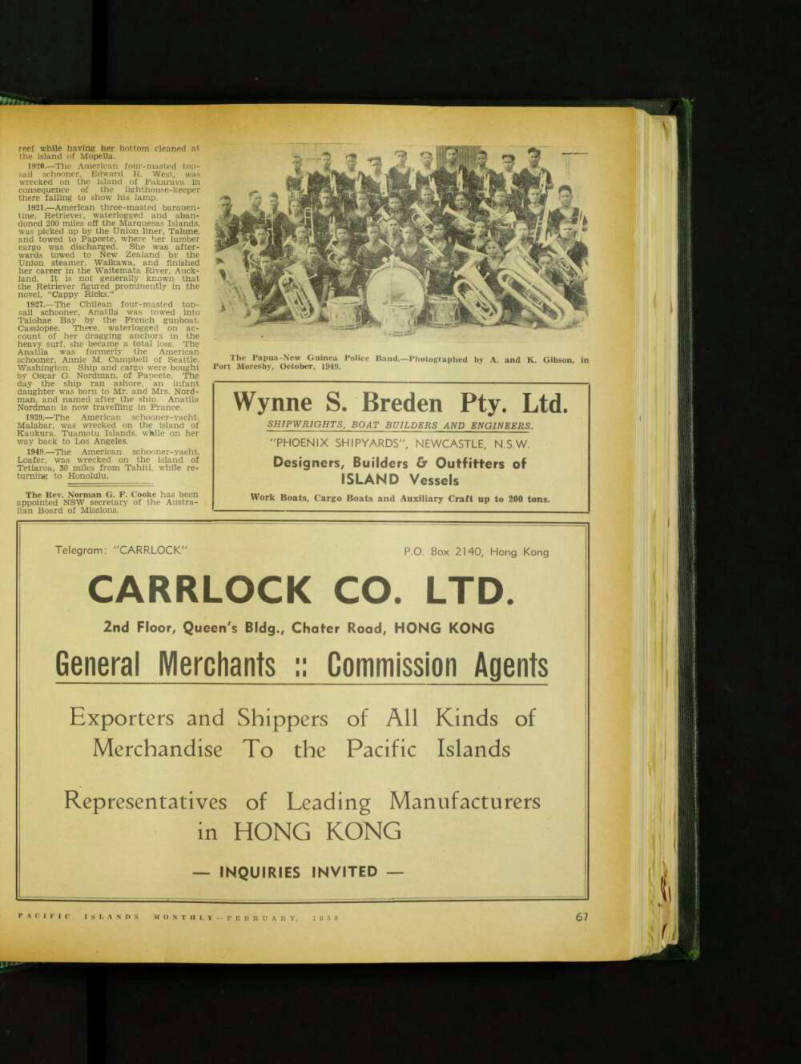
The Papua-New Guinea Police Band.—Photographed by A. and K. Gibson, in Port Moresby, October, 1949.
French refugees from Formosa, Mr.
Ernest Muller and family, accompanied by a young Hong Kong born Britisher arrived recently in Brisbane by the 7,280-ton British ship Harpathian. The party was on its way to New Caledonia “in search of peace.” Mr. Muller is a marine engineer.
Miss Therese O’Brein, of Madang, New Guinea, will visit Queensland in February before making a trip to England for a long holiday.
Mr. Charles McPhee, well-known artist of Western Samoa was a visitor to Pago Pago at the end of 1949. He held a successful exhibition of his paintings.
Mr. J. Price, planter, of Savusavu, Fiji, visited New Zealand in October. It was his first trip away from Fiji for 21 years and he planned to stay six weeks. The noise, the traffic and the general hurly burly so irritated him, however, that after two weeks he got on the Matua and went back to Fiji.