Dr. Vernon Remembered At The Mission
pp. 27-28 · Read in the full issue
Mission In The Mud
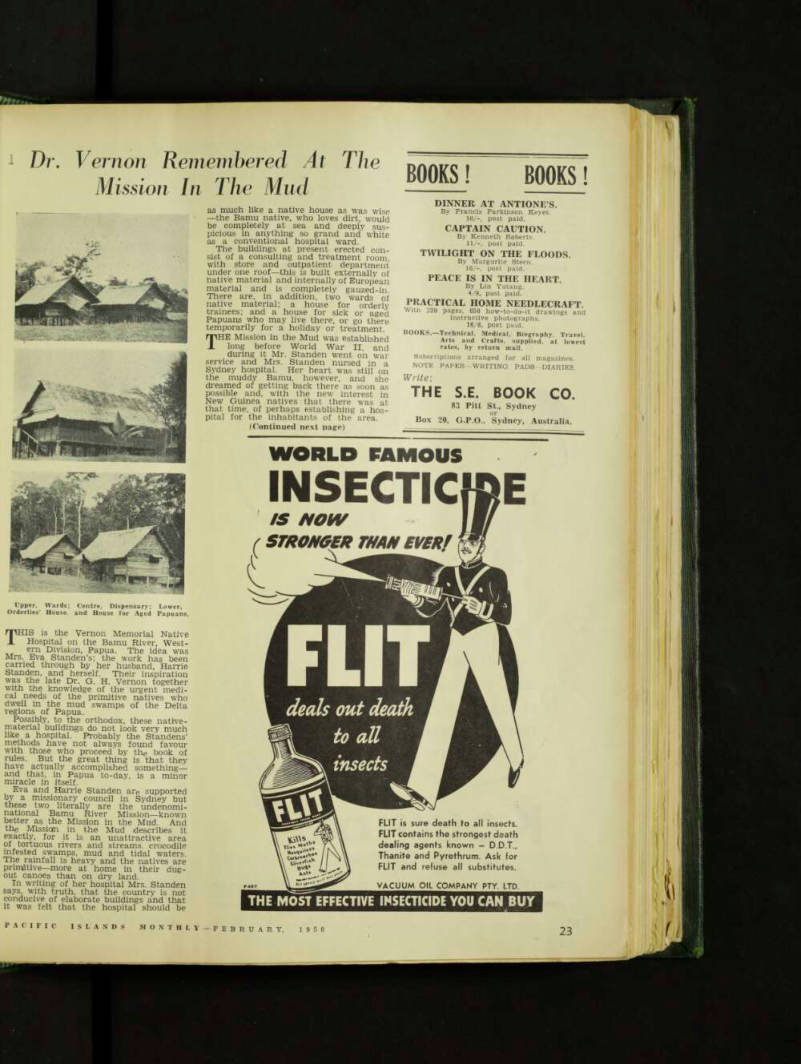
THIS is the Vernon Memorial Native Hospital on the Bamu River, West ern Division, Papua. The idea was Mrs. Eva Standen’s; the work has been carried through by her husband, Harrie Standen, and herself. Their inspiration was the late Dr. G. H. Vernon together with the knowledge of the urgent medi cal needs of the primitive natives who dwell in the mud swamps of the Delta regions of Papua.
Possibly, to the orthodox, these native material buildings do not look very much like a hospital. Probably the Standens’ methods have not always found favour with those who proceed by th e book of rules. But the great thing is that they have actually accomplished something— and that, in Papua to-day, is a minor miracle in itself.
Eva and Harrie Standen are supported by a missionary council in Sydney but these two literally are the undenomi national Bamu River Mission —known better as the Mission in the Mud. And the Mission in the Mud describes it exactly, for it is an unattractive area of tortuous rivers and streams, crocodile infested swamps, mud and tidal waters.
The rainfall is heavy and the natives are primitive—more at home in their dug out canoes than on dry land.
In writing of her hospital Mrs. Standen says, with truth, that the country is not conducive of elaborate buildings and that it was felt that the hospital should be
as much like a native house as was wise —the Bamu native, who loves dirt, would be completely at sea and deeply sus picious in anything so grand and white as a conventional hospital ward.
The buildings at present erected con sist of a consulting and treatment room with store and outpatient department under one roof—this is built externally of native material and internally of European material and is completely gauzed-in There are, in addition, two wards of native material; a house for orderly trainees; and a house for sick or aged Papuans who may live there, or go there temporarily for a holiday or treatment.
THE Mission in the Mud was established long before World War 11, and during it Mr. Standen went on war service and Mrs. Standen nursed in a Sydney hospital. Her heart was still on the muddy Bamu, however, and she dreamed of getting back there as soon as possible and, with the new interest in New Guinea natives that there was at that time, of perhaps establishing a hos pital for the inhabitants of the area.
(Continued next page)
Upper, Wards; Centre, Dispensary; Lower, Orderlies’ House, and House for Aged Papuans.
In 1946, the war over and in Port Moresby awaiting transport to the Delta, she talked over her hopes with Dr.
Vernon who was waiting for transport in the opposite direction. The doctor had spent a number of in the Delta and his advice and encouragement had meant much to the Standens.
Before Mrs. Standen had got to Daru, however, news of the doctor’s sudden death reached her and it seemed then that it was only fitting that the hospital that she had in mind should be dedicated to the memory of the man
who had endeared himself to thousands —Papuan or European, all suffering mankind had a claim upon him. During the war his special job was the native serviceman—but countless Australians and Americans have a place in their hearts for the Old Doc., who walked the Kokoda Trail with them and who was never too tired or too busy to help them on their way.
A fund was opened by the Standens and donations from Papua and Australia, with Administration grants, finally reached £BOO. Included in this amount
is a sum given by the AIF 11th Light Horse Brigade of World War I, of which Dr. Vernon had been medical officer— they felt that this was the kind of memorial of which the doctor himself would have approved.
As the fund grew slowly, sites for the hospital buildings were inspected and visits up the central and upper Bamu re vealed that some land was a little higher than the then headquarters of the Mission on Maipani Island where monthly spring-tides covered most of the land. In early 1949, therefore, the head quarters were moved up near the junc tion of the Bamu and Wawoi Rivers and a start made on the Vernon Memorial Hospital under what were seemingly im possible conditions. Lack of transport and workers and material, local wars among the people, climatic disturbances, the breaking away of the river banks on the best sites all meant delay and hard work. But the will to do is everything and to-day the hospital is a going con cern. Already many infants and others in the area owe their lives to the treat ment they have received there.
At the end of last year the Admini stration sent along Dr. Joan Refshauge to see what was being done; her encourage ment has meant a great deal to the Standens, their medical trainees and helpers.
IN the three months between September and December, 1949, 2,254 treatments were given to outpatients; 78 infants were examined and treated or put on special food; and 900 injections for yaws were given. .. . , Capital expenditure from the fund amounted to £342. A sum of £205 has been set aside for future building and £250 for current running costs. In com parison with the huge sums necessary to establish a more orthodox hospital this all seems absurdly modest and out of all proportion to the good work done.
The Vernon Memorial Hospital can still do with your help, however; your spare shillings will always be welcome. (See story of Dr. Vernon, page 82, tins issue.)