The Month In Moresby
pp. 15-101 · Read in the full issue
From Our Own Correspondent
Port Moresby, Feb. 2.
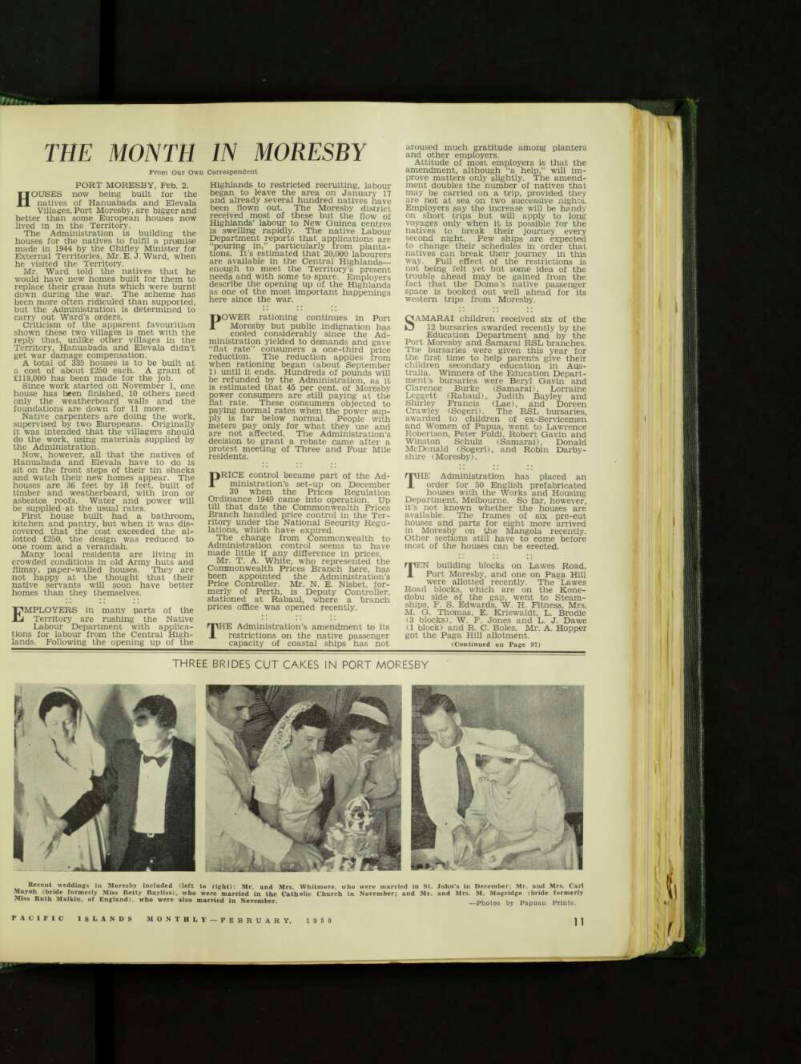
HOUSES now being built for the natives of Hanuabada and Elevala Villages, Port Moresby, are bigger and better than some European houses now lived in in the Territory.
The Administration is building the houses for the natives to fulfil a promise made in 1944 by the Chifley Minister for External Territories, Mr. E. J. Ward, when he visited the Territory.
Mr. Ward told the natives that he would have new homes built for them to replace their grass huts which were burnt down during the war. The scheme has been more often ridiculed than supported, but the Administration is determined to carry out Ward’s orders.
Criticism of the apparent favouritism shown these two villages is met with the reply that, unlike other villages in the Territory, Hanuabada and Elevala didn’t get war damage compensation.
A total of 335 houses is to be built at a cost of about £250 each. A grant of £llB,OOO has been made for the job.
Since work started on November 1, one house has been finished, 10 others need only the weatherboard walls and the foundations are down for 11 more.
Native carpenters are doing the work, supervised by two Europeans. Originally it was intended that the villagers should do the work, using materials supplied by the Administration.
Now, however, all that the natives of Hanuabada and Elevala have to do is sit on the front steps of their tin shacks and watch their new homes appear. The houses are 36 feet by 18 feet, built of timber and weatherboard, with iron or asbestos roofs. Water and power will be supplied-at the usual rates.
First house built had a bathroom, kitchen and pantry, but when it was dis covered that the cost exceeded the al lotted £250, the design was reduced to one room and a verandah.
Many local residents are living in crowded conditions in old Army huts and flimsy, paper-walled houses. They are not happy at the thought that their native servants will soon have better homes than they themselves.
EMPLOYERS in many parts of the Territory are rushing the Native Labour Department with applica tions for labour from the Central High lands. Following the opening up of the
Highlands to restricted recruiting, labour began to leave the area on January 17 and already several hundred natives have been flown out. The Moresby district received most of these but the flow of Highlands’ labour to New Guinea centres is swelling rapidly. The native Labour Department reports that applications are “pouring in,” particularly from planta tions. It’s estimated that 20,000 labourers are available in the Central Highlands— enough to meet the Territory’s present needs and with some to spare. Employers describe the opening up of the Highlands as one of the most important happenings here since the war.
POWER rationing continues in Port Moresby but public indignation has cooled considerably since the Ad ministration yielded to demands and gave “flat rate” consumers a one-third price reduction. The reduction applies from when rationing began (about September 1) until it ends. Hundreds of pounds will be refunded by the Administration, as it is estimated that 45 per cent, of Moresby power consumers are still paying at the flat rate. These consumers objected to paying normal rates when the power sup ply is far below normal. People with meters pay only for what they use and are not affected. The Administration’s decision to grant a rebate came after a protest meeting of Three and Four Mile residents.
PRICE control became part of the Ad ministration’s set-up on December 30 when the Prices Regulation Ordinance 1949 came into operation. Up till that date the Commonwealth Prices Branch handled price control in the Ter ritory under the National Security Regu lations, which have expired.
The change from Commonwealth to Administration control seems to have made little if any difference in prices.
Mr. T. A. White, who represented the Commonwealth Prices Branch here, has been appointed the Administration’s Price Controller. Mr. N. E. Nisbet, for merly of Perth, is Deputy Controller, stationed at Rabaul, where a branch prices office was opened recently.
THE Administration’s amendment to its restrictions on the native passenger capacity of coastal ships has not
aroused much gratitude among planters and other employers.
Attitude of most employers is that the amendment, although “a help,” will im prove matters only slightly. The amend ment doubles the number of natives that may be carried on a trip, provided they are not at sea on two successive nights.
Employers say the increase will be handy on short trips but will apply to long voyages only when it is possible for the natives to break their journey every second night. Few ships are expected to change their schedules in order that natives can break their journey in this way. Full effect of the restrictions is not being felt yet but some idea of the trouble ahead may be gained from the fact that the Doma’s native passenger space is booked out well ahead for its western trips from Moresby.
SAMARAI children received six of the 12 bursaries awarded recently by the Education Department and by the Port Moresby and Samarai RSL branches.
The bursaries were given this year for the first time to help parents give their children secondary education in Aus tralia. Winners of the Education Depart ment’s bursaries were Beryl Gavin and Clarence Burke (Samarai), Lorraine Leggett (Rabaul), Judith Bayley and Shirley Francis (Lae), and Doreen Crawley (Sogeri). The RSL bursaries, awarded to children of ex-Servicemen and Women of Papua, went to Lawrence Robertson, Peter Foldi, Robert Gavin and Winston Schulz (Samarai), Donald McDonald (Sogeri), and Robin Darby shire (Moresby).
THE Administration has placed an order for 50 English prefabricated houses with the Works and Housing Department, Melbourne. So far, however, it’s not known whether the houses are available. The frames of six pre-cut houses and parts for eight more arrived in Moresby on the Mangola recently.
Other sections still have to come before most of the houses can be erected.
TEN building blocks on Lawes Road, Port Moresby, and one on Paga Hill were allotted recently. The Lawes Road blocks, which are on the Kone dobu side of the gap, went to Steam ships, F. S. Edwards, W. H. Fitness, Mrs.
M. G. Thomas, E. Kriewaldt, L. Brodie (3 blocks), W. F. Jones and L. J. Dawe (1 block) and R. C. Boles. Mr. A. Hopper got the Paga Hill allotment.
(Continued on Page 97)
FORTY-EIGHT members of the Papua- New Guinea native police band may go to Sydney and Brisbane this year.
New South Wales RSL has invited the band to the Anzac Day ceremony in Sydney in April and Major-General Nimmo, GOC Northern Command, has suggested that the band attend the Bris bane Exhibition in August. The proposal is being considered by the External Ter ritories Department.
The natives are eager to make the trip.
A few of them were in the band when it visited Sydney and Melbourne in sup port of the Liberty Loan in 1944, but most of them became members after that visit. If they do go to Australia this year, the bandsmen will be issued with their first overcoats and probably their first footwear.
THE Port Moresby Musical Society was formed at a recent meeting and re hearsals have started. More singers are needed, however. The society will at first concentrate on choral work but, later, if enough musicians volunteer, it will also do orchestral work. Musical Director is Dr. D. Lincoln-Crow and the Committee consists of Mr. W, C. Groves (chairman), Mrs. P. Frank (secretary), Mr. A. Pollard (treasurer), Mrs. Smith and Mr. Dale. Mrs. J. Mac Michael is the accompaniste.
Miss Dorothy Armstrong, Of The
Health Department, and Mr. Keith Boyle of APC, were married at St.
John’s Church of England, Port Moresby, on January 7. Matron of honour was Iris Magee and Mr. Max Taylor was best man. Mr. J. Gannon, of the Common wealth Bank, gave the bride away. After a reception at the Hotel Papua, the couple went to Rouna Falls for their honeymoon.
Miss Nan Eglinton, of the Agriculture Department, Moresby, and Mr. Colin McEachern, of the PMG Department, were married quietly at the LMS Mission on January 14. Mr. Len Smith was best man and Mrs. Lambden attended! the bride.
THE 1950 Rugby League season in Port Moresby will start on April 2 with trial games. Efforts are being made to form new teams, in addition to last season’s rivals, Paga Hill and the Maganis, The Port Moresby Rugby League Association hopes to send a re presentative team to New Guinea this year.
GJOLICITOR J. Irwin Cromie is back in Moresby after a holiday in New Zealand. Mrs. Cromie, who is now in Melbourne, will return later.
Veteran BP skipper, Captain Vogelman, paid a rare visit to the Territory last month as relieving skipper on the Man gola.
After running the RSL Club at Moresby for two years, Mr. and Mrs. Bill Penny left on the January Bulolo for Sydney. The new manager, Mr. Victor Snudden, and his wife, arrived from Western Australia a few days later.
Mr, Bill Kerr, who has been acting District Labour Officer at Moresby, is now acting DLO at Wau.
The Director of Agriculture, Stock and Fisheries, Mr. W. Cottrell-Dormer, left this week for Australia on his way to Malaya where he will spend most of his leave. Mr. Cottrell-Dormer will combine his holiday with a study of agricultural methods in Malaya. APC’s assistant ac countant in the Territory, Mr. L. Ben nett, also left for Malaya recently. He will join the staff of the Anglo-Oriental Tin Mining Co.
A son was born to Mr. and Mrs. J.
Dowling, of Jacquinot Bay, New Britain, in Sydney on February 14.
Mr. R. W. Parkinson has returned to Suva from leave in Australia. While on leave he completed the degree of Bachelor of Commerce at Melbourne University, specialising in statistical method. He was formerly Controller of Imports, Prices and Foreign Exchange in Fiji, has now as sumed duty as Government Statistician.