Aneityum
pp. 56-57 · Read in the full issue
Giants of Aneityum
By Harold J. Pollock
TO-DAY the New Hebrides Group, lying to the North East of New Caledonia, is one of the least civilised in the South Seas. On the Hebridean islands of Malekula and Santo, cannibalism is said still to be practised amongst the natives of the interior, and there are many savages living there who have not yet seen a white man. But it is not because of cannibalism that the New Hebrides are known to-day, but for the comparative recent discovery of forests of the giant kauri pine whose wonderful timbers are much in demand in Australia for making plywood.
Recently I made a cruise on the little French trading motor ship, Polynesien, to the New Hebrides, and my interest was aroused when I was informed that a call was to be made at Aneityum, the most southerly island of the Group to pick up a cargo of Kauri.
On a fine sunny morning the little trading ship glided to her anchorage in the beautiful bay at Aneityum, and dropped anchor in water so still and blue that every fleecy cloud in the sky was mirrored in it. I feasted my eyes on the
entrancing scene spread before me. The bay half mooned in a wide arc, and as usual with most tropical Islands, thousands of coconut palms waved their graceful plumes all along the shore. In the distance, the hills stretched away to hazy infinity, while one or two prominent peaks were shrouded with rain clouds. It was on the green slopes of these moun tains, I was told, that the valuable kauri pines grow to prodigious heights.
Soon I was ashore and shaking hands with two husky, sun-tanned, young Aus tralians, employees of the Aneityum Log ging Co., Ltd., and when I showed interest in their work they kindly offered to take me to the kauri forests. A large American army truck was driven from under a native thatched garage and we were soon bumping over the roughly made clay road winding, ever upwards, to the hills. All the roads on the islands have been made by the employees of the Logging Co., and whenever a new tract of forest is opened up for timber cutting, a new road has to be hewn through the trees and dense undergrowth to give the tractors and trucks access to the kauri trees.
After the truck had ground its way up over about three miles of rutty road, the flora suddenly changed magically from open grass land to dense, rain forest. So abrupt was the change that you could easily have marked it on a chart of the island with a definite line. The tall trees shut out most of the sunlight, and the air was now pleasantly cool and fresh, with a smell of damp earth. As we drove my friends pointed out the different kinds of trees growing by the track, and my memory flashed back to my native New Zealand rain forests, the similarity ac centuated by the large number of grace ful tree ferns, and many orchids growing from the tree trunks.
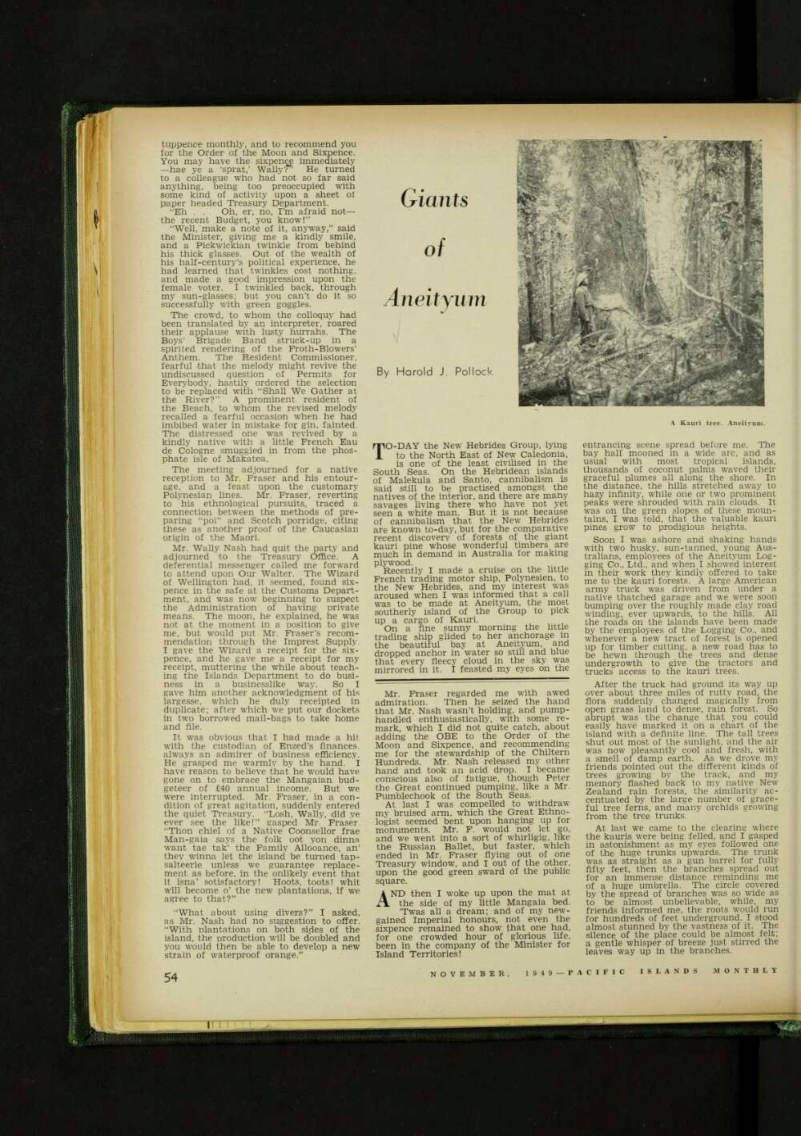
At last we came to the clearing where the kauris were being felled, and I gasped in astonishment as my eyes followed one of the huge trunks upwards. The trunk was as straight as a gun barrel for fully fifty feet, then the branches spread out for an immense distance reminding me of a huge umbrella. The circle covered by the spread of branches was so wide as to be almost unbelievable, while, my friends informed me, the roots would run for hundreds of feet underground. I stood almost stunned by the vastness of it. The silence of the place could be almost felt; a gentle whisper of breeze just stirred the leaves way up in the branches.
A Kauri tree, Aneityum.
THE natives of Aneityum never visit the kauri forests which they regard as the home of evil spirits. If you ask a native to come with you to the glades of the kauri, a look of horror will come over his face; with popping eyes and bated breath he will say “Tapu, Tapu.” Only with high wages and plenty of tinned meat were some of the natives finally induced to work for the Company.
Next I was standing on the stump of a fallen kauri 26 feet in circumference, the largest tree the company had yet felled. I ran my hand over the smooth saw-cut and marvelled at the even tex ture of the timber. This tree yielded 20,000 suner feet of timber, which when dressed would be valued at about £l,OOO.
The huge head of branches had been sawn off and left to the ravages of the white ants. In the head alone would be many hundreds of pounds worth of beautiful kauri, but it is not economic to ship this timber. The men briefly explained the method of felling and hauling the giants.
They told me that when a kauri falls the ground shakes as though stricken by an earthquake, and the dull roar of the impact echoes round the hills for minutes afterwards.
The supply of kauri on Aneityum is by no means unlimited, but the Condominium Government wisely insists that the com pany replant the valuable tree. However, once the supply of native timber is ex hausted, centuries must elapse before the planted trees will be of sufficient size to cut. The kauri is an extremely slow grower and one log that was assessed by experts in Sydney, was estimated to be 3,000 years old. A planted cone will grow in one year to a baby tree only about an inch in height. Replanting Kauri is look ing a long, long way ahead.
An average tree yields about 10,000 to 12,000 super feet and approximately 100,000 feet are taken each shipment to Sydney. The kauri pine grows also on the islands of Malekula and Santo in the Group, but the timber men say it is too inaccessible and remote to be ‘logged on these islands. The trees on Aneityum are said to be identical with the splendid pines formerly found in New Zealand where the forests are nearly cut out. The valuable kauri gum is also in large quantities on Aneityum, but to date this has not been commercialised.
THE island is one of the most fertile places I have ever visited. The highest peak is 2,800 ft. and the coast line 30 miles in extent. Before the coming of the missionaries, the population was said to be 6,000 Melanesians, but with the introduction of so-called civilisation the ranks were, as usual, quickly deci mated, and to-day a sad remnant of 150 souls remains. The missionaries have left now and the crumbling remains of the massive church are the only evidence that they were ever there. There is food and plenty to support a population of thousands: the climate is temperate and cool for the tropics, the only disease being malaria, and even this is not very pre valent.
Forests of banana palms, 20 and 30 feet high, grow wild almost everywhere you look, most of the luscious, golden fruit falls to the ground to form the thick layer of natural compost. The stately paw-paw tree rivals the banana palm in profusion of growth, and here again, most of the nutritious golden fruit falls to the ground to rot, for why should the native eat fruits when he can buy tinned meats from the store? Almost every tropical fruit you can name is growing lavishly on the island, including pineapples, passion fruits, granadillas you can scarcely lift, oranges, sweet potatoes and even a native tomato. The Logging Co. employees have raised a garden where giant cabbages, lettuces, tomatoes, carrots and most all cold country vegetables grow as well, or better, than they would in Australia.
They even raise delicious strawberries on
Aneityum. Irrigation is unnecessary, for almost every evening nature attends to this department with a gentle shower of warm rain. After 1 such a shower the earth seems vibrant with life; you can almost see the plants grow.
Nations greedy for land and natural resources fight wars, talk of wars, plan wars; scientists think out new and horrible methods of wholesale destruction, while bounteous islands like Aneityum he undisturbed, rotting for centuries in the sun.
When the giants of the island are all felled, the Logging Company will leave.
Nature, in a few short months, will obliterate the scars made in the earth by the falling Goliaths; the baby kauris will grow their few inches each year for decades, for centuries, for aeons. The luscious fruits will continue to rot away, unwanted, unknown, not needed even to feed the animals or birds.
The picture of Aneityum Island will long remain on the screen of my memory.