Ayr Is
p. 25 · Read in the full issue
Death Of Major E. B.
A Veteran of Three Wars
THERE were expressions of general regret, in the South-west Pacific, early in October, when it was learned that Major E. B. Ayris (“the little Major”) had died, following an urgent operation in Port Moresby Hospital.
Thus ended a picturesque and colourful career. He was about 72 years old.
Since the war ended, Major Ayris had a brief period in Lae, NG, and then be came bookkeeper on a Queensland sheep station. Then he was offered, and accepted, the secretaryship of the Sports Club at Kokopo, and in September he left Sydney, in high glee at the thought of returning to the country and people he loved. He complained of an abdominal pain just before departure; he was seri ously ill when he reached Rabaul; and he was sent by plane at once to Port Moresby.
He served in the Boer War, and was one of the few men selected, later on, for admission to the commissioned rank of the permanent British Army. In the course of 15 years in the Army he was stationed in distant places like China and St. Helena; and then he left the Army and went pearl-fishing off north west Australia.
He came into Broome on his pearling lugger one day in 1914 and found there was a war going on. He went im mediately to Perth, and joined up with the Australians, as a private. When it was discovered that he had held com missioned rank, he was given a commis sion, and, to his outspoken disgust, he was kept in Australia for 18 months,
training troops. Then he went to France with the AIF, as a captain on the staff of General “Bull” Antill. He was des cribed as “a splendid officer”; but the tough old general did not like the dandi fied little Englishman, and he was rather kept back, during his service in France.
Ayris was discharged in Australia, and wandered around for years, filling many jobs. He was married in the United States; but the marriage was not a success and, after some domestic mix-up in Australia, he went off to New Guinea.
For several years, he was the officer in charge of the training of the New Guinea native police, and his work was highly commended. When he
was retired, on account of age, he went to Wau and be came an office executive for New Guinea Goldfields, Ltd.
He was closely associated with the social life of the gold fields capital.
Although now so old as to preclude enlistment, he would not stay out of World War 11, and eventually he saw a lot of hard service on the “little ships” in and around New Guinea waters. He loved a good party, a good dinner, and a bad story.
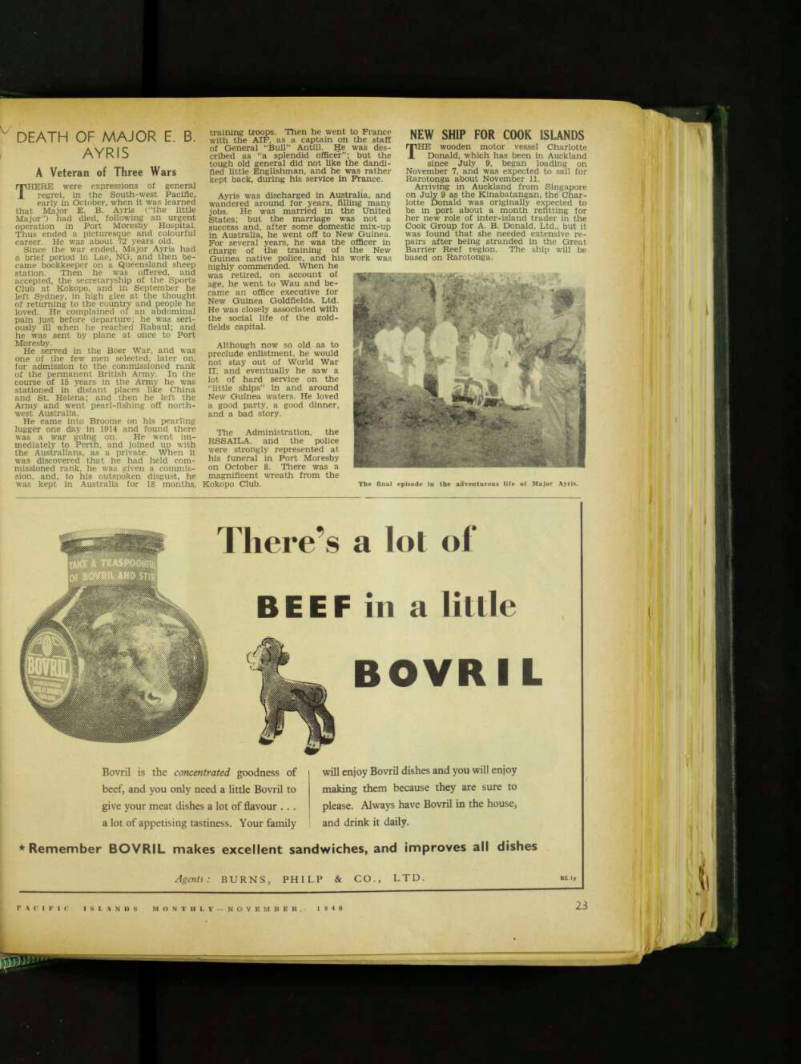
The Administration, the RSSAILA, and the police were strongly represented at his funeral in Port Moresby on October 8. There was a magnificent wreath from the Kokopo Club.