Rabaul Roundabout
p. 13 · Read in the full issue
Prom Our Own Correspondent
Rabaul. Nov 10.
MR. S. A. LONERGAN, the Acting Government Secretary and Mr. E.
A. F. Head, the Public Service Com missioner, arrived in Rabaul by Qantas plane on October 7, 1949. They inspected Administration establishments in Rabaul and Mr. Lonergan met a number of mem bers of the public, discussing with them matters relating to Administration policy —in particular what is to be the future of Rabaul. * ON the evening of Friday, October 7, a bomb exploded in the Vuvu Central Catholic School. The explosion shattered dormitory windows and showered dormitory houses with shrapnel.
There were no injuries despite the fact that 270 native pupils were at night study. Sometime previously, a bomb ex ploded in the football field and since then the natives have been instructed to col lect the rubbish from the grounds and burn it in a pit. The pit was so deep that it was impossible to observe that at the bottom of it lay this buried bomb— the youngsters, therefore, lit the fire and adjourned to night study. Shortly after wards the bomb exploded.
There are 36 known bombs in the school area. ♦ ON October 12, Bishop Leo Scharmach left Vunapope Mission by car for Kambira. He was accompanied by Father Joseph Reischl, Diocessan Direc tor of Music, and Father J. Dempsey, Director of Catholic Education. At Kam bira the party was met by Mr. B. Staple man, and taken on board the St. Robert to Vunaplanting.
The occasion of the Bishop’s visit to Vunaplanting was the Baptism of the last twelve pagans among the North Coast Bainings—all the Baining tribes on the North Coast are now entirely Catholic.
The present population of Vunaplanting numbers only 47. In 1938, when this Bain ing village was at Randulit, in the moun tains, it numbered 318 persons. * THE first inter-school sports meeting ever to be held in Rabaul took place on Friday, October 21, 1949. Opened by District Officer, Mr. J. K. McCarthy, in presence of the Director of Education Mr. Groves, the meeting was a great suc cess. Schools competing were: Primary European School, Kerevat; Elementary A European School, Rabaul: Primary Rabaul Chinese; Elementary B Eurasians, Rabaul; Methodist Kindergarten, Rabaul.
Elementary A Eurasian pupils from Ko kopo were unable to compete due to the road being impassable on that day due to the earthquake.
The meeting took the form of general sports based pn similar events in Australia, Elementary A Chinese S:hool, Rabaul, were the winners. * ANOTHER severe earth tremor shook Kokopo and Rabaul at 4 a.m. on November 1, 1949 (See page 33 this issue.) A spokesman for the Public Works Depart ment reports that the only damage is to about 57 tanks
and a further landslide on the Rabaul- Kokopo road.
This tremor, we felt was more disturb ing than the last, because it took place at night. It is eerie to awake to the knowledge that the house is once again withstanding a severe shaking and feel that this time, surely, it must fall down.
Suddenly a sleepy town is a blaze of light—very few residents “slept through it all.” Domestic animals were, as usual, terrified and so were house-boys.
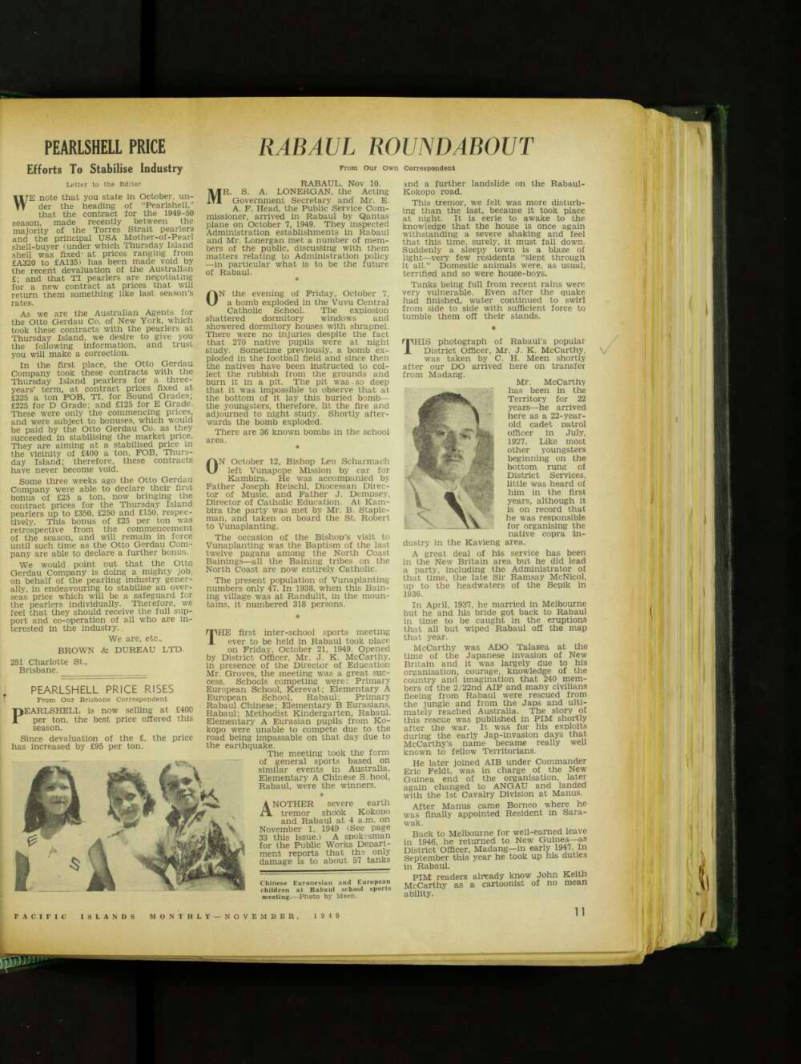
Tanks being full from recent rains were very vulnerable. Even after the quake had finished, water continued to swirl from side to side with sufficient force to tumble them off their stands. ♦ THIS photograph of Rabaul’s popular District Officer, Mr, J. K. McCarthy, was taken by C. H. Meen shortly after our DO arrived here on transfer from Madang.
Mr. McCarthy has been in the Territory for 22 years—he arrived here as a 22-year old cadet patrol officer in July, 1927. Like most other youngsters beginning on the bottom rung of District Services, little was heard of him in the first years, although it is on record that he was responsible for organising the native copra in
dustry in the Kavieng area.
A great deal of his service has been in the New Britain area but he did lead a party, including the Administrator of that time, the late Sir Ramsay McNicol, up to the headwaters of the Sepik in 1936.
In April, 1937, he married in Melbourne but he and his bride got back to Rabaul in time to be caught in the eruptions that all but wiped Rabaul off the map that year.
McCarthy was ADO Talasea at the time of the Japanese invasion of New Britain and it was largely due to his organisation, courage, knowledge of the country and imagination that 240 mem bers of the 2/22nd AIP and many civilians fleeing from Rabaul were rescued from the jungle and from the Japs and ulti mately reached Australia. The story of this rescue was published in PIM shortly after the war. It was for his exploits during the early Jap-invasion days that McCarthy’s name became really well known to fellow Territorians.
He later joined AIB under Commander Eric Feldt, was in charge of the New Guinea end of the organisation, later again changed to ANGAU and landed with the Ist Cavalry Division at Manus.
After Manus came Borneo where he was finally appointed Resident in Sara wak.
Back to Melbourne for well-earned leave in 1946, he returned to New Guinea—as District Officer, Madang—in early 1947 In September this year he took up his duties in Rabaul.
PIM readers already know John Keith McCarthy as a cartoonist of no mean ability.