The Rebirth Of Rabaul
pp. 23-25 · Read in the full issue

A Tribute to Officials Who Made it Possible
From Our Own Correspondent
RABAUL, September 15. 171 TH the transfer in early September of District Officer Charles D. Bates, from Rabaul to a similar position t Madang, on the New Guinea main md, it is appropriate to look back on tie progress made in the rehabilitation f Rabaul and district since tie re-occupation in 1945. Rabaul is ot, and will never be, the town it was efore 1941—the new New Britain ad ilnistrative centre will be built nearer Fokopo. However, the fact that resi ents here to-day can live under sasonably civilised conditions is due, in large measure, to the talents Mr. Bates rought to the colossal job of reorgani ation that confronted him on Septem er, 10, 1945 —exactly four years before e left the town for his new appoint lent.
The New Britain District was re ccupied by Australian Forces, under Feneral Father, on September 10, 1945. here landed simultaneously, a section f the Australian New Guinea Admini tration Unit, under the command of lajor C. D. Bates, MC, whose job was ) take control of all civilians in the ew Britain area. The population com rised about 90,000 natives in the razelle Peninsula and the Talasea and
rasmata sub-districts, and in addition, cvo or three thousand Chinese, a con iderable half-caste population, and all x-prisonefrs-of-war.
In the early days of the Australian e-occupation, ANGAU did a great deal f its work through interpreters in order d formulate repatriation plans for these ermer Jap prisoners—there were Euro leans, mostly members of the Sacred leart of Jesus Order, with a few pre war residents of Rabaul; some Chinese nd half-castes; between 30,000 and 0,000 Indians captured by the Japanese t the fall of Singapore and taken to Few Britain: Formosans, who had been rought to Rabaul by the Japs as ibourers; and many Koreans who, al though part of the Japanese army, main
tained they had been impressed by the Japanese to fight for them.
It soon became obvious that ANGAU. with its limited resources, could not at tend to all these people and, in conse quence the unit was relieved of the responsibility of all civilians other than
those who were natives of the country, pre-war Chinese inhabitants and half castes, or those Europeans who had been in Japanese concentration camps.
AT this stage, Rabaul was a shambles.
The once-beautiful avenues of trees were gone or were battered wrecks; bush tracks were the only roads, but it was difficult even for a jeep to nego tiate them.
It' was impossible to recognise former building sites —even such well known
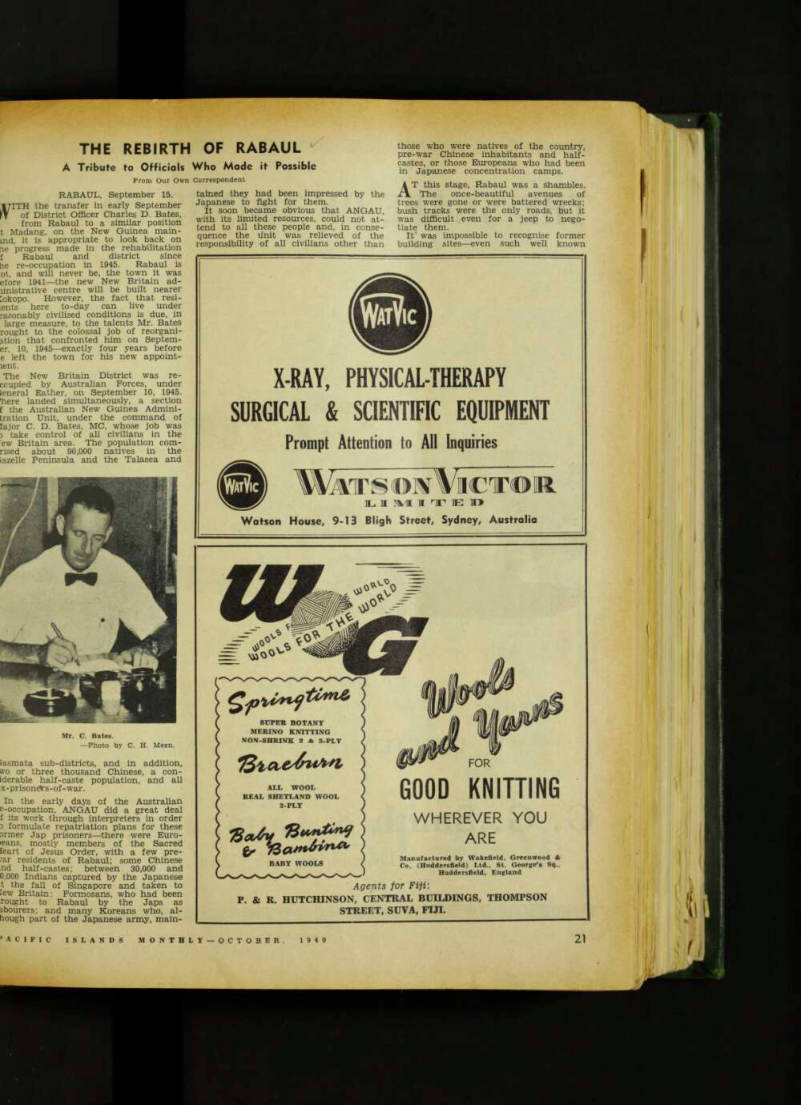
Mr. C. Bates. —Photo by C. H. Meen.
es as the District Office, Post Office, ;w Guinea Club, etc. Men returning, iging to see some relic of the past, ild not even locate the places where ;ir own homes had been, rhe local native villages were in a nilar state of destruction, and this jition was made worse when 120,000 panese prisoners and Formosans were icentrated in 15 camps, many of them native village land which necessi ed the removal of natives to other less table areas. However, due to the orts of ANGAU officers, combined with establishment of BMD HQ, with onel Jones in charge of District vices, a more sympathetic attitude s adopted towards the natives and ne real rehabilitation work commenced m about April, 1946. Since that date ;ives have returned to pre-war village ;s, and new villages, although not up pre-war standards, have been built, rhe work of rehabilitating these tives was tremendous as food trees 3 galip, bread-fruit and coconut were npletely destroyed in some parts, tive land throughout the Gazelle ninsula and inhabited coastal ;ions of New Britain, had been taken ;r entirely by the enemy during their npation and for four years the :ives had been thus deprived of most their arable land. n June, 1946, New Britain reverted to il administration control and the mer officer in charge of ANGAU, Mr.
D. Bates, was appointed District Eicer, New Britain, with headquarters Rabaul.
'Tom that time the rehabilitation pro imme received added impetus—Army frictions could no longer interfere ;h the return of Europeans to their
plantations, and ttte natives to their villages. Shortage of materials, lack of equipment of all descriptions hampered progress, however, although with close co-operation between Administration and all sections of the New Britain com munity, plans were dovetailed and pro gress became noticeable. Within one year fifteen plantations were producing much-needed copra, hundreds of native villages had been reformed, and an edu cation programme for the natives com menced in October, 1945. When Mr.
Boisen, Education Officer, arrived in Rabaul, mid-1946, he had an active going programme as a basis for his work.
Mr. Bbisen was the right choice for this work —he was known and loved by all the local natives, and his enthusi asm together with unceasing work, put the Education programme for natives in the Rabaul district on a sound basis, RABAUL in pre-war days was the focal point of all business within the Territory, and during the early post-war period it began to regain that position. Business houses were re established, Burns Philp and Co., Ltd., New Guinea Company, Ltd., Colyer Watson, Limited commenced to trade again. Chinatown, a Shadow of its former self, struggled back into existence.
The first meeting of the Town Council of Rabaul’s Chinatown was held in the Mayor’s Office in September, 1945, and from this commenced the programme for the re-establishment of the Chinese community.
In the replanning of the Rabaul town ship it was decided to reconstruct on the pre-war sites, open up pre-war roads within the township and establish new wharves and other public utilities as near as practicable, to those which were in
existence before the war. Much has yet to be done.
All buildings in Rabaul are of a temporary construction due to the pro posed removal of the New Britain head quarters to Kokopo. Contour survey of the new town site has commenced and it is anticipated that within five years all Administration officers will be es tablished there. A re-habilitation pro gramme would not be complete without the revival of sporting bodies. With the money received from War Damage In surance this has been made possible, sup plemented by the funds raised by the individual organisations. To-day we have a playing field equal to none in the Terxitc/ry where cricket, baseball, afad tennis are played. Our swimming pool is almost reconstructed.
This is only a very brief story of the rebirth of a town; to tell it in detail would take a volume.