Effect Of Devalued £Stg. In Pacific Countries
p. 10 · Read in the full issue
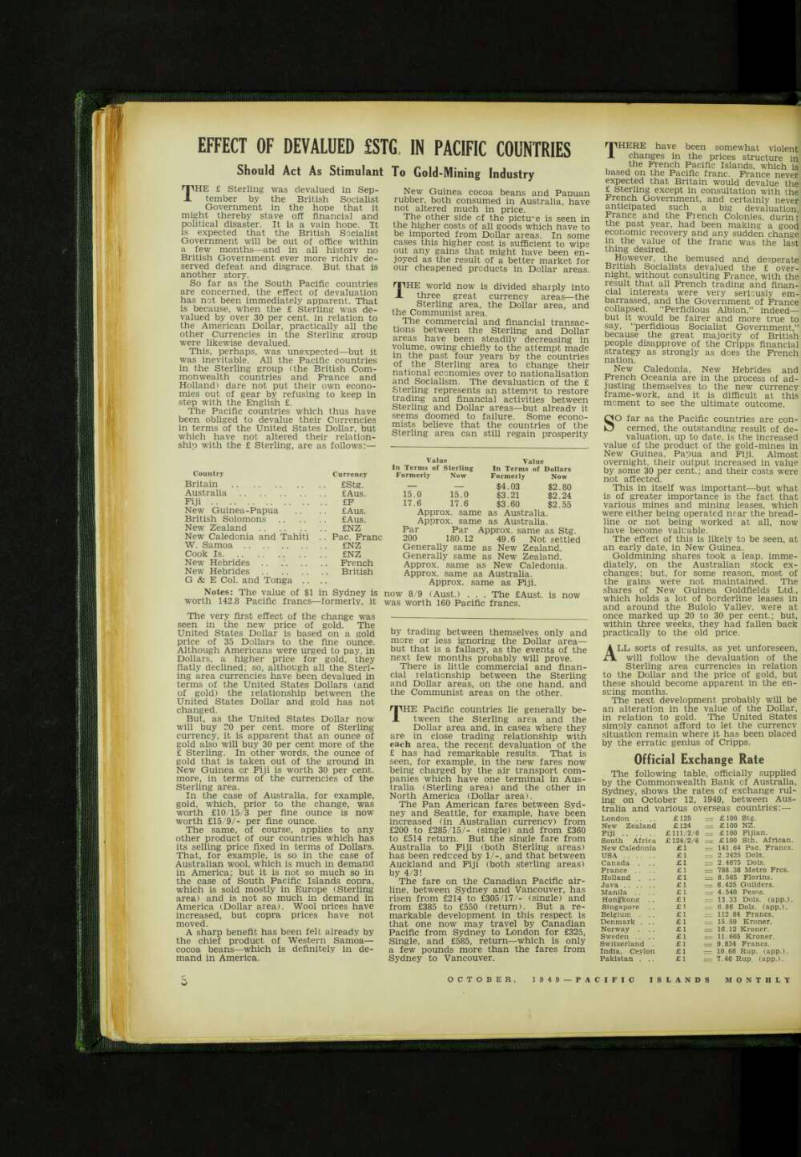
Should Act As Stimulant To Gold-Mining Industry
THE £ Sterling was devalued in Sep tember by the British Socialist Government in the hope that it might thereby stave off financial and political disaster. It is a vain hope. It is expected that the British Socialist Government will be out of office within a few months —and in all history no British Government ever more richly de served defeat and disgrace. But that is another story.
So far as the South Pacific countries are concerned, the effect of devaluation has not been immediately apparent. That is because, when the £ Sterling was de valued by over 30 per cent, in relation to the American Dollar, practically all the other Currencies in the Sterling group were likewise devalued.
This, perhaps, was unexpected—but it was inevitable. All the Pacific countries in the Sterling group (the British Com monwealth countries and France and Holland) dare not put their own econo mies out of gear by refusing to keep in step with the English £.
The Pacific countries which thus have been obliged to devalue their Currencies in terms of the United States Dollar, but which have not altered their relation ship with the £ Sterling, are as follows; —
The very first effect of the change was seen in the new price of gold. The United States Dollar is based on a gold price of 35 Dollars to the fine ounce.
Although Americans were urged to pay, in Dollars, a higher price for gold, they flatly declined: so, although all the Sterl ing area currencies have been devalued in terms of the United States Dollars (and of gold) the relationship between the United States Dollar and gold has not changed.
But, as the United States Dollar now will buy 30 per cent, more of Sterling currency, it is apparent that an ounce of gold also will buy 30 per cent more of the £ Sterling. In other words, the ounce of gold that is taken out of the ground in New Guinea or Fiji is worth 30 per cent, more, in terms of the currencies of the Sterling area.
In the case of Australia, for example, gold, which, prior to the change, was worth £lO/15/3 per fine ounce is now worth £l5/9/- per fine ounce.
The same, of course, applies to any other product of our countries which has its selling price fixed in terms of Dollars.
That, for example, is so in the case of Australian wool, which is much in demand in America; but it is not so much so in the case of South Pacific Islands copra, which is sold mostly in Europe (Sterling area) and is not so much in demand in America (Dollar area). Wool prices have increased, but copra prices have not moved.
A sharp benefit has been felt already by the chief product of Western Samoa— cocoa beans—which is definitely in de mand in America.
New Guinea cocoa beans and Papuan rubber, both consumed in Australia, have not altered much in price.
The other side of the picture is seen in the higher costs of all goods which have to be imported from Dollar areas. In some cases this higher cost is sufficient to wipe out any gains that might have been en joyed as the result of a better market for our cheapened products in Dollar areas.
THE world now is divided sharply into three great currency areas —the Sterling area, the Dollar area, and the Communist area.
The commercial and financial transac tions between the Sterling and Dollar areas have been steadily decreasing in volume, owing chiefly to the attempt made in the past four years by the countries of the Sterling area to change their national economies over to nationalisation and Socialism. The devaluation of the £ Sterling represents an attempt to restore trading and financial activities between Sterling and Dollar areas—but already it seems doomed to failure. Some econo mists believe that the countries of the Sterling area can still regain prosperity
by trading between themselves only and more or less ignoring the Dollar area — but that is a fallacy, as the events of the next few months probably will prove.
There is little commercial and finan cial relationship between the Sterling and Dollar areas, on the one hand, and the Communist areas on the other.
THE Pacific countries lie generally be tween the Sterling area and the Dollar area and, in cases where they are in close trading relationship with each area, the recent devaluation of the £ has had remarkable results. That is seen, for example, in the new fares now being charged by the air transport com panies which have one terminal in Aus tralia (Sterling area) and the other in North America (Dollar area).
The Pan American fares between Syd ney and Seattle, for example, have been increased (in Australian currency) from £2OO to £285/15/- (single) and from £360 to £514 return. But the single fare from Australia to Fiji (both Sterling areas) has been reduced by 1/-, and that between Auckland and Fiji (both sterling areas) by 4/3!
The fare on the Canadian Pacific air line, between Sydney and Vancouver, has risen from £214 to £305/17/- (single) and from £385 to £550 (return). But a re markable development in this respect is that one now may travel by Canadian Pacific from Sydney to London for £325, Single, and £585, return—which is only a few pounds more than the fares from Sydney to Vancouver.
THERE have been somewhat violent changes in the prices structure in the French Pacific Islands, which is based on the Pacific franc. France never expected that Britain would devalue the £ Sterling except in consultation with the French Government, and certainly never anticipated such a big devaluation France and the French Colonies, durin; the past year, had been making a good economic recovery and any sudden change in the value of the franc was the last thing desired.
However, the bemused and desperate British Socialists devalued the £ over night, without consulting France, with the result that all French trading and finan cial interests were very seriously em barrassed, and the Government of France collapsed. “Perfidious Albion,” indeed— but it would be fairer and more true to say, “perfidious Socialist Government,” because the great majority of British people disapprove of the Cripps financial strategy as strongly as does the French nation.
New Caledonia, New Hebrides and French Oceania are in the process of ad justing themselves to the new currency frame-work, and it is difficult at this moment to see the ultimate outcome.
SO far as the Pacific countries are con cerned, the outstanding result of de valuation, up to date, is the increased value of the product of the gold-mines in New Guinea, Papua and Fiji. Almost overnight, their output increased in value by some 30 per cent.; and their costs were not affected.
This in itself was important—but what is of greater importance is the fact that various mines and mining leases, which were either being operated near the bread line or not being worked at all, now have become valuable.
The effect of this is likely to be seen, at an early date, in New Guinea.
Goldmining shares took a leap, imme diately, on the Australian stock ex changes; but, for some reason, most of the gains were not maintained. The shares of New Guinea Goldfields Ltd., which holds a lot of borderline leases in and around the Bulolo Valley, were at once marked up 20 to 30 per cent.; but, within three weeks, they had fallen back practically to the old price.
ALL sorts of results, as yet unforeseen, will follow the devaluation of the Sterling area currencies in relation to the Dollar and the price of gold, but these should become apparent in the en suing months.
The next development probably will be an alteration in the value of the Dollar, in relation to gold. The United States simply cannot afford to let the currency situation remain where it has been placed by the erratic genius of Cripps.
Official Exchange Rate
The following table, officially supplied by the Commonwealth Bank of Australia, Sydney, shows the rates of exchange rul ing on October 12, 1949, between Aus tralia and various overseas countries; — London ... £ 125 = £ 100 Stg.
New Zealand £124 £lOO NZ.
Fiji £lll/2/6 = £lOO Fijian.
South Africa £124/2/6 = £lOO Sth. African.
New Caledonia £1 = 141.64 Pac. Francs.
USA £1 = 2.2425 Dols.
Canada ... £1 = 2.4675 Dols.
Prance ... £1 = 788.38 Metro Frcs.
Holland . .. £1 = 8.565 Florins.
Java £1 = 8.425 Guilders.
Manila ... £1 = 4.540 Pesos.
Hongkong .. £1 =13.33 Dols. (app.).
Singapore .. £1 = 6.86 Dols. (app.).
Belgium ... £1 = 112.84 Francs.
Denmark ... £1 =15.59 Kroner.
Norway . .. £1 =16.12 Kroner.
Sweden ... £1 = 11.665 Kroner.
Switzerland . £1 = 9.834 Francs.
India, Ceylon £1 =10.66 Rup. (app.).
Pakistan ... £1 = 7.46 Rup. (app.).
t Value Value In Terms of Sterling In Terms of Dollars Country Currency Formerly Now Formerly Now Britain .. £Stg, — $4.03 $2.80 Australia 15.0 15.0 $3.21 $2.24 Fiji .. £F 17.6 17.6 $3.60 $2.55 New Guinea-Papua £Aus.
Approx, same as Australia.
British Solomons £Aus.
Approx, same as Australia.
New Zealand £NZ Par Par Annrox. same as Ste-.
New Caledonia and Tahiti .. Pac. Franc 200 180.12 49.6 Not settled W. Samoa £NZ Generally same as New Zealand.
Cook Is £NZ Generally same as New Zealand.
New Hebrides French Approx, same as New Caledonia.
New Hebrides British Approx, same as Australia.
G & E Col. and Tonga ..
Approx, same as Fiji.
Notes: The value of $1 in Sydney is now 8/9 (Aust.) . . .
The £Aust. is now worth 142.8 Pacific francs —formerly, it was worth 160 Pacific francs.