Cogea, a Village InVanua Leva, Fiji
p. 92 · Read in the full issue
By H. F. L. Parham
CIGGEA village, situated about a mile j up the Wainunu River, Vanua Levu, is a very pretty place.
Clear creek water, on both sides of the village, runs rapidly over very rocky beds to join the river at this point, and adds to the attractive appearance of the place, with bush-covered hills in the distance.
The scenery along the river bank is varied, with masses of coconut palms on the left bank and bush-covered land on the other.
In this part of Bua Province the change from dry to wet zone is very noticeable, on account of the way most of the palm trunks are absolutely covered with large creeping ferns.
About half way up the river to Cogea there is a small sort of island, which is said to be tabu. The reason given is that “no one is allowed to cut trees there, as it belongs to a Tevora”.
Close to Cogea there is a hot spring, between the village and the washing-pool in the creek; the spring has green slime in it and does not look very clean; but it is really hot. In the stones beside it there grows an unusual species of Com melina. It is much smaller than the commoner sort, and its rather tiny flowers are of a pinkish colour, instead of blue.
In reference to the hot springs of the lower valley of the Wainunu River, Guppy writes: “All the springs are situ ated in the tidal part of the river valley, with the exception of Cogea, which is just above this limit”.
Mr. Guppy records, when writing of the Savu Savu hot springs, that in 1863 “The Chief of Wainunu (Tui Wainunu) came to fight the Savu Savu people” and that “he endeavoured, but without success, to choke up the springs by heaping earth over them”.
Fiji’s well-known Tea Estate is up the Wainunu River.
The legend of how Wainunu got its name and other more historical facts are to be found in the “Early History of Vanua Levu”, by Mrs. Parham.
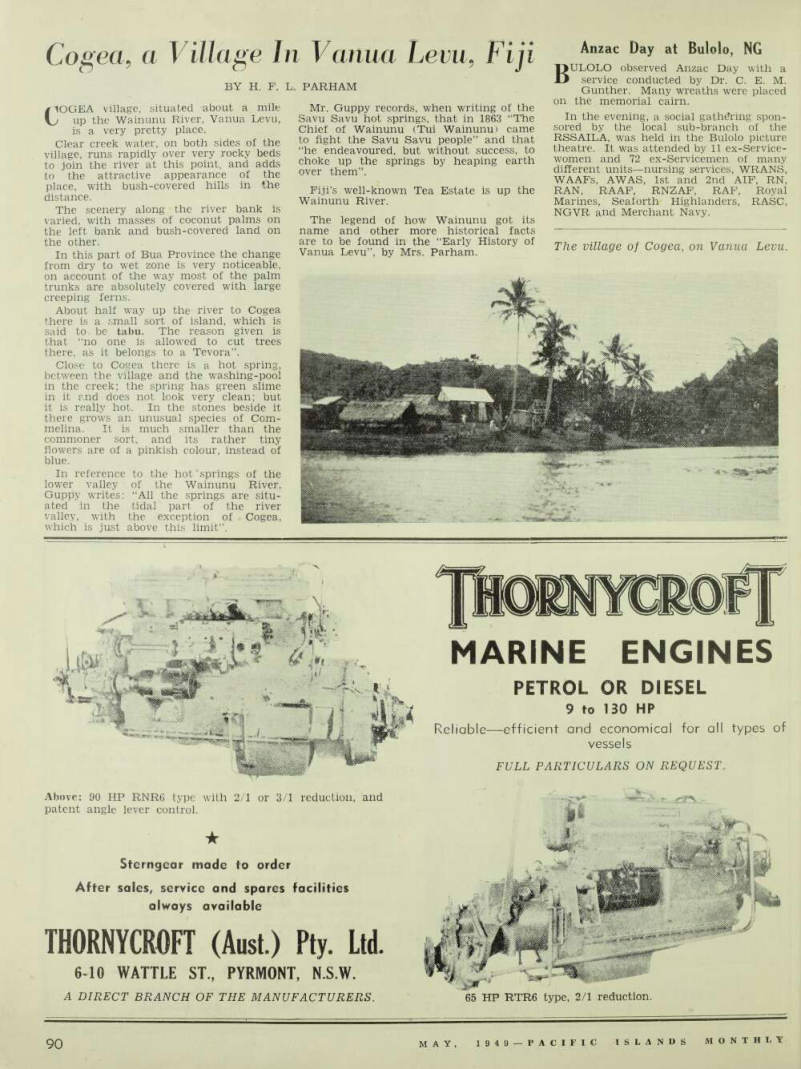
The village of Cogea, on Vanua Leva.